
Free ATI TEAS 7 Science guide
October 2026 - Macromolecules Study Guide for nursing students in
Carbohydrates supply quick energy, lipids store energy and build membranes, proteins do the structural and enzymatic work, and nucleic acids carry genetic information. Each is built from its own monomer, and matching monomer to macromolecule answers most questions here.
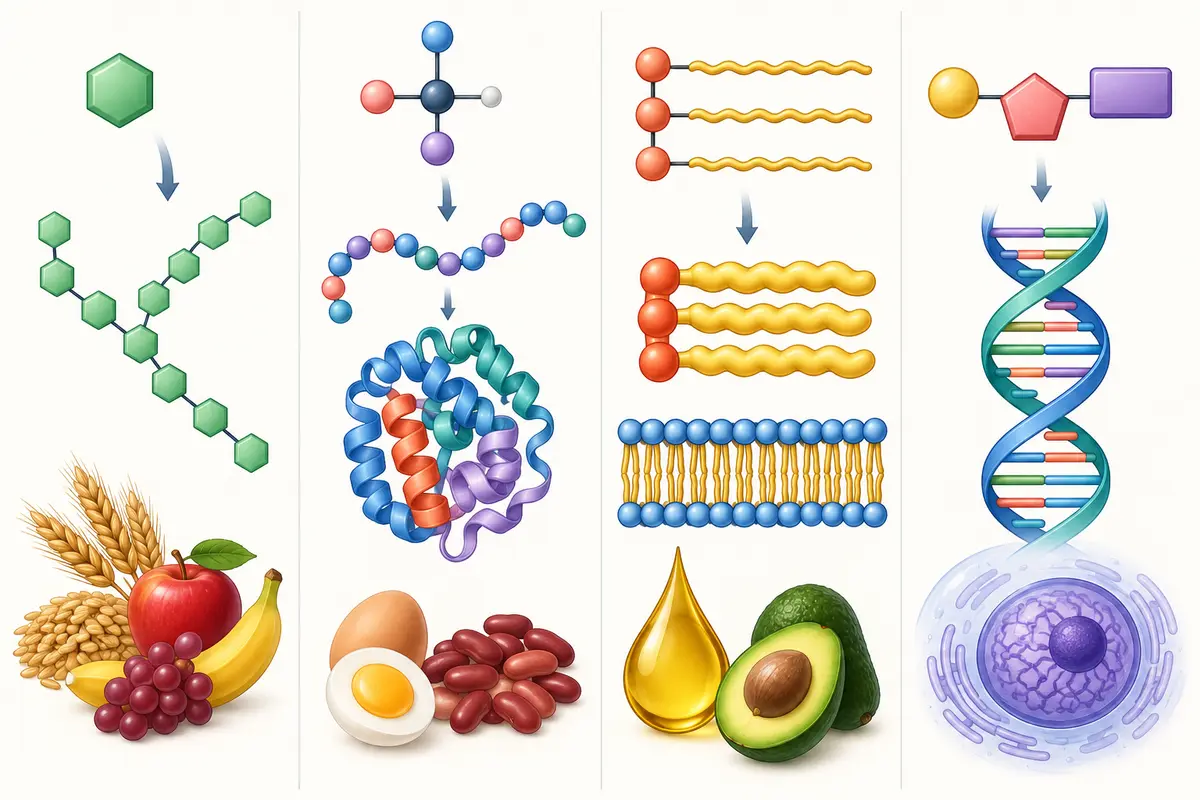
The four groups
| Macromolecule | Monomer | Main function | Examples |
|---|---|---|---|
| Carbohydrate | Monosaccharide | Quick energy; some structural roles | Glucose, starch, glycogen, cellulose |
| Lipid | Fatty acids and glycerol | Long-term energy storage, membranes, insulation, some hormones | Fats, oils, phospholipids, cholesterol |
| Protein | Amino acid | Structure, transport, enzymes, immune defence | Haemoglobin, collagen, antibodies, enzymes |
| Nucleic acid | Nucleotide | Storing and carrying genetic information | DNA, RNA |
Carbohydrates
- Monosaccharides are single sugars — glucose, fructose.
- Disaccharides are two joined — sucrose, lactose.
- Polysaccharides are long chains — starch (plant storage), glycogen (animal storage in liver and muscle), cellulose (plant structure).
- They are the body's first-choice fuel, which is why blood glucose is regulated so tightly.
Lipids
- Not water-soluble, which is what defines the group.
- Saturated fats have no double bonds between carbons and are usually solid at room temperature; unsaturated fats have them and are usually liquid.
- Phospholipids form the cell membrane, arranged in a bilayer with water-attracting heads facing out.
- They carry more than twice the energy per gram of carbohydrate, which is why they are the storage form.
Proteins and enzymes
Proteins are chains of amino acids folded into a specific three-dimensional shape, and that shape is the function. Change the shape and the protein stops working, which is what denaturation means.
Enzymes are proteins that speed up specific reactions. Each has an active site shaped to fit one substrate, which is why enzymes are specific. Heat and extreme pH denature them — and because the shape is lost rather than the molecule destroyed, a denatured enzyme is inactive even though it is all still there.
A fever's danger and an enzyme's optimum are the same fact. Human enzymes work best around 37°C and at the pH of their location — which is why pepsin needs stomach acid and would not function in the small intestine.
Identifying a macromolecule from a description
Worked example
A molecule is insoluble in water, stores energy densely, and forms part of the cell membrane. Which group is it, and what is its monomer?
- Insoluble in water rules out carbohydrates and most proteins.
- Dense energy storage points to lipids.
- Membrane formation confirms it — phospholipids are the membrane's building block.
- Lipids are built from fatty acids and glycerol.
A lipid, built from fatty acids and glycerol. The three clues in the description each point at a different lipid function, which is how these questions are usually constructed.
Terms to know
- Monomer
- The single unit that macromolecules are built from.
- Polymer
- A long chain of monomers.
- Monosaccharide
- A single sugar unit, such as glucose.
- Polysaccharide
- A chain of sugars, such as starch or glycogen.
- Amino acid
- The monomer of proteins.
- Nucleotide
- The monomer of DNA and RNA.
- Enzyme
- A protein that speeds up a specific reaction.
- Active site
- The part of an enzyme shaped to fit its substrate.
- Substrate
- The molecule an enzyme acts on.
- Denaturation
- Loss of a protein's shape, and therefore its function.
What the TEAS asks most
The same core ideas appear in different wording. If you can answer these without stopping to think, you have what this section requires.
Which macromolecule is built from this monomer?
Amino acids build proteins, monosaccharides build carbohydrates, nucleotides build nucleic acids.
What is the body's primary energy source?
Carbohydrates for immediate energy; lipids for long-term storage.
What happens to an enzyme at high temperature?
It denatures — the active site loses its shape and the enzyme stops working.
Which macromolecule forms the cell membrane?
Lipids, specifically phospholipids arranged in a bilayer.
Key points
- Carbohydrates from monosaccharides; lipids from fatty acids and glycerol; proteins from amino acids; nucleic acids from nucleotides.
- Carbohydrates are quick energy; lipids are dense storage and membranes.
- A protein's shape is its function.
- Enzymes are proteins with an active site specific to one substrate.
- Heat and extreme pH denature enzymes without destroying the molecule.
Review quiz
4 questions on this topic, each with the reasoning worked through. Pick an answer to see how it went, or open the explanation straight away.
-
Question 1 of 4
Which macromolecule is built from amino acids?
Show the answer and explanation
Correct answer: C. Protein
Amino acids link into chains that fold into proteins. Carbohydrates are built from monosaccharides, nucleic acids from nucleotides, and lipids from fatty acids and glycerol rather than from a repeating monomer in the same sense.
-
Question 2 of 4
What happens to an enzyme when it is heated well above its optimum temperature?
Show the answer and explanation
Correct answer: B. It denatures — its active site loses shape and it stops functioning.
Heat disrupts the folding that gives the active site its shape, so the substrate no longer fits. Rates do rise with temperature up to the optimum, which is why the first choice is tempting, but past that point activity collapses — and the molecule is still present, just misshapen.
-
Question 3 of 4
Which macromolecule group provides the most energy per gram and forms the cell membrane?
Show the answer and explanation
Correct answer: B. Lipids
Lipids carry more than twice the energy per gram of carbohydrate and, as phospholipids, form the membrane bilayer. Carbohydrates are the quick-access fuel, proteins do structural and catalytic work, and nucleic acids store information rather than energy.
-
Question 4 of 4
Glycogen is the form in which animals store glucose. Which macromolecule group does it belong to?
Show the answer and explanation
Correct answer: A. Carbohydrate
Glycogen is a polysaccharide — a long chain of glucose units — which places it firmly among the carbohydrates. Starch is the plant equivalent and cellulose the structural one, all three built from the same monomer arranged differently.
Put this TEAS topic into practice
Build a set on structure and function of macromolecules and use the rationale on every question to reinforce what you just reviewed.
Keep reading
More TEAS Resources
Guides and tools across the TEAS course.
TEAS 7 Exam Prep
Format, sections, timing
TEAS 7 FAQ
Scoring, retakes, test day
Is the TEAS Hard?
An honest answer
How Long Is the TEAS 7?
209 minutes, section by section
What Is a Passing TEAS Score?
Your programme sets the bar
TEAS Reading
18 topics · 39 scored questions
TEAS Math
18 topics · 34 scored questions
TEAS Science
22 topics · 44 scored questions
TEAS English
21 topics · 33 scored questions
Free TEAS Practice Test
Sit a set before you buy
TEAS Plans & Pricing
Choose your access
Start TEAS Prep
Create your account
TEAS Study Guide
All four sections, free
8-Week Study Plan
Week-by-week schedule
TEAS Cheat Sheet
Formulas and high-yield facts
TEAS vs HESI A2
Which exam to take