
Free ATI TEAS 7 Science guide
October 2026 - Microorganisms & Disease Study Guide for nursing students in
Bacteria, viruses, fungi and parasites cause disease by different mechanisms, which is why antibiotics treat bacterial infections and do nothing at all against viruses. Sorting a pathogen into the right group is what most questions in this topic come down to.
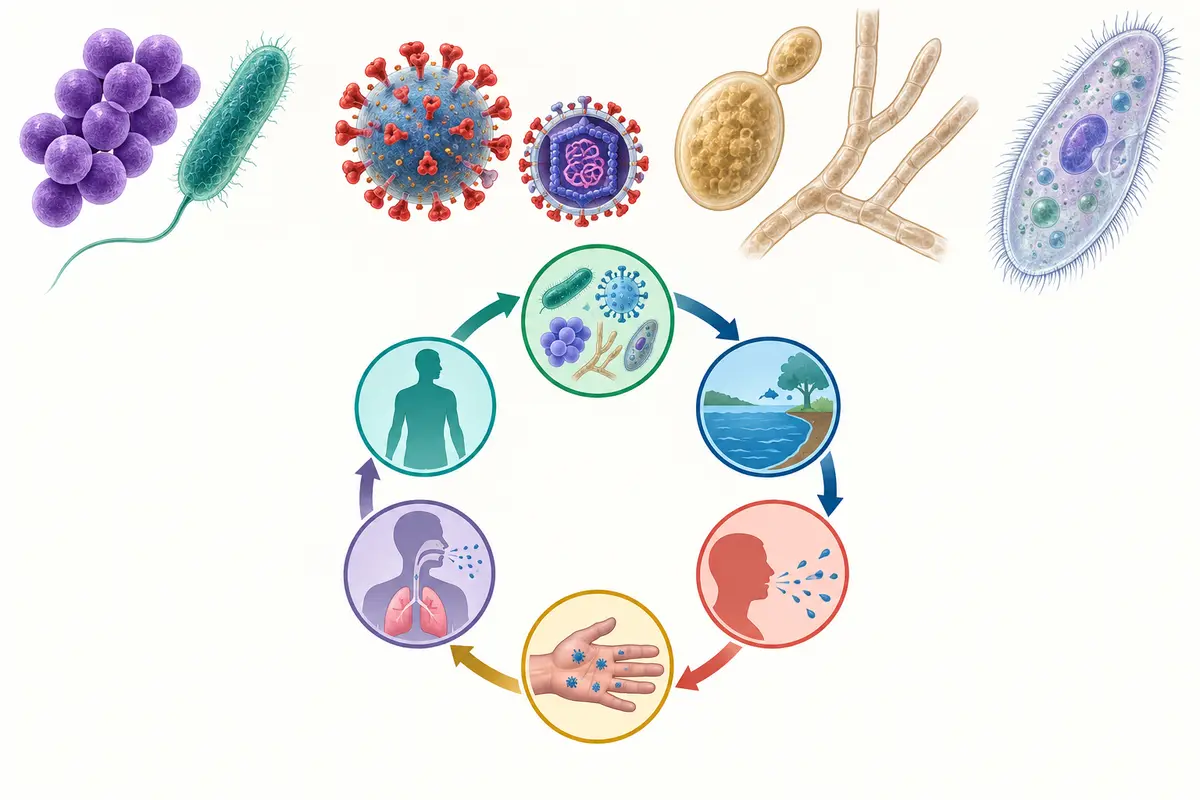
The four groups
| Pathogen | Living cell? | Treated with | Examples |
|---|---|---|---|
| Bacteria | Yes — single-celled prokaryotes | Antibiotics | Strep throat, tuberculosis, most urinary infections |
| Viruses | No — genetic material in a protein coat | Antivirals; mostly supportive care | Influenza, chickenpox, the common cold, HIV |
| Fungi | Yes — eukaryotes | Antifungals | Thrush, athlete's foot, ringworm |
| Parasites | Yes — eukaryotes, living on or in a host | Antiparasitics | Malaria, tapeworm, lice |
Why antibiotics do nothing against viruses
Antibiotics work by attacking structures and processes that bacteria have and human cells do not — a bacterial cell wall, bacterial ribosomes, bacterial enzymes. A virus has none of these. It is genetic material in a protein coat, and it reproduces by hijacking a host cell's machinery, which means there is nothing bacterial for the drug to target.
This is not a matter of dose or of the antibiotic being weak. There is no mechanism at all, which is why an antibiotic prescribed for a cold has no effect on the illness while still exposing bacteria elsewhere in the body to the drug.
Viruses are not considered living by most definitions: they cannot reproduce, metabolise or respond on their own. Everything a virus does happens inside a host cell using that cell's equipment.
Antibiotic resistance
A frequently tested application of natural selection.
- A bacterial population varies. A few individuals happen to survive a given antibiotic.
- The antibiotic kills the susceptible ones, leaving the survivors to reproduce.
- The next generation is descended from survivors, so resistance becomes common.
- The bacteria did not become resistant in response to the drug — resistant individuals were selected for. That distinction is the point of the question.
How infections spread
- Direct contact — touching, including contaminated hands.
- Droplet — coughs and sneezes over short distances.
- Airborne — smaller particles that stay suspended and travel further.
- Vehicle — contaminated food, water or equipment.
- Vector — carried by another organism, as malaria is by mosquitoes.
Reasoning about a treatment decision
Worked example
A patient with a sore throat is found to have a viral infection. Why would an antibiotic not help, and what would it risk?
- Identify the pathogen type: viral.
- Recall the mechanism of antibiotics: they target bacterial structures.
- A virus has no cell wall, no bacterial ribosomes and no bacterial enzymes, so there is no target.
- Meanwhile the drug still reaches the bacteria that normally live in the body, selecting for resistant ones.
It cannot help, because there is nothing for it to act on — and it exposes the body's other bacteria to selection pressure, which is how resistance spreads.
Terms to know
- Pathogen
- An organism or agent that causes disease.
- Bacterium
- A single-celled prokaryote. Some are harmful, many are not.
- Virus
- Genetic material in a protein coat that reproduces only inside a host cell.
- Fungus
- A eukaryotic organism such as a yeast or mould.
- Parasite
- An organism living on or in a host at the host's expense.
- Host
- The organism a pathogen infects.
- Antibiotic
- A drug that kills or inhibits bacteria. Ineffective against viruses.
- Antibiotic resistance
- The survival and spread of bacteria that antibiotics no longer kill.
- Vector
- An organism that carries a pathogen from one host to another.
- Normal flora
- The harmless microorganisms that ordinarily live in and on the body.
What the TEAS asks most
The same core ideas appear in different wording. If you can answer these without stopping to think, you have what this section requires.
Which type of pathogen causes this disease?
Learn the examples in the table — most questions are a direct match.
Why will an antibiotic not treat this infection?
Because it is viral, and antibiotics act on bacterial structures a virus does not have.
How does antibiotic resistance develop?
By natural selection: resistant individuals survive and reproduce. Bacteria do not adapt in response to the drug.
How is this infection transmitted?
Match the route: contact, droplet, airborne, vehicle or vector.
Key points
- Bacteria, viruses, fungi and parasites cause disease by different mechanisms.
- Antibiotics target bacterial structures, so they cannot affect viruses.
- Viruses are not living cells and reproduce only inside a host.
- Resistance arises by natural selection, not by bacteria responding to the drug.
- Transmission routes: contact, droplet, airborne, vehicle, vector.
Review quiz
4 questions on this topic, each with the reasoning worked through. Pick an answer to see how it went, or open the explanation straight away.
-
Question 1 of 4
Why are antibiotics ineffective against viral infections?
Show the answer and explanation
Correct answer: B. Antibiotics target bacterial structures that viruses do not have.
A virus has no cell wall, no bacterial ribosomes and no bacterial enzymes, so an antibiotic has nothing to act on. Speed and dose are irrelevant when no mechanism exists, and "resistant" is the wrong word — resistance describes bacteria that were once susceptible.
-
Question 2 of 4
Which of these conditions is caused by a fungus?
Show the answer and explanation
Correct answer: C. Athlete's foot
Athlete's foot is a fungal infection of the skin and is treated with antifungals. Influenza is viral, tuberculosis is bacterial, and malaria is caused by a parasite carried by mosquitoes — one from each of the other three groups.
-
Question 3 of 4
How does antibiotic resistance develop in a bacterial population?
Show the answer and explanation
Correct answer: B. Bacteria that happen to survive reproduce, so their descendants dominate.
This is natural selection: variation already exists, the drug removes the susceptible individuals, and the survivors pass on their resistance. Bacteria do not adapt on demand, and neither the drug nor the immune system is the thing that changes.
-
Question 4 of 4
Malaria is transmitted to humans by mosquitoes. What is the mosquito's role called?
Show the answer and explanation
Correct answer: C. A vector
An organism that carries a pathogen from one host to another is a vector. The pathogen itself is the parasite causing malaria, and the human is the host in whom the disease develops.
Put this TEAS topic into practice
Build a set on role of microorganisms in disease and use the rationale on every question to reinforce what you just reviewed.
Keep reading
More TEAS Resources
Guides and tools across the TEAS course.
TEAS 7 Exam Prep
Format, sections, timing
TEAS 7 FAQ
Scoring, retakes, test day
Is the TEAS Hard?
An honest answer
How Long Is the TEAS 7?
209 minutes, section by section
What Is a Passing TEAS Score?
Your programme sets the bar
TEAS Reading
18 topics · 39 scored questions
TEAS Math
18 topics · 34 scored questions
TEAS Science
22 topics · 44 scored questions
TEAS English
21 topics · 33 scored questions
Free TEAS Practice Test
Sit a set before you buy
TEAS Plans & Pricing
Choose your access
Start TEAS Prep
Create your account
TEAS Study Guide
All four sections, free
8-Week Study Plan
Week-by-week schedule
TEAS Cheat Sheet
Formulas and high-yield facts
TEAS vs HESI A2
Which exam to take