
Free ATI TEAS 7 Science guide
October 2026 - Atomic Structure & the Periodic Table Study Guide for nursing students in
Protons and neutrons sit in the nucleus and electrons orbit it. The atomic number is the proton count and defines the element; the mass number is protons plus neutrons. Groups run down the table and periods run across it.
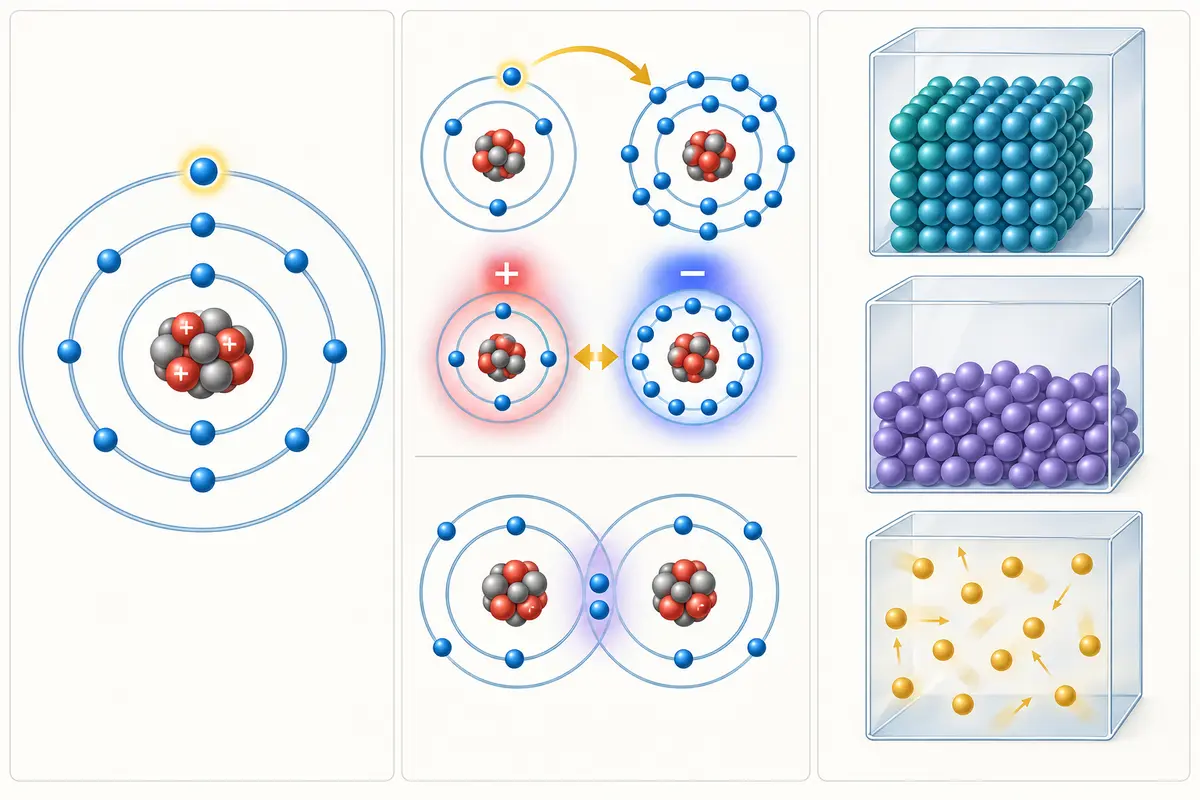
The three subatomic particles
| Particle | Charge | Location | Mass |
|---|---|---|---|
| Proton | Positive | Nucleus | 1 unit |
| Neutron | Neutral | Nucleus | 1 unit |
| Electron | Negative | Orbiting the nucleus | Negligible |
The two numbers
- Atomic number = the number of protons. It identifies the element and never changes — change it and you have a different element.
- Mass number = protons + neutrons. Electrons contribute nothing measurable.
- To find neutrons: mass number − atomic number.
- In a neutral atom, electrons equal protons. In an ion they do not, which is why the ion has a charge.
Isotopes and ions
Two different ways an atom of one element can vary, and the exam tests the distinction.
| What changes | What stays | Result | |
|---|---|---|---|
| Isotope | Number of neutrons | Protons, and so the element | Different mass, same chemistry |
| Ion | Number of electrons | Protons, and so the element | Net electrical charge |
Gaining an electron makes a negative ion, and losing one makes a positive ion. It reads backwards because electrons are the negative particle — adding a negative makes the total negative.
Reading the periodic table
Elements are arranged in order of atomic number. A period is a horizontal row, and a group is a vertical column. Elements in the same group have the same number of outer electrons, which is why they behave similarly — group 1 metals all react vigorously, group 18 noble gases all sit inert with a full outer shell.
Rough position tells you the type: metals occupy the left and centre, non-metals sit at the upper right, and the metalloids run along the staircase between them.
Reading an element entry
Worked example
An element has an atomic number of 11 and a mass number of 23. Describe its atom.
- Atomic number 11 means 11 protons — that identifies the element as sodium.
- Neutral atoms have equal electrons, so 11 electrons.
- Neutrons:
23 - 11 = 12. - Its position in group 1 means one outer electron, which it loses readily to form a positive ion.
11 protons, 11 electrons, 12 neutrons. Losing its single outer electron gives Na⁺, with 10 electrons and still 11 protons.
Terms to know
- Atom
- The smallest unit of an element that retains its properties.
- Proton
- A positively charged particle in the nucleus. Its count defines the element.
- Neutron
- A neutral particle in the nucleus.
- Electron
- A negatively charged particle orbiting the nucleus.
- Atomic number
- The number of protons.
- Mass number
- Protons plus neutrons.
- Isotope
- An atom of the same element with a different number of neutrons.
- Ion
- An atom that has gained or lost electrons, and so carries a charge.
- Group
- A vertical column of the periodic table. Shared outer electrons, similar behaviour.
- Period
- A horizontal row of the periodic table.
- Valence electrons
- The outer-shell electrons that determine how an atom bonds.
What the TEAS asks most
The same core ideas appear in different wording. If you can answer these without stopping to think, you have what this section requires.
How many neutrons does this atom have?
Mass number minus atomic number.
What distinguishes two isotopes of an element?
A different number of neutrons, and so a different mass. The proton count is unchanged.
What is the charge on this ion?
Count how many electrons were gained or lost. Gained means negative, lost means positive.
Why do elements in the same group behave similarly?
They have the same number of outer electrons.
Key points
- Protons and neutrons are in the nucleus; electrons orbit it.
- Atomic number is protons and defines the element; mass number is protons plus neutrons.
- Neutrons = mass number − atomic number.
- Isotopes differ in neutrons; ions differ in electrons.
- Groups are columns with shared outer electrons; periods are rows.
Review quiz
4 questions on this topic, each with the reasoning worked through. Pick an answer to see how it went, or open the explanation straight away.
-
Question 1 of 4
An atom has an atomic number of 17 and a mass number of 35. How many neutrons does it have?
Show the answer and explanation
Correct answer: B. 18
35 - 17 = 18neutrons. 17 is the proton count, 35 is the combined total of protons and neutrons, and 52 comes from adding the two numbers instead of subtracting. -
Question 2 of 4
Two atoms of the same element have different numbers of neutrons. What are they?
Show the answer and explanation
Correct answer: B. Isotopes
Isotopes share a proton count — so they are the same element — and differ only in neutrons, giving them different masses but the same chemistry. Ions differ in electrons, and changing the proton count would make them different elements entirely.
-
Question 3 of 4
An atom gains two electrons. What is the result?
Show the answer and explanation
Correct answer: B. A negative ion with a charge of 2−
Electrons are negatively charged, so gaining two leaves the atom with two more negatives than positives, a charge of 2−. Losing electrons is what produces a positive ion, and neither changes the proton count that determines the element.
-
Question 4 of 4
Why do elements in the same group of the periodic table have similar chemical properties?
Show the answer and explanation
Correct answer: C. They have the same number of outer-shell electrons.
Bonding behaviour is determined by the outer electrons, and every element in a group has the same number of them. Neutron counts and masses vary widely within a group, and a period is the horizontal row rather than the column.
Put this TEAS topic into practice
Build a set on atomic structure and the periodic table and use the rationale on every question to reinforce what you just reviewed.
Keep reading
More TEAS Resources
Guides and tools across the TEAS course.
TEAS 7 Exam Prep
Format, sections, timing
TEAS 7 FAQ
Scoring, retakes, test day
Is the TEAS Hard?
An honest answer
How Long Is the TEAS 7?
209 minutes, section by section
What Is a Passing TEAS Score?
Your programme sets the bar
TEAS Reading
18 topics · 39 scored questions
TEAS Math
18 topics · 34 scored questions
TEAS Science
22 topics · 44 scored questions
TEAS English
21 topics · 33 scored questions
Free TEAS Practice Test
Sit a set before you buy
TEAS Plans & Pricing
Choose your access
Start TEAS Prep
Create your account
TEAS Study Guide
All four sections, free
8-Week Study Plan
Week-by-week schedule
TEAS Cheat Sheet
Formulas and high-yield facts
TEAS vs HESI A2
Which exam to take