
Free ATI TEAS 7 Science guide
October 2026 - Chemical Reactions & Bonding Study Guide for nursing students in
Ionic bonds transfer electrons between a metal and a non-metal; covalent bonds share them between non-metals. Balanced equations must carry the same number of each atom on both sides — matter is neither created nor destroyed in a reaction.
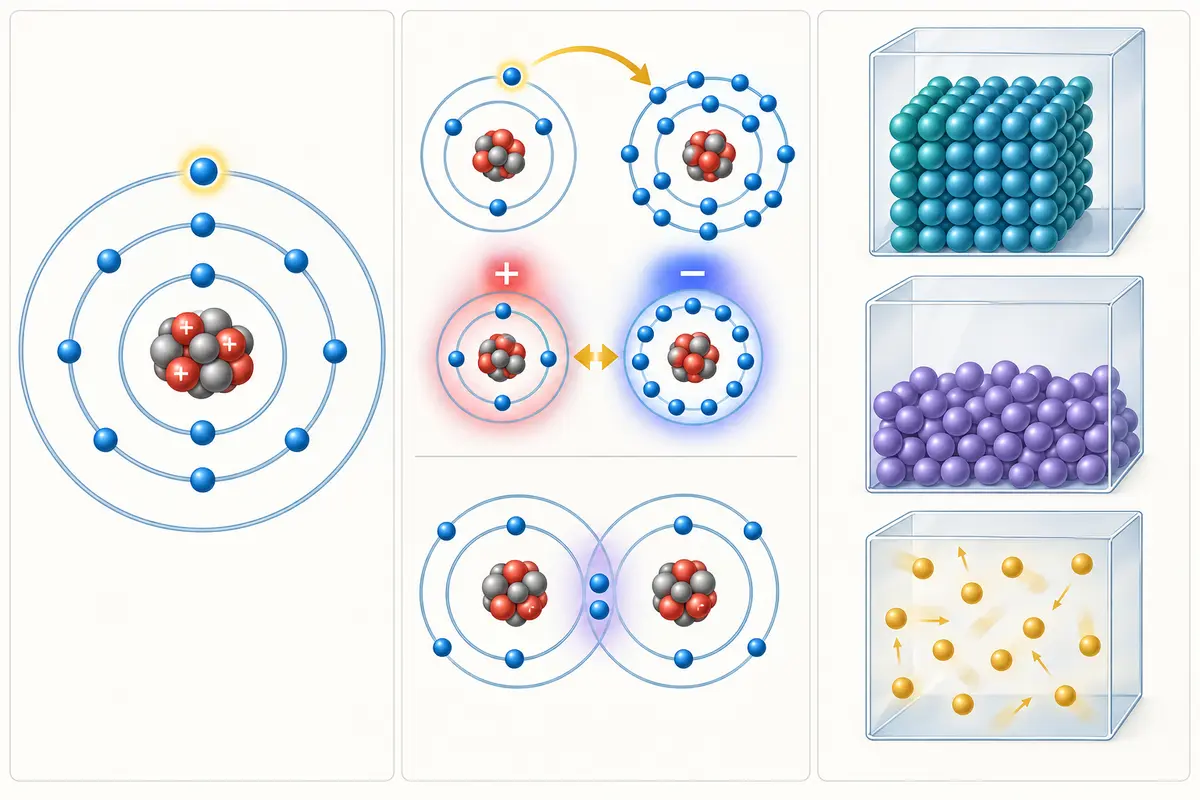
The bond types
| Bond | What happens | Between | Example |
|---|---|---|---|
| Ionic | Electrons are transferred | A metal and a non-metal | NaCl — sodium gives an electron to chlorine |
| Covalent | Electrons are shared | Two non-metals | H₂O — oxygen shares with two hydrogens |
| Hydrogen bond | Weak attraction between molecules | Polar molecules | Between water molecules — why water behaves as it does |
A hydrogen bond is not a true chemical bond in the way ionic and covalent bonds are. It is a weak attraction *between* molecules rather than a link holding atoms together within one, and it takes far less energy to break — which is why water evaporates without decomposing.
Why atoms bond at all
Atoms are most stable with a full outer electron shell — eight electrons, for most of the elements you will meet. Bonding is how they get there. A metal with one or two outer electrons finds it easiest to give them away; a non-metal a few short finds it easiest to take or share.
That is why metals form positive ions, non-metals form negative ions, and the noble gases in group 18 do not bond at all: their outer shells are already full, so they have nothing to gain.
Balancing an equation
The law of conservation of mass means every atom on the left must appear on the right.
- Count each type of atom on both sides.
- Adjust the coefficients — the big numbers in front — to make the counts match.
- Never change a subscript. Changing H₂O to H₂O₂ makes it a different substance, not a balanced one.
- Recount everything at the end, including atoms you had already balanced, since a later change may have unbalanced them.
Balancing step by step
Worked example
Balance: H₂ + O₂ → H₂O
- Count as written: left has 2 H and 2 O; right has 2 H and 1 O. Oxygen does not match.
- Put a 2 in front of the water:
H₂ + O₂ → 2H₂O. Oxygen now balances at 2 each side. - Recount hydrogen: left has 2, right now has 4. Hydrogen has been unbalanced by the fix.
- Put a 2 in front of the hydrogen:
2H₂ + O₂ → 2H₂O. Now 4 H and 2 O on both sides.
2H₂ + O₂ → 2H₂O. Note how balancing oxygen unbalanced hydrogen — which is why the final recount is not optional.
Reaction types and energy
| Type | Pattern | Example |
|---|---|---|
| Synthesis | Two or more combine into one | A + B → AB |
| Decomposition | One breaks into several | AB → A + B |
| Single replacement | One element displaces another | A + BC → AC + B |
| Double replacement | Two compounds swap partners | AB + CD → AD + CB |
| Combustion | A fuel reacts with oxygen, releasing energy | Produces CO₂ and H₂O |
| Exothermic | Releases energy — often felt as heat | Combustion, respiration |
| Endothermic | Absorbs energy from the surroundings | Photosynthesis, an instant cold pack |
Catalysts and rate
- A catalyst speeds a reaction up by lowering the energy needed to start it, and is not consumed.
- Enzymes are biological catalysts, which is the link back to the macromolecules topic.
- Rate also rises with temperature, concentration and surface area.
- A catalyst does not change how much product forms — only how fast it arrives.
Terms to know
- Ionic bond
- A bond formed by transferring electrons between a metal and a non-metal.
- Covalent bond
- A bond formed by sharing electrons between non-metals.
- Hydrogen bond
- A weak attraction between polar molecules.
- Reactant
- A substance present at the start of a reaction, on the left of the arrow.
- Product
- A substance formed by the reaction, on the right.
- Coefficient
- The number in front of a formula, used to balance an equation.
- Subscript
- The small number within a formula. Never changed when balancing.
- Catalyst
- A substance that speeds a reaction without being consumed.
- Exothermic
- Releasing energy to the surroundings.
- Endothermic
- Absorbing energy from the surroundings.
What the TEAS asks most
The same core ideas appear in different wording. If you can answer these without stopping to think, you have what this section requires.
What type of bond is this?
Metal plus non-metal is ionic; two non-metals is covalent.
Which equation is correctly balanced?
Count each atom on both sides. Only the coefficients may be adjusted.
What does a catalyst do?
Speeds the reaction by lowering the activation energy, without being used up or changing the yield.
Is this reaction exothermic or endothermic?
Releasing energy is exothermic; absorbing it — and so feeling cold — is endothermic.
Key points
- Ionic bonds transfer electrons; covalent bonds share them.
- Atoms bond to reach a full outer shell, which is why noble gases do not.
- Balance equations with coefficients only, never by altering a subscript.
- Mass is conserved: every atom on the left appears on the right.
- Catalysts lower activation energy and are not consumed.
Review quiz
4 questions on this topic, each with the reasoning worked through. Pick an answer to see how it went, or open the explanation straight away.
-
Question 1 of 4
Sodium reacts with chlorine to form sodium chloride. What kind of bond holds it together?
Show the answer and explanation
Correct answer: B. Ionic, because an electron is transferred from the metal to the non-metal
Sodium is a metal that gives up its single outer electron and chlorine is a non-metal that accepts it, producing oppositely charged ions that attract — the definition of an ionic bond. Sharing between two non-metals would be covalent, and hydrogen bonds are weak attractions between polar molecules.
-
Question 2 of 4
Which of these equations is correctly balanced?
Show the answer and explanation
Correct answer: B.
2H₂ + O₂ → 2H₂OThe second gives 4 hydrogen and 2 oxygen atoms on each side. The first leaves oxygen unbalanced, the third balances by changing a subscript — producing hydrogen peroxide, a different substance — and the fourth has 4 oxygen atoms on the left against 2 on the right.
-
Question 3 of 4
What does a catalyst do in a chemical reaction?
Show the answer and explanation
Correct answer: B. It lowers the energy needed to start the reaction and is not consumed.
A catalyst provides an easier route to the same destination, so the reaction goes faster while the catalyst survives intact. It changes neither the yield nor the products — enzymes work the same way in the body.
-
Question 4 of 4
An instant cold pack becomes cold when activated. What kind of reaction is taking place?
Show the answer and explanation
Correct answer: B. Endothermic, because energy is absorbed from the surroundings
The pack feels cold because the reaction is drawing energy in from its surroundings, which is what endothermic means. Exothermic reactions such as combustion release energy and would make the pack warm instead.
Put this TEAS topic into practice
Build a set on chemical reactions and chemical bonding and use the rationale on every question to reinforce what you just reviewed.
Keep reading
More TEAS Resources
Guides and tools across the TEAS course.
TEAS 7 Exam Prep
Format, sections, timing
TEAS 7 FAQ
Scoring, retakes, test day
Is the TEAS Hard?
An honest answer
How Long Is the TEAS 7?
209 minutes, section by section
What Is a Passing TEAS Score?
Your programme sets the bar
TEAS Reading
18 topics · 39 scored questions
TEAS Math
18 topics · 34 scored questions
TEAS Science
22 topics · 44 scored questions
TEAS English
21 topics · 33 scored questions
Free TEAS Practice Test
Sit a set before you buy
TEAS Plans & Pricing
Choose your access
Start TEAS Prep
Create your account
TEAS Study Guide
All four sections, free
8-Week Study Plan
Week-by-week schedule
TEAS Cheat Sheet
Formulas and high-yield facts
TEAS vs HESI A2
Which exam to take