
Free ATI TEAS 7 Science guide
October 2026 - Mendel's Laws & Punnett Squares Study Guide for nursing students in
Mendel's laws of segregation and independent assortment underpin the Punnett square. A cross of two heterozygotes gives the familiar 3:1 phenotype and 1:2:1 genotype ratios — and drawing the square takes fifteen seconds and removes the guesswork entirely.
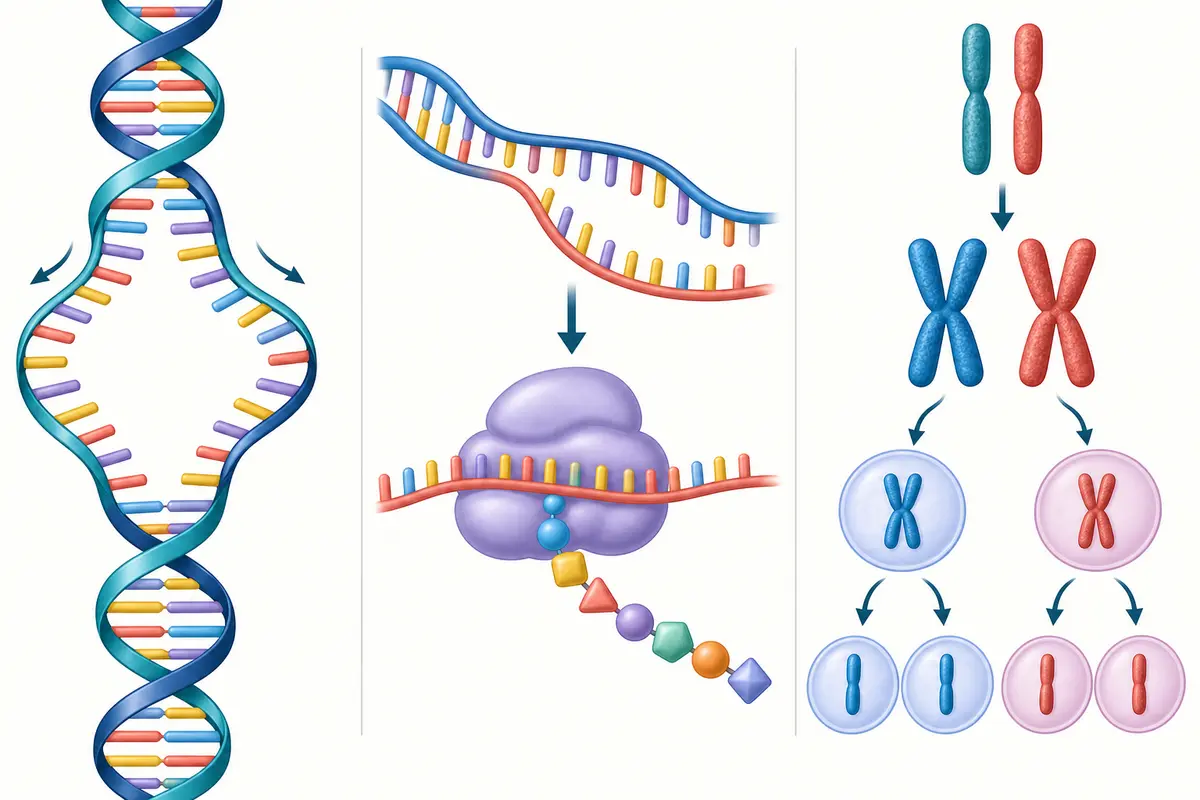
Mendel's two laws
- Segregation — the two alleles for a trait separate during gamete formation, so each gamete carries one of them. This is why a heterozygous parent produces two kinds of gamete in equal numbers.
- Independent assortment — alleles for different traits are inherited independently of one another. Eye colour does not travel with height.
How to draw a Punnett square
Put one parent's two alleles across the top and the other parent's down the side. Fill each of the four boxes with the letter from its row and the letter from its column, writing the capital first. The four boxes are the four equally likely offspring genotypes.
For a Bb × Bb cross, the boxes come out BB, Bb, Bb, bb. Three of the four carry at least one dominant allele, giving a 3:1 phenotype ratio, while the genotypes divide 1:2:1. Those two ratios describe the same square, and mixing them up is the commonest error here.
The crosses worth recognising on sight
| Cross | Genotypes | Phenotype ratio |
|---|---|---|
BB × bb |
All Bb | All dominant |
Bb × Bb |
1 BB : 2 Bb : 1 bb | 3 dominant : 1 recessive |
Bb × bb |
2 Bb : 2 bb | 1 dominant : 1 recessive |
BB × Bb |
2 BB : 2 Bb | All dominant |
bb × bb |
All bb | All recessive |
The ratio is a probability, not a promise. A Bb × Bb cross gives each offspring a 25% chance of being bb — independently. Four children can all be recessive, exactly as four coin tosses can all be heads.
Working backwards from the phenotype
Worked example
Two parents both show a dominant trait, and one of their children shows the recessive trait. What are the parents' genotypes?
- The child shows the recessive trait, so the child must be
bb. - A child receives one allele from each parent, so each parent must have supplied a
b. - But both parents show the dominant trait, so each must also carry a
B. - Therefore both parents are
Bb.
Both parents are heterozygous, Bb. This backwards reasoning — from a recessive child to two carrier parents — is one of the most common question forms in the topic.
Beyond simple dominance
Two patterns that do not follow the standard rules, and which the exam names explicitly.
- Incomplete dominance — the heterozygote is intermediate. A red and a white flower give pink.
- Codominance — both alleles show fully and separately. AB blood type is the standard example.
- Sex-linked traits sit on the X chromosome, which is why some conditions appear far more often in males, who have only one X.
Terms to know
- Allele
- One version of a gene.
- Dominant
- An allele expressed whenever it is present, written as a capital.
- Recessive
- An allele expressed only when both alleles are recessive.
- Homozygous
- Two identical alleles.
- Heterozygous
- Two different alleles. Also called a carrier for a recessive condition.
- Punnett square
- A grid showing the possible offspring genotypes from a cross.
- Segregation
- Mendel's law that allele pairs separate during gamete formation.
- Independent assortment
- Mendel's law that different traits are inherited independently.
- Incomplete dominance
- The heterozygote shows an intermediate phenotype.
- Codominance
- Both alleles are fully expressed.
What the TEAS asks most
The same core ideas appear in different wording. If you can answer these without stopping to think, you have what this section requires.
What proportion of offspring will show the recessive trait?
Draw the square. For Bb × Bb, one box in four, so 25%.
What are the possible genotypes of the offspring?
The contents of the four boxes, expressed as a 1:2:1 or 2:2 ratio.
Two unaffected parents have an affected child. What are their genotypes?
Both heterozygous carriers. The child must have received a recessive allele from each.
Which law explains why two traits are inherited separately?
Independent assortment.
Key points
- Segregation separates allele pairs into gametes; independent assortment separates different traits.
- A
Bb × Bbcross gives 3:1 phenotypes and 1:2:1 genotypes. - Draw the square rather than reasoning it out — it is faster and it does not slip.
- A recessive child of two unaffected parents means both parents are carriers.
- Ratios are probabilities for each offspring independently, not guaranteed outcomes.
Review quiz
4 questions on this topic, each with the reasoning worked through. Pick an answer to see how it went, or open the explanation straight away.
-
Question 1 of 4
Two heterozygous parents (
Bb × Bb) have a child. What is the probability that the child shows the recessive trait?Show the answer and explanation
Correct answer: B. 25%
The square gives
BB,Bb,Bb,bb, and only thebbbox shows the recessive trait — one in four. 75% is the proportion showing the dominant trait, and 50% is the proportion that are heterozygous carriers. -
Question 2 of 4
A homozygous dominant parent (
BB) is crossed with a homozygous recessive parent (bb). What are the offspring?Show the answer and explanation
Correct answer: C. All
Bb, showing the dominant traitEvery gamete from one parent carries
Band every gamete from the other carriesb, so all four boxes areBb. Each child carries the recessive allele without showing it — the 1:2:1 pattern requires both parents to be heterozygous. -
Question 3 of 4
Two parents who do not have a recessive condition have a child who does. What does this tell you about the parents?
Show the answer and explanation
Correct answer: B. Both parents must be heterozygous carriers.
The child is
bb, so each parent contributed a recessive allele — yet neither shows the trait, so each must also carry a dominant one. A homozygous recessive parent would show the condition, and homozygous dominant parents could not supply the alleles at all. -
Question 4 of 4
A red flower crossed with a white flower produces all pink offspring. What does this demonstrate?
Show the answer and explanation
Correct answer: B. Incomplete dominance
An intermediate phenotype in the heterozygote is the definition of incomplete dominance. Complete dominance would give all red offspring, codominance would give flowers with both red and white patches rather than a blend, and independent assortment concerns two different traits.
Put this TEAS topic into practice
Build a set on mendel's law of inheritance and use the rationale on every question to reinforce what you just reviewed.
Keep reading
More TEAS Resources
Guides and tools across the TEAS course.
TEAS 7 Exam Prep
Format, sections, timing
TEAS 7 FAQ
Scoring, retakes, test day
Is the TEAS Hard?
An honest answer
How Long Is the TEAS 7?
209 minutes, section by section
What Is a Passing TEAS Score?
Your programme sets the bar
TEAS Reading
18 topics · 39 scored questions
TEAS Math
18 topics · 34 scored questions
TEAS Science
22 topics · 44 scored questions
TEAS English
21 topics · 33 scored questions
Free TEAS Practice Test
Sit a set before you buy
TEAS Plans & Pricing
Choose your access
Start TEAS Prep
Create your account
TEAS Study Guide
All four sections, free
8-Week Study Plan
Week-by-week schedule
TEAS Cheat Sheet
Formulas and high-yield facts
TEAS vs HESI A2
Which exam to take