
Free ATI TEAS 7 Science guide
October 2026 - Respiratory System Study Guide for nursing students in
Air travels from the nose to the pharynx, larynx, trachea, bronchi, bronchioles and finally the alveoli, where gas exchange happens across a wall one cell thick. The diaphragm contracts and flattens to draw air in; at rest, breathing out needs no muscular effort at all.
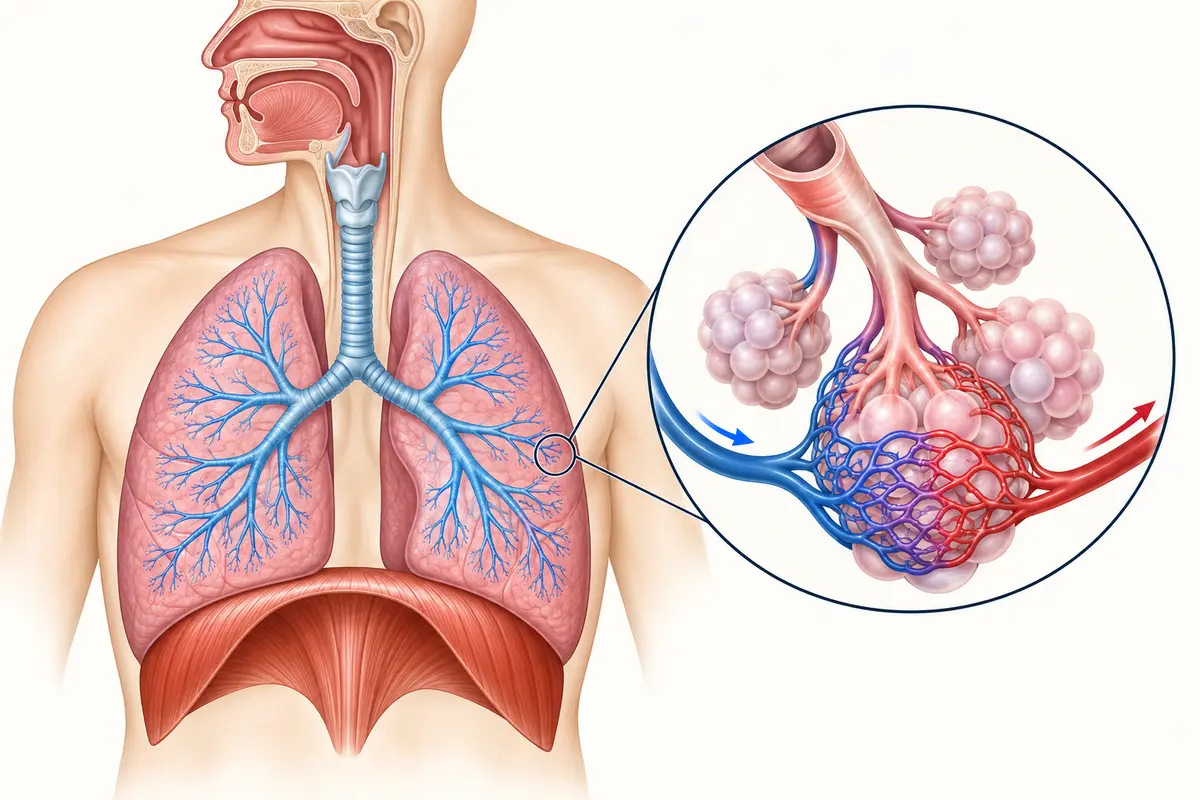
The path of air
Learn this as a narrowing sequence: one trachea, two bronchi, thousands of bronchioles, millions of alveoli.
- Nose or mouth
- Pharynx
- Larynx
- Trachea
- Bronchi
- Bronchioles
- Alveoli
Upper and lower tract
The division matters because questions ask which structures belong where.
- Upper tract — nose, nasal cavity, pharynx and larynx. It warms, humidifies and filters incoming air.
- Lower tract — trachea, bronchi, bronchioles and alveoli. This is where conduction ends and exchange begins.
- The epiglottis is the flap that closes over the larynx during swallowing, which is what keeps food out of the airway.
Gas exchange
Alveoli are microscopic air sacs wrapped in capillaries. Oxygen diffuses from the alveolar air into the blood, and carbon dioxide diffuses the other way — both moving down their own concentration gradients, with no energy required.
Three features make the exchange efficient: an enormous total surface area, a barrier one cell thick on each side, and a dense capillary network that keeps the gradient steep by constantly carrying oxygenated blood away.
The mechanics of breathing
| Diaphragm | Chest volume | Pressure inside | Air | |
|---|---|---|---|---|
| Inhalation | Contracts and flattens | Increases | Falls below atmospheric | Flows in |
| Exhalation (at rest) | Relaxes and domes upward | Decreases | Rises above atmospheric | Flows out |
Inhalation is active and quiet exhalation is passive, driven by the elastic recoil of the lungs. Forced exhalation — coughing, blowing out hard — does use muscles, but a question about breathing at rest is asking about recoil.
Reasoning about a blockage
Worked example
A patient inhales a small object that lodges in a bronchiole. What is affected, and why is the effect limited?
- Locate the bronchiole in the sequence: after the bronchi, before the alveoli.
- Everything downstream of the blockage is cut off — the alveoli that bronchiole supplies.
- Everything upstream still works, and so does every other branch at the same level.
- Because the tree divides many times, one bronchiole serves a small fraction of the alveoli.
Gas exchange stops in the alveoli served by that bronchiole only. The branching structure is what limits the damage — the same blockage in the trachea would affect both lungs entirely.
The link to the cardiovascular system
- Oxygen-poor blood arrives at the lungs through the pulmonary artery.
- Oxygen-rich blood leaves through the pulmonary vein to the left atrium.
- Carbon dioxide levels, not oxygen levels, are the main driver of the urge to breathe.
- Haemoglobin in red blood cells is what carries the oxygen once it has crossed into the blood.
Terms to know
- Alveoli
- Microscopic air sacs where gas exchange takes place.
- Diaphragm
- The dome-shaped muscle below the lungs that drives inhalation.
- Trachea
- The windpipe, the single tube carrying air towards the bronchi.
- Bronchi
- The two main branches into the lungs.
- Bronchioles
- The fine branches leading to the alveoli.
- Epiglottis
- The flap that closes the larynx during swallowing.
- Diffusion
- Passive movement of a substance down its concentration gradient.
- Elastic recoil
- The lungs' natural tendency to spring back, which drives quiet exhalation.
What the TEAS asks most
The same core ideas appear in different wording. If you can answer these without stopping to think, you have what this section requires.
Where does gas exchange occur?
In the alveoli, across a wall one cell thick, by diffusion.
What happens to the diaphragm during inhalation?
It contracts and flattens, increasing chest volume and lowering the pressure inside.
Which structure does air pass through next?
Follow the narrowing sequence from nose to alveoli.
Which structures make up the upper respiratory tract?
Nose, nasal cavity, pharynx and larynx.
Key points
- Nose, pharynx, larynx, trachea, bronchi, bronchioles, alveoli.
- Gas exchange happens only in the alveoli, by diffusion.
- The diaphragm contracts and flattens to inhale.
- Quiet exhalation is passive elastic recoil, not muscular effort.
- Surface area, a one-cell barrier and a dense capillary bed make exchange efficient.
Review quiz
4 questions on this topic, each with the reasoning worked through. Pick an answer to see how it went, or open the explanation straight away.
-
Question 1 of 4
Where in the respiratory system does gas exchange take place?
Show the answer and explanation
Correct answer: C. The alveoli
Only the alveoli have walls thin enough and a capillary supply dense enough for diffusion. The trachea, bronchi and pharynx are conducting structures: they move air towards the alveoli without exchanging anything with the blood.
-
Question 2 of 4
What happens to the diaphragm during inhalation?
Show the answer and explanation
Correct answer: A. It contracts and flattens, increasing the volume of the chest cavity
Contracting flattens the dome, which enlarges the chest cavity and drops the pressure inside so air flows in. Relaxing and doming upward describes exhalation, and while the ribs assist, the diaphragm is the primary muscle of inhalation.
-
Question 3 of 4
Air has just passed the larynx. Which structure does it reach next?
Show the answer and explanation
Correct answer: B. The trachea
The larynx opens directly into the trachea. The pharynx comes before the larynx, and bronchioles and alveoli lie further down after the bronchi have branched — the sequence narrows steadily and cannot be skipped.
-
Question 4 of 4
Which feature of the alveoli most directly enables efficient gas exchange?
Show the answer and explanation
Correct answer: B. Walls one cell thick, surrounded by capillaries
Diffusion needs the shortest possible distance and a steep gradient, which a one-cell wall against a capillary provides. Thick walls would obstruct exchange, cartilage rings support the trachea, and cilia line the airways rather than the alveoli.
Put this TEAS topic into practice
Build a set on respiratory system and use the rationale on every question to reinforce what you just reviewed.
Keep reading
More TEAS Resources
Guides and tools across the TEAS course.
TEAS 7 Exam Prep
Format, sections, timing
TEAS 7 FAQ
Scoring, retakes, test day
Is the TEAS Hard?
An honest answer
How Long Is the TEAS 7?
209 minutes, section by section
What Is a Passing TEAS Score?
Your programme sets the bar
TEAS Reading
18 topics · 39 scored questions
TEAS Math
18 topics · 34 scored questions
TEAS Science
22 topics · 44 scored questions
TEAS English
21 topics · 33 scored questions
Free TEAS Practice Test
Sit a set before you buy
TEAS Plans & Pricing
Choose your access
Start TEAS Prep
Create your account
TEAS Study Guide
All four sections, free
8-Week Study Plan
Week-by-week schedule
TEAS Cheat Sheet
Formulas and high-yield facts
TEAS vs HESI A2
Which exam to take