
Free ATI TEAS 7 Science guide
October 2026 - Nervous System Study Guide for nursing students in
The central nervous system is the brain and spinal cord; the peripheral nervous system is everything else. The peripheral system divides into somatic voluntary control and autonomic involuntary control, and the autonomic divides again into sympathetic — fight or flight — and parasympathetic — rest and digest.
The divisions, in order
Almost every question on this topic is asking where in this hierarchy something sits.
| Division | Contains | Controls |
|---|---|---|
| Central (CNS) | Brain and spinal cord | Processing and integration |
| Peripheral (PNS) | All nerves outside the CNS | Carrying signals in and out |
| — Somatic | Nerves to skeletal muscle | Voluntary movement |
| — Autonomic | Nerves to organs and glands | Involuntary function |
| —— Sympathetic | Part of the autonomic | Fight or flight |
| —— Parasympathetic | Part of the autonomic | Rest and digest |
Sympathetic against parasympathetic
Expect at least one question distinguishing these. They oppose each other organ by organ.
| Effect on | Sympathetic | Parasympathetic |
|---|---|---|
| Heart rate | Increases | Decreases |
| Airways | Dilate | Constrict |
| Pupils | Dilate | Constrict |
| Digestion | Slows | Stimulates |
| Blood to skeletal muscle | Increases | Returns to baseline |
The neuron
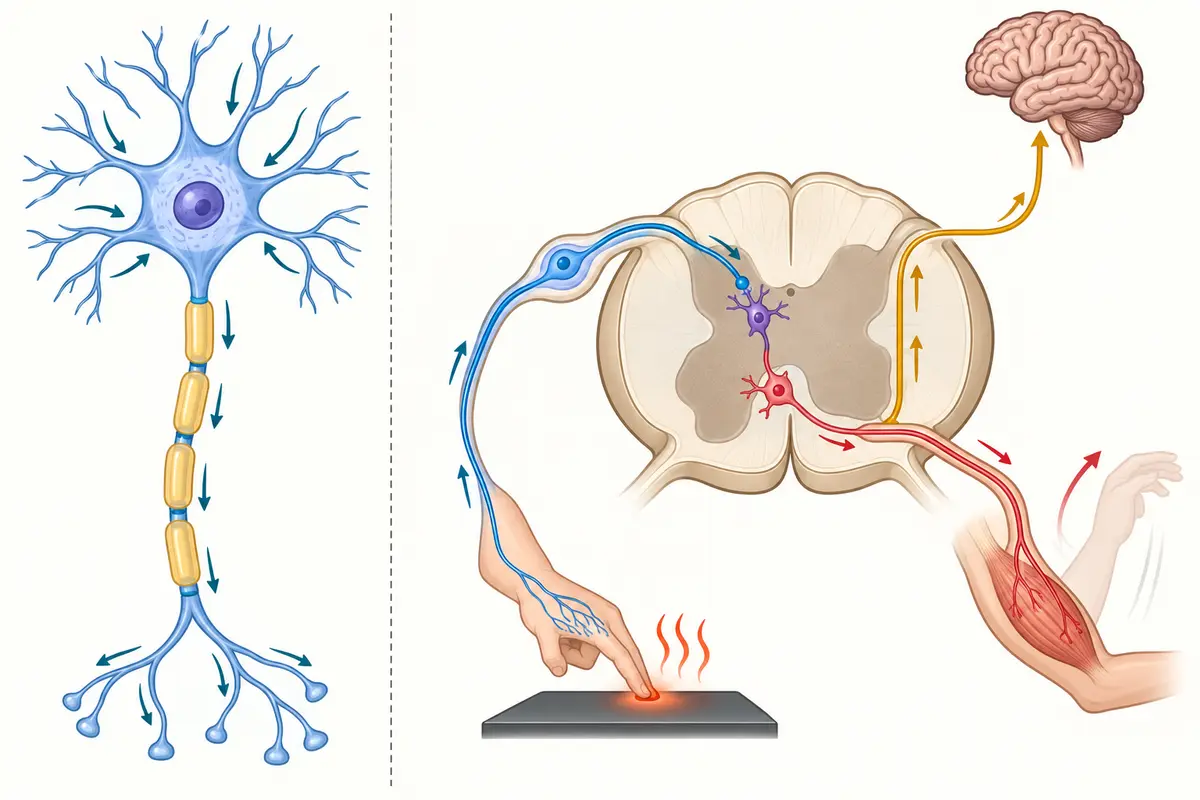
Signals travel one way through a neuron, and the parts are named by their role in that journey.
- Dendrites receive incoming signals.
- The cell body integrates them.
- The axon carries the impulse away.
- The myelin sheath insulates the axon and speeds conduction.
- The synapse is the gap between neurons, crossed by chemical neurotransmitters rather than by the electrical signal itself.
Reflex arcs
A reflex bypasses the brain. A sensory neuron carries the signal to the spinal cord, where it connects — sometimes through a single interneuron — straight to a motor neuron that produces the response. The brain is informed afterwards, which is why you have already pulled your hand back before you feel the pain.
That short route is the point: fewer synapses mean less delay, and the protective response happens faster than conscious decision could manage.
Brain regions worth knowing
- Cerebrum — thought, voluntary movement, sensation, language. The largest part.
- Cerebellum — balance, coordination and fine motor control.
- Brainstem — breathing, heart rate and blood pressure. Damage here is life-threatening because these functions are automatic.
- Hypothalamus — temperature, hunger, thirst, and the link between the nervous and endocrine systems.
Sympathetic and parasympathetic are not on and off; both run continuously, and the balance between them shifts. A question describing a slowed heart rate after a fright is describing parasympathetic activity returning, not sympathetic activity being switched off.
Terms to know
- CNS
- Central nervous system: the brain and spinal cord.
- PNS
- Peripheral nervous system: all nerves outside the CNS.
- Somatic
- The voluntary division of the PNS, controlling skeletal muscle.
- Autonomic
- The involuntary division, controlling organs and glands.
- Sympathetic
- The fight-or-flight branch of the autonomic system.
- Parasympathetic
- The rest-and-digest branch.
- Neuron
- A nerve cell: dendrites, cell body, axon.
- Synapse
- The junction between two neurons, crossed by neurotransmitters.
- Myelin
- The insulating sheath that speeds signal conduction along an axon.
- Reflex arc
- A rapid response routed through the spinal cord rather than the brain.
What the TEAS asks most
The same core ideas appear in different wording. If you can answer these without stopping to think, you have what this section requires.
Which division does this structure belong to?
Brain and spinal cord are central; everything else is peripheral.
Which branch produces this effect?
Speeding up and preparing for exertion is sympathetic; slowing down and digesting is parasympathetic.
What is the function of the myelin sheath?
To insulate the axon and increase the speed of conduction.
Why is a reflex faster than a voluntary response?
It is processed in the spinal cord, so the signal does not travel to the brain first.
Key points
- CNS is brain and spinal cord; PNS is everything else.
- PNS splits into somatic (voluntary) and autonomic (involuntary).
- Sympathetic is fight or flight; parasympathetic is rest and digest.
- Signals run dendrites → cell body → axon → synapse.
- Reflexes are processed in the spinal cord, which is what makes them fast.
Review quiz
4 questions on this topic, each with the reasoning worked through. Pick an answer to see how it went, or open the explanation straight away.
-
Question 1 of 4
A patient's heart rate rises, pupils dilate and digestion slows. Which division of the nervous system is responsible?
Show the answer and explanation
Correct answer: B. The sympathetic branch of the autonomic system
All three changes prepare the body for exertion, which is the sympathetic profile. The parasympathetic branch would produce the opposite pattern, and the somatic system controls skeletal muscle voluntarily rather than governing organs.
-
Question 2 of 4
Which structure belongs to the central nervous system?
Show the answer and explanation
Correct answer: B. The spinal cord
The CNS consists of exactly two things, the brain and the spinal cord. A named nerve, a skin receptor and a junction with muscle are all peripheral, which is where every structure outside those two belongs.
-
Question 3 of 4
What is the function of the myelin sheath?
Show the answer and explanation
Correct answer: B. To insulate the axon and speed up conduction
Myelin is insulation, and insulation is what allows an impulse to travel quickly along an axon. Receiving signals is the dendrites' job, integration happens in the cell body, and neurotransmitter release occurs at the axon terminal.
-
Question 4 of 4
Why does a person withdraw their hand from a hot surface before consciously feeling pain?
Show the answer and explanation
Correct answer: B. The reflex is processed in the spinal cord, bypassing the brain
A reflex arc routes the signal through the spinal cord straight to a motor neuron, so the movement happens before the signal has reached the brain to be experienced. The pain message does travel to the brain, just afterwards — and withdrawal is skeletal movement, which is somatic rather than sympathetic.
Put this TEAS topic into practice
Build a set on nervous system and use the rationale on every question to reinforce what you just reviewed.
Keep reading
More TEAS Resources
Guides and tools across the TEAS course.
TEAS 7 Exam Prep
Format, sections, timing
TEAS 7 FAQ
Scoring, retakes, test day
Is the TEAS Hard?
An honest answer
How Long Is the TEAS 7?
209 minutes, section by section
What Is a Passing TEAS Score?
Your programme sets the bar
TEAS Reading
18 topics · 39 scored questions
TEAS Math
18 topics · 34 scored questions
TEAS Science
22 topics · 44 scored questions
TEAS English
21 topics · 33 scored questions
Free TEAS Practice Test
Sit a set before you buy
TEAS Plans & Pricing
Choose your access
Start TEAS Prep
Create your account
TEAS Study Guide
All four sections, free
8-Week Study Plan
Week-by-week schedule
TEAS Cheat Sheet
Formulas and high-yield facts
TEAS vs HESI A2
Which exam to take