Free ATI TEAS 7 Science guide
October 2026 - Digestive System Study Guide for nursing students in
Mechanical and chemical digestion run from the mouth through the oesophagus, stomach, small intestine and large intestine. Almost all nutrient absorption happens in the small intestine; the large intestine reabsorbs water. Knowing which organ does which job answers most questions on this topic.
The path of food
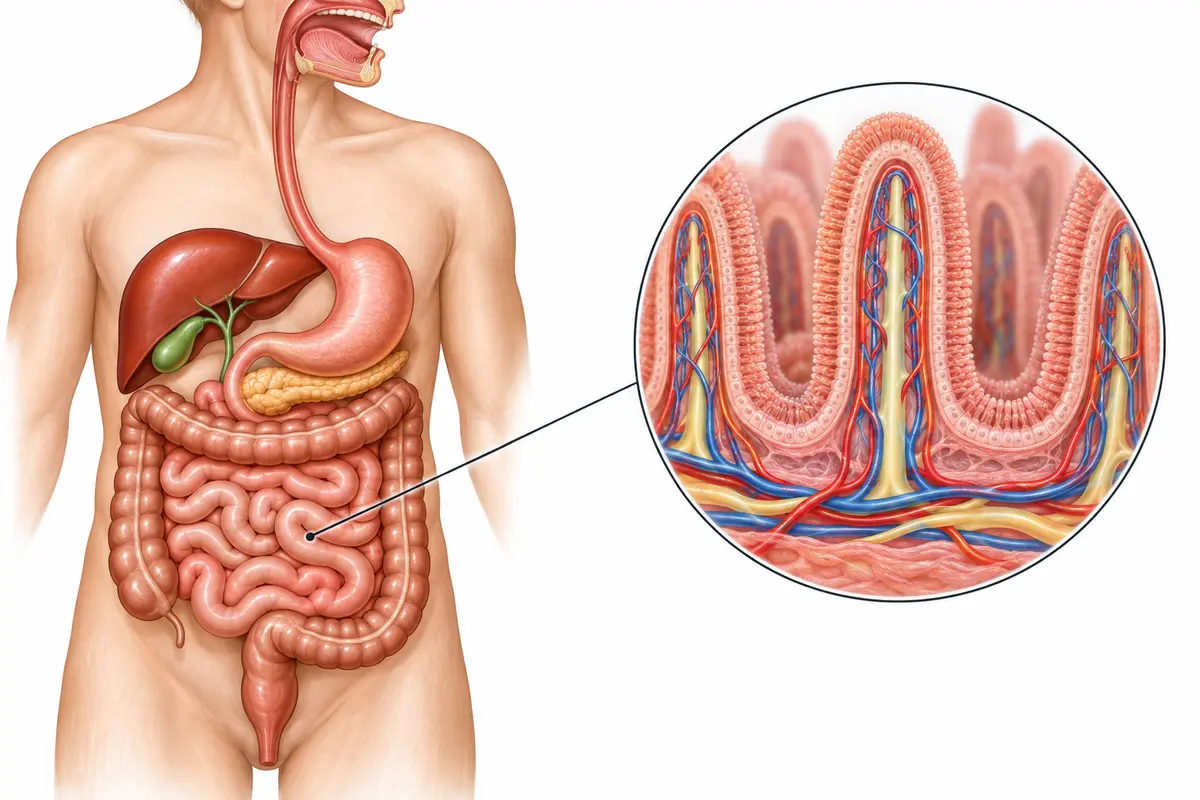
One continuous tube from mouth to anus. The accessory organs — liver, gallbladder and pancreas — sit alongside it and deliver substances into it without food passing through them.
- Mouth
- Pharynx
- Oesophagus
- Stomach
- Small intestine
- Large intestine
- Rectum
What each organ actually does
| Organ | Mechanical | Chemical | Absorption |
|---|---|---|---|
| Mouth | Chewing | Salivary amylase begins starch digestion | Negligible |
| Oesophagus | Peristalsis | None | None |
| Stomach | Churning | Acid and pepsin begin protein digestion | Water, alcohol, some drugs |
| Small intestine | Mixing | Pancreatic enzymes and bile finish the job | Almost all nutrients |
| Large intestine | Movement | Bacterial fermentation | Water and some vitamins |
Mechanical or chemical
The exam asks you to sort processes into these two categories.
- Mechanical digestion breaks food into smaller pieces without changing it chemically: chewing, churning in the stomach, and the emulsifying action of bile on fat.
- Chemical digestion breaks the molecules themselves apart, and it is done by enzymes and acid.
- Bile is the one worth watching: it is not an enzyme, and its action on fat is mechanical, breaking large droplets into small ones so enzymes have more surface to work on.
The accessory organs
- Liver — produces bile, and processes absorbed nutrients arriving from the intestine.
- Gallbladder — stores and concentrates bile, releasing it when fat arrives.
- Pancreas — releases enzymes for all three macronutrient groups, plus bicarbonate that neutralises stomach acid entering the small intestine.
- None of the three is part of the tube. Food never enters them.
Absorption and digestion are different processes. The stomach is where protein digestion begins, but it is not where protein is absorbed — that happens in the small intestine, and questions rely on the confusion between the two.
Why the small intestine absorbs so much
Its lining is folded, and the folds carry villi, and the villi carry microvilli. Each level of folding multiplies the surface area, producing a total area vastly larger than the organ's length suggests.
Each villus contains capillaries that take up sugars and amino acids, and a lymphatic vessel that takes up fats. That is the structural answer to any question about why absorption happens where it does.
Predicting the effect of a missing organ
Worked example
A patient has had their gallbladder removed. Which type of food would you expect them to find hardest to tolerate, and why?
- Identify what the gallbladder does: stores and concentrates bile, releasing a bolus of it when needed.
- Identify what bile acts on: fat, which it emulsifies into small droplets.
- Without storage, bile still reaches the intestine from the liver, but in a slow trickle rather than a surge.
- So a large amount of fat arriving at once outpaces the available bile.
Fatty meals, especially large ones. The liver still makes bile, but without a reservoir to release it in quantity, a sudden fat load cannot be emulsified efficiently.
Terms to know
- Peristalsis
- Waves of muscular contraction that move food along the tube.
- Chyme
- The semi-liquid mixture leaving the stomach.
- Enzyme
- A protein that speeds a specific chemical reaction, such as breaking down starch.
- Amylase
- The enzyme that digests starch. Present in saliva and pancreatic juice.
- Pepsin
- The stomach enzyme that begins protein digestion, active in acid.
- Bile
- A liver secretion that emulsifies fat. Not an enzyme.
- Villi
- Finger-like projections lining the small intestine that multiply its surface area.
- Absorption
- The passage of digested nutrients from the gut into the blood or lymph.
What the TEAS asks most
The same core ideas appear in different wording. If you can answer these without stopping to think, you have what this section requires.
Where does most nutrient absorption occur?
The small intestine, because of villi and microvilli multiplying the surface area.
Which process is mechanical and which chemical?
Chewing, churning and emulsification are mechanical. Enzymes and acid are chemical.
What is the function of the large intestine?
Reabsorbing water and some vitamins, and forming stool. Very little nutrient absorption.
Which organ produces bile, and which stores it?
The liver produces it; the gallbladder stores and concentrates it.
Key points
- Mouth, oesophagus, stomach, small intestine, large intestine — one continuous tube.
- Liver, gallbladder and pancreas are accessory organs; food never passes through them.
- Almost all nutrient absorption is in the small intestine.
- The large intestine reabsorbs water.
- Bile emulsifies fat mechanically and is not an enzyme.
Review quiz
4 questions on this topic, each with the reasoning worked through. Pick an answer to see how it went, or open the explanation straight away.
-
Question 1 of 4
Where does the majority of nutrient absorption take place?
Show the answer and explanation
Correct answer: B. The small intestine
Villi and microvilli give the small intestine an enormous absorptive surface, and its capillaries and lymph vessels carry nutrients away. The stomach absorbs only water, alcohol and some drugs, the large intestine mainly reclaims water, and the oesophagus absorbs nothing.
-
Question 2 of 4
Which of the following is an example of mechanical rather than chemical digestion?
Show the answer and explanation
Correct answer: C. Bile emulsifying fat into smaller droplets
Bile breaks large fat droplets into small ones without altering the molecules, which is mechanical action — and it is the reason bile is not classed as an enzyme. The other three are enzymes cleaving chemical bonds.
-
Question 3 of 4
What is the primary function of the large intestine?
Show the answer and explanation
Correct answer: C. Reabsorbing water and forming stool
Water reclamation and stool formation are what the large intestine is for, along with some vitamin absorption from bacterial activity. Nutrient absorption belongs to the small intestine, bile comes from the liver, and protein digestion begins in the stomach.
-
Question 4 of 4
Which organ releases enzymes for carbohydrates, proteins and fats, along with bicarbonate to neutralise stomach acid?
Show the answer and explanation
Correct answer: C. The pancreas
The pancreas covers all three macronutrient groups and supplies the bicarbonate that protects the small intestine from arriving acid. The liver makes bile, the gallbladder stores it, and the stomach produces the acid being neutralised.
Put this TEAS topic into practice
Build a set on digestive system and use the rationale on every question to reinforce what you just reviewed.
Keep reading
More TEAS Resources
Guides and tools across the TEAS course.
TEAS 7 Exam Prep
Format, sections, timing
TEAS 7 FAQ
Scoring, retakes, test day
Is the TEAS Hard?
An honest answer
How Long Is the TEAS 7?
209 minutes, section by section
What Is a Passing TEAS Score?
Your programme sets the bar
TEAS Reading
18 topics · 39 scored questions
TEAS Math
18 topics · 34 scored questions
TEAS Science
22 topics · 44 scored questions
TEAS English
21 topics · 33 scored questions
Free TEAS Practice Test
Sit a set before you buy
TEAS Plans & Pricing
Choose your access
Start TEAS Prep
Create your account
TEAS Study Guide
All four sections, free
8-Week Study Plan
Week-by-week schedule
TEAS Cheat Sheet
Formulas and high-yield facts
TEAS vs HESI A2
Which exam to take