
Free ATI TEAS 7 Science guide
October 2026 - Reproductive System Study Guide for nursing students in
Expect structures and their functions, gamete production, and the hormonal control of the menstrual cycle by oestrogen and progesterone. The questions are anatomical and hormonal rather than clinical, and knowing which structure does which job covers most of them.
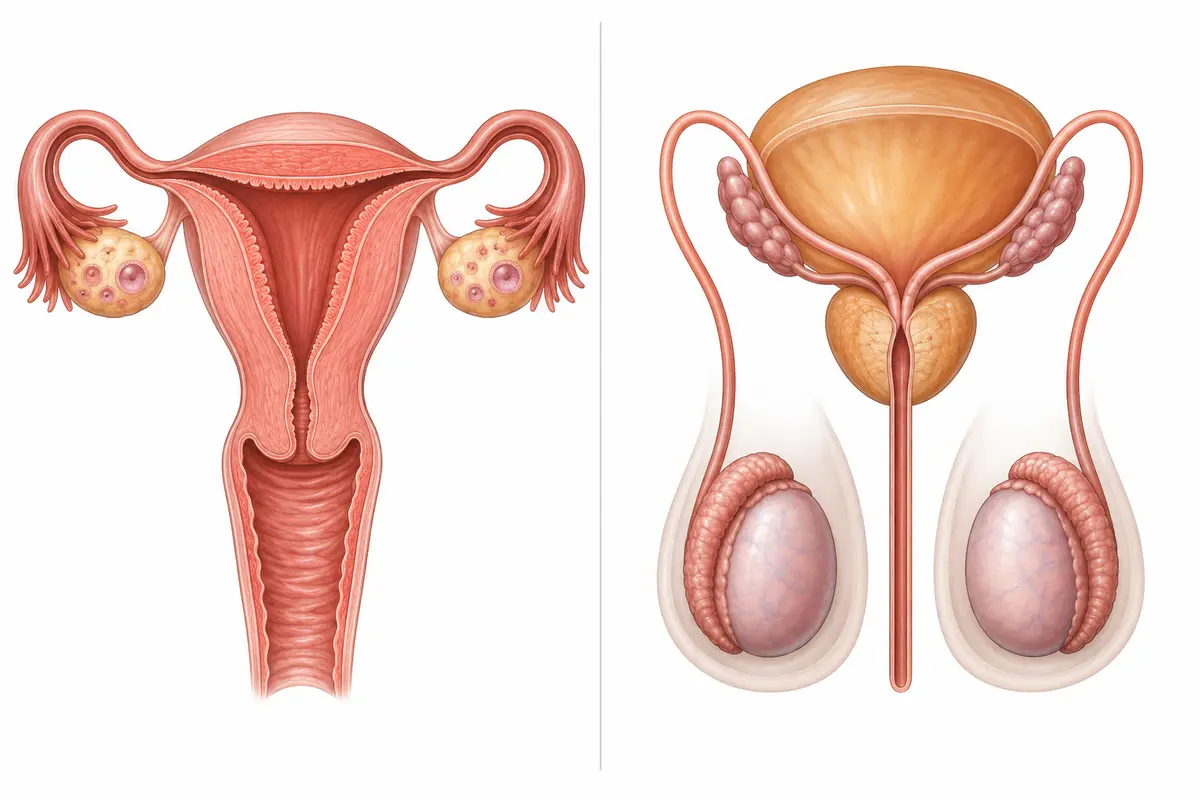
Male structures
| Structure | Function |
|---|---|
| Testes | Produce sperm and testosterone |
| Epididymis | Where sperm mature and are stored |
| Vas deferens | Carries sperm from the epididymis towards the urethra |
| Seminal vesicles and prostate | Add fluid that nourishes and transports sperm |
| Urethra | Carries semen out — and urine, at other times |
Female structures
| Structure | Function |
|---|---|
| Ovaries | Produce eggs, oestrogen and progesterone |
| Fallopian tubes | Carry the egg towards the uterus. Fertilisation normally happens here |
| Uterus | Where an embryo implants and develops |
| Endometrium | The uterine lining, built up and shed each cycle |
| Cervix | The opening between the uterus and the vagina |
Fertilisation happens in the fallopian tube, not the uterus. The uterus is where implantation occurs several days later. Questions rely on the assumption that both events happen in the same place.
Gametes
- A gamete is a sex cell — sperm or egg — and carries 23 chromosomes, half the number in a body cell.
- Gametes are made by meiosis, which halves the chromosome number and produces genetically varied cells.
- At fertilisation the two sets combine into a zygote with 46 chromosomes, which then divides by mitosis.
- Sperm production is continuous from puberty; egg production is cyclical, with one released per cycle.
The menstrual cycle
Roughly 28 days, with ovulation near the midpoint. The exam asks about the order and the hormones.
| Phase | Days (approx.) | What happens |
|---|---|---|
| Menstruation | 1–5 | The endometrium is shed |
| Follicular | 1–13 | A follicle matures; oestrogen rises and rebuilds the endometrium |
| Ovulation | ~14 | The egg is released from the ovary |
| Luteal | 15–28 | Progesterone maintains the thickened endometrium |
What the hormones are actually doing
Oestrogen dominates the first half of the cycle: it rebuilds the endometrium after menstruation and prepares for ovulation. Progesterone dominates the second half: its job is to maintain that lining so an embryo could implant.
If no fertilisation occurs, progesterone falls, and the lining it was supporting is shed — which is menstruation, and the start of the next cycle. During pregnancy, progesterone stays high, which is why the cycle stops.
Terms to know
- Gamete
- A sex cell — sperm or egg — carrying 23 chromosomes.
- Meiosis
- Cell division producing gametes with half the chromosome number.
- Zygote
- The single cell formed when sperm and egg fuse, with 46 chromosomes.
- Ovulation
- The release of an egg from the ovary, around day 14.
- Endometrium
- The uterine lining, rebuilt and shed each cycle.
- Oestrogen
- The hormone dominating the first half of the cycle; rebuilds the endometrium.
- Progesterone
- The hormone dominating the second half; maintains the endometrium.
- Implantation
- The embryo embedding in the uterine lining.
- Testosterone
- The hormone produced by the testes, driving sperm production and male characteristics.
What the TEAS asks most
The same core ideas appear in different wording. If you can answer these without stopping to think, you have what this section requires.
Where does fertilisation usually occur?
In the fallopian tube.
How many chromosomes does a gamete carry?
23 — half the 46 in a body cell, restored when two gametes fuse.
Which hormone maintains the uterine lining after ovulation?
Progesterone. Its fall is what triggers menstruation.
What is the function of this structure?
Learn the two tables. Most questions here are direct structure-to-function matches.
Key points
- Testes produce sperm and testosterone; ovaries produce eggs, oestrogen and progesterone.
- Fertilisation happens in the fallopian tube; implantation happens in the uterus.
- Gametes carry 23 chromosomes and are made by meiosis; a zygote has 46.
- Oestrogen builds the endometrium; progesterone maintains it.
- Ovulation is around day 14, and falling progesterone triggers menstruation.
Review quiz
4 questions on this topic, each with the reasoning worked through. Pick an answer to see how it went, or open the explanation straight away.
-
Question 1 of 4
Where does fertilisation normally take place?
Show the answer and explanation
Correct answer: B. In the fallopian tube
Sperm meet the egg in the fallopian tube, and the resulting zygote then travels to the uterus to implant several days later. The ovary releases the egg but is not where fertilisation occurs, and the cervix is a passage rather than a site.
-
Question 2 of 4
How many chromosomes does a human gamete contain?
Show the answer and explanation
Correct answer: B. 23
Meiosis halves the chromosome number, so each gamete carries 23 and the zygote formed at fertilisation has the full 46. Sperm and egg carry the same number, which is what makes the arithmetic work.
-
Question 3 of 4
Which hormone maintains the thickened endometrium in the second half of the menstrual cycle?
Show the answer and explanation
Correct answer: C. Progesterone
Progesterone dominates the luteal phase and holds the lining in place for a possible implantation; when it falls, the lining is shed. Oestrogen does the rebuilding in the first half, testosterone is the principal male hormone, and insulin has no role in the cycle.
-
Question 4 of 4
What is the function of the epididymis?
Show the answer and explanation
Correct answer: B. Storing sperm while they mature
Sperm leave the testes immature and complete their development while stored in the epididymis. Testosterone comes from the testes themselves, seminal fluid from the seminal vesicles and prostate, and urine travels through the urethra.
Put this TEAS topic into practice
Build a set on male and female reproductive system and use the rationale on every question to reinforce what you just reviewed.
Keep reading
More TEAS Resources
Guides and tools across the TEAS course.
TEAS 7 Exam Prep
Format, sections, timing
TEAS 7 FAQ
Scoring, retakes, test day
Is the TEAS Hard?
An honest answer
How Long Is the TEAS 7?
209 minutes, section by section
What Is a Passing TEAS Score?
Your programme sets the bar
TEAS Reading
18 topics · 39 scored questions
TEAS Math
18 topics · 34 scored questions
TEAS Science
22 topics · 44 scored questions
TEAS English
21 topics · 33 scored questions
Free TEAS Practice Test
Sit a set before you buy
TEAS Plans & Pricing
Choose your access
Start TEAS Prep
Create your account
TEAS Study Guide
All four sections, free
8-Week Study Plan
Week-by-week schedule
TEAS Cheat Sheet
Formulas and high-yield facts
TEAS vs HESI A2
Which exam to take