
Free ATI TEAS 7 Science guide
October 2026 - Cell Structure & Organization Study Guide for nursing students in
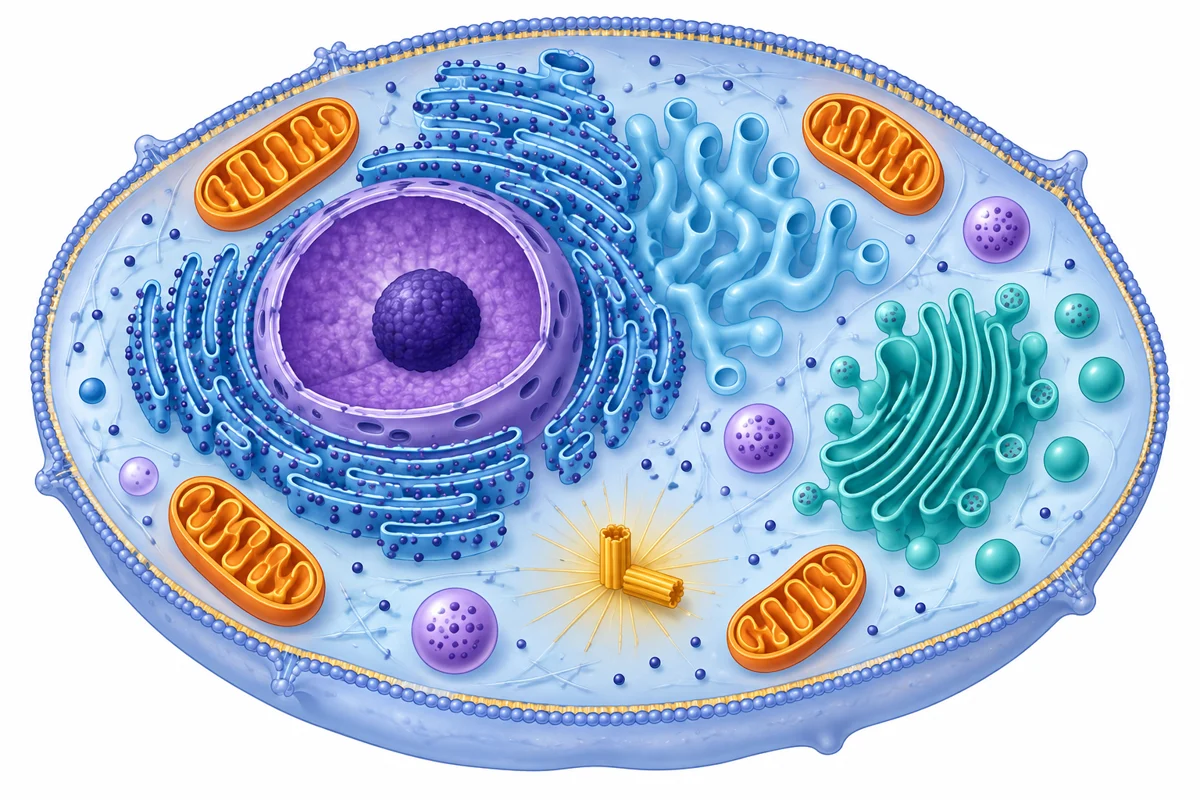
Mitochondria produce ATP, ribosomes build proteins, the nucleus holds DNA, and the Golgi packages material for transport. Prokaryotes have no nucleus or membrane-bound organelles; eukaryotes have both. Plant cells add a cell wall and chloroplasts, which animal cells lack.
The organelles and what they do
Most questions in this topic are a direct match between a structure and its job.
| Organelle | Function | Memory hook |
|---|---|---|
| Nucleus | Holds DNA and directs cell activity | The control centre |
| Mitochondria | Produce ATP by cellular respiration | The powerhouse |
| Ribosomes | Build proteins from amino acids | The assembly line |
| Rough ER | Studded with ribosomes; transports newly made proteins | The corridor with workbenches |
| Smooth ER | Makes lipids and detoxifies | The corridor without them |
| Golgi apparatus | Modifies, packages and ships proteins | The postal room |
| Lysosome | Digests waste and worn-out components | The recycling unit |
| Cell membrane | Controls what enters and leaves | The gatekeeper |
| Cytoplasm | The fluid holding the organelles | The workspace |
| Vacuole | Storage; very large in plant cells | The store cupboard |
Prokaryotic and eukaryotic cells
| Prokaryotic | Eukaryotic | |
|---|---|---|
| Nucleus | No — DNA floats free in the cytoplasm | Yes |
| Membrane-bound organelles | No | Yes |
| Size | Smaller | Larger |
| Examples | Bacteria | Animals, plants, fungi, protists |
Prokaryotes still have ribosomes. Ribosomes are not membrane-bound, so "no membrane-bound organelles" does not exclude them — every cell needs to build proteins. This is a favourite trap.
Plant against animal cells
- Both have a nucleus, mitochondria, ribosomes, ER, Golgi and a cell membrane.
- Only plants have a rigid cell wall outside the membrane, chloroplasts for photosynthesis, and one large central vacuole.
- Only animals have small lysosomes in quantity, and centrioles used in cell division.
- A plant cell keeps its shape because of the wall; an animal cell has no such support.
Levels of organisation
The exam asks where a given structure sits in this hierarchy.
- Cell
- Tissue
- Organ
- Organ system
- Organism
Predicting from organelle counts
Worked example
Heart muscle cells contain far more mitochondria than skin cells. What does that tell you?
- Identify what mitochondria do: produce ATP.
- Ask what ATP is for: any energy-requiring process, especially contraction.
- Heart muscle contracts continuously, without rest, for a lifetime.
- So its energy demand is far higher than that of a barrier tissue.
That cardiac muscle has a much higher energy demand. Organelle counts follow function, which is why this reasoning works in either direction — high mitochondria implies high energy use, and vice versa.
Terms to know
- Organelle
- A specialised structure inside a cell with a specific job.
- Prokaryote
- A cell with no nucleus or membrane-bound organelles, such as a bacterium.
- Eukaryote
- A cell with a nucleus and membrane-bound organelles.
- Cytoplasm
- The fluid inside a cell that holds the organelles.
- ATP
- The molecule cells use as their immediate energy currency.
- Chloroplast
- The plant organelle that carries out photosynthesis.
- Cell wall
- A rigid layer outside the membrane of plant and bacterial cells.
- Tissue
- A group of similar cells performing a shared function.
- Organ
- Several tissues working together for a function.
What the TEAS asks most
The same core ideas appear in different wording. If you can answer these without stopping to think, you have what this section requires.
Which organelle performs this function?
Learn the table — most questions here are direct matches.
What distinguishes a prokaryotic from a eukaryotic cell?
No nucleus and no membrane-bound organelles. Ribosomes are still present.
Which structure is found in plant cells but not animal cells?
Cell wall, chloroplasts, and a large central vacuole.
Which level of organisation is this?
Cell, tissue, organ, organ system, organism — in that order.
Key points
- Nucleus stores DNA, mitochondria make ATP, ribosomes build proteins, Golgi packages them.
- Prokaryotes lack a nucleus and membrane-bound organelles but still have ribosomes.
- Plant cells add a cell wall, chloroplasts and a large central vacuole.
- Organelle abundance follows the cell's function.
- Organisation runs cell → tissue → organ → organ system → organism.
Review quiz
4 questions on this topic, each with the reasoning worked through. Pick an answer to see how it went, or open the explanation straight away.
-
Question 1 of 4
Which organelle is responsible for producing ATP?
Show the answer and explanation
Correct answer: B. The mitochondrion
Mitochondria carry out cellular respiration, converting glucose and oxygen into ATP. Ribosomes build proteins, the Golgi packages them for transport, and lysosomes break down waste — all of them consumers of ATP rather than producers.
-
Question 2 of 4
Which of the following is true of a prokaryotic cell?
Show the answer and explanation
Correct answer: B. It has no nucleus and no membrane-bound organelles, but does have ribosomes.
A prokaryote's DNA floats free in the cytoplasm and it has no membrane-bound compartments — but ribosomes are not membrane-bound, so bacteria have them and make proteins. Prokaryotes are also typically smaller, not larger.
-
Question 3 of 4
Which structure is found in plant cells but not in animal cells?
Show the answer and explanation
Correct answer: C. Chloroplast
Chloroplasts carry out photosynthesis and exist only in plant cells, along with the cell wall and a large central vacuole. Mitochondria, the cell membrane and the nucleus are common to both — plants respire as well as photosynthesise.
-
Question 4 of 4
A group of similar cells working together to perform a function is called
Show the answer and explanation
Correct answer: B. a tissue.
A tissue is the level immediately above the cell. An organ is several tissues combined, an organ system is several organs, and an organelle is a structure inside a single cell — one level below where the question is pointing.
Put this TEAS topic into practice
Build a set on cell structure, function and organization and use the rationale on every question to reinforce what you just reviewed.
Keep reading
More TEAS Resources
Guides and tools across the TEAS course.
TEAS 7 Exam Prep
Format, sections, timing
TEAS 7 FAQ
Scoring, retakes, test day
Is the TEAS Hard?
An honest answer
How Long Is the TEAS 7?
209 minutes, section by section
What Is a Passing TEAS Score?
Your programme sets the bar
TEAS Reading
18 topics · 39 scored questions
TEAS Math
18 topics · 34 scored questions
TEAS Science
22 topics · 44 scored questions
TEAS English
21 topics · 33 scored questions
Free TEAS Practice Test
Sit a set before you buy
TEAS Plans & Pricing
Choose your access
Start TEAS Prep
Create your account
TEAS Study Guide
All four sections, free
8-Week Study Plan
Week-by-week schedule
TEAS Cheat Sheet
Formulas and high-yield facts
TEAS vs HESI A2
Which exam to take