
Free ATI TEAS 7 Science guide
October 2026 - Urinary System Study Guide for nursing students in
The kidneys filter blood, balance fluid and electrolytes, and produce urine that passes through the ureters to the bladder and out via the urethra. The nephron is the functional unit, and knowing its three stages answers most questions in this topic.
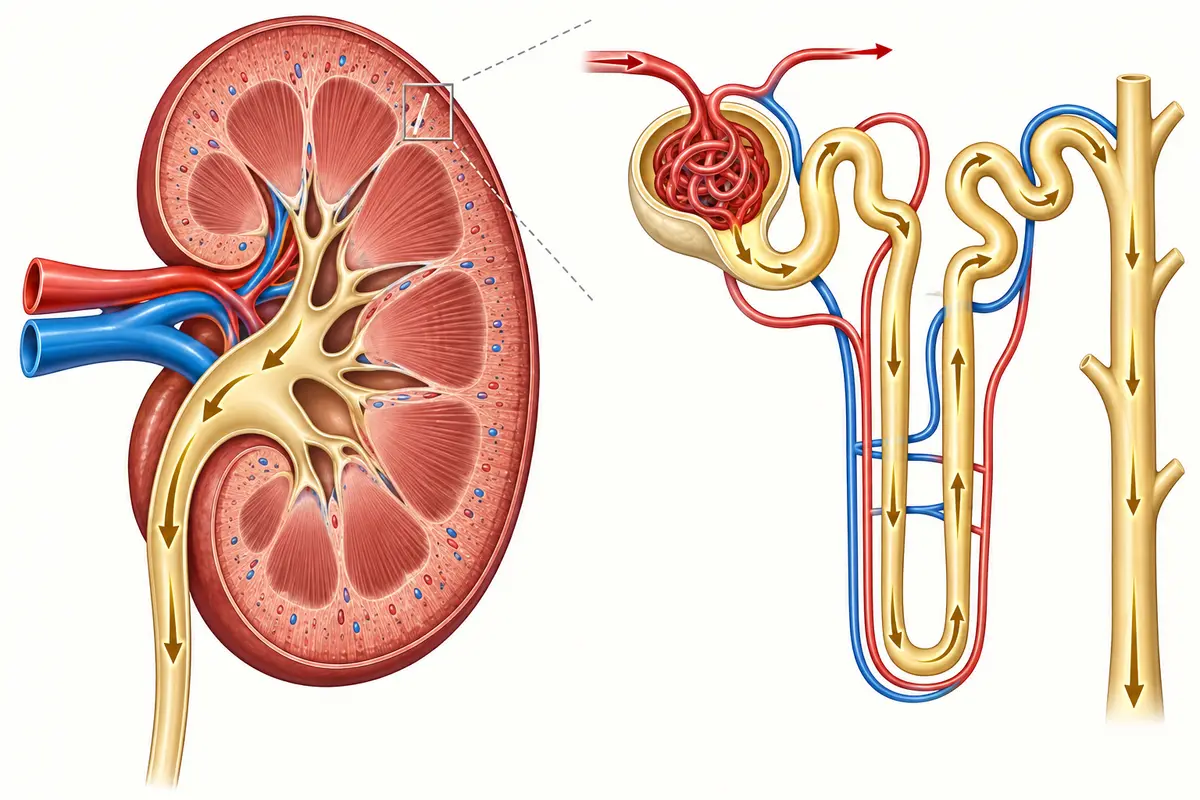
The path of urine
Two of everything until the urethra: two kidneys, two ureters, one bladder, one urethra.
- Kidney
- Ureter
- Bladder
- Urethra
- Out
Ureter and urethra are the pair students mix up. The ureters are the two tubes from the kidneys to the bladder; the urethra is the single tube from the bladder to the outside. If there are two of them, it is ureters.
What the kidneys do
More than making urine. Several of these are what the exam actually asks about.
- Filter waste — urea from protein breakdown, along with excess salts and drugs.
- Balance fluid — deciding how much water to keep and how much to release.
- Balance electrolytes — sodium, potassium and others, within narrow limits.
- Regulate blood pH — by adjusting how much acid is excreted.
- Influence blood pressure — through fluid volume and hormonal signalling.
- Stimulate red blood cell production — by releasing erythropoietin.
The nephron, in three stages
Each kidney holds around a million of these. The sequence is the point.
| Stage | Where | What happens |
|---|---|---|
| Filtration | Glomerulus | Pressure forces water, salts, glucose and waste out of the blood. Cells and large proteins stay behind |
| Reabsorption | Tubule | Almost all water and all useful substances — glucose, amino acids, most sodium — are taken back into the blood |
| Secretion | Tubule | Additional waste and excess ions are added from the blood into the filtrate |
Why filtration is not selective but the result is
The glomerulus filters by size and pressure alone. It cannot tell glucose from urea, so useful substances leave the blood alongside waste. Selectivity comes at the next stage: reabsorption takes back what the body needs, and what remains becomes urine.
That two-step design explains a common clinical observation. Glucose is normally reabsorbed completely, so finding glucose in urine means the amount filtered has exceeded what the tubule can reclaim.
Reasoning about fluid balance
Worked example
A person has drunk very little all day. What happens to their urine, and what drives the change?
- Low fluid intake concentrates the blood.
- The body responds by releasing antidiuretic hormone (ADH).
- ADH makes the kidney tubules more permeable to water, so more water is reabsorbed.
- Less water leaves in the urine.
Urine becomes smaller in volume and darker, because ADH has increased water reabsorption. The concentration of urine is a direct readout of the body's fluid state.
Terms to know
- Nephron
- The functional unit of the kidney, where filtration, reabsorption and secretion happen.
- Glomerulus
- The capillary cluster where blood is filtered.
- Filtration
- Forcing water and small solutes out of the blood into the nephron.
- Reabsorption
- Returning water and useful substances from the filtrate to the blood.
- Secretion
- Adding further waste from the blood into the filtrate.
- Ureter
- One of the two tubes from the kidneys to the bladder.
- Urethra
- The single tube from the bladder to the outside.
- Urea
- The nitrogen waste produced from protein breakdown.
- ADH
- Antidiuretic hormone, which increases water reabsorption and concentrates urine.
- Electrolyte
- A dissolved ion such as sodium or potassium, kept within narrow limits.
What the TEAS asks most
The same core ideas appear in different wording. If you can answer these without stopping to think, you have what this section requires.
What is the functional unit of the kidney?
The nephron.
Where does filtration take place?
In the glomerulus, driven by blood pressure.
Which tube carries urine from the kidney to the bladder?
The ureter. The urethra carries it out of the body.
Why does urine become darker when fluid intake is low?
ADH increases water reabsorption, so the same waste leaves in less water.
Key points
- Kidney, ureter, bladder, urethra — two ureters, one urethra.
- The nephron is the functional unit; each kidney holds about a million.
- Filtration, reabsorption, secretion — in that order.
- Filtration is non-selective; reabsorption is what makes the outcome selective.
- Kidneys also regulate pH, blood pressure and red blood cell production.
Review quiz
4 questions on this topic, each with the reasoning worked through. Pick an answer to see how it went, or open the explanation straight away.
-
Question 1 of 4
Which structure carries urine from a kidney to the bladder?
Show the answer and explanation
Correct answer: B. The ureter
The ureters are the two tubes running from the kidneys down to the bladder; the urethra is the single tube from the bladder to the outside. The nephron is a microscopic unit within the kidney, and the renal artery brings blood in rather than carrying urine out.
-
Question 2 of 4
Where in the nephron does filtration of the blood occur?
Show the answer and explanation
Correct answer: A. The glomerulus
Blood pressure in the glomerular capillaries forces water and small solutes out of the blood and into the nephron. The collecting duct handles final water adjustment, and the bladder and ureter simply store and transport what the kidney has already produced.
-
Question 3 of 4
Glucose is filtered out of the blood at the glomerulus but is not normally present in urine. Why?
Show the answer and explanation
Correct answer: B. Glucose is reabsorbed from the filtrate back into the blood.
Filtration works by size and pressure and cannot distinguish useful substances from waste, so glucose does leave the blood — and is then reclaimed during reabsorption. Nothing is broken down in the nephron, and the bladder only stores urine.
-
Question 4 of 4
A patient who has drunk very little produces a small volume of dark urine. Which hormone is responsible?
Show the answer and explanation
Correct answer: B. Antidiuretic hormone
ADH makes the tubules more permeable to water, so more is reabsorbed and the urine leaving is concentrated. Insulin and glucagon regulate blood glucose, and adrenaline drives the fight-or-flight response rather than water balance.
Put this TEAS topic into practice
Build a set on urinary system and use the rationale on every question to reinforce what you just reviewed.
Keep reading
More TEAS Resources
Guides and tools across the TEAS course.
TEAS 7 Exam Prep
Format, sections, timing
TEAS 7 FAQ
Scoring, retakes, test day
Is the TEAS Hard?
An honest answer
How Long Is the TEAS 7?
209 minutes, section by section
What Is a Passing TEAS Score?
Your programme sets the bar
TEAS Reading
18 topics · 39 scored questions
TEAS Math
18 topics · 34 scored questions
TEAS Science
22 topics · 44 scored questions
TEAS English
21 topics · 33 scored questions
Free TEAS Practice Test
Sit a set before you buy
TEAS Plans & Pricing
Choose your access
Start TEAS Prep
Create your account
TEAS Study Guide
All four sections, free
8-Week Study Plan
Week-by-week schedule
TEAS Cheat Sheet
Formulas and high-yield facts
TEAS vs HESI A2
Which exam to take