
Free ATI TEAS 7 Science guide
October 2026 - Lymphatic & Immune System Study Guide for nursing students in
The lymphatic system returns fluid to the bloodstream and filters it through lymph nodes on the way. Immunity comes in two forms: innate defences that are fast and non-specific, and adaptive responses that are slower, targeted, and remembered.
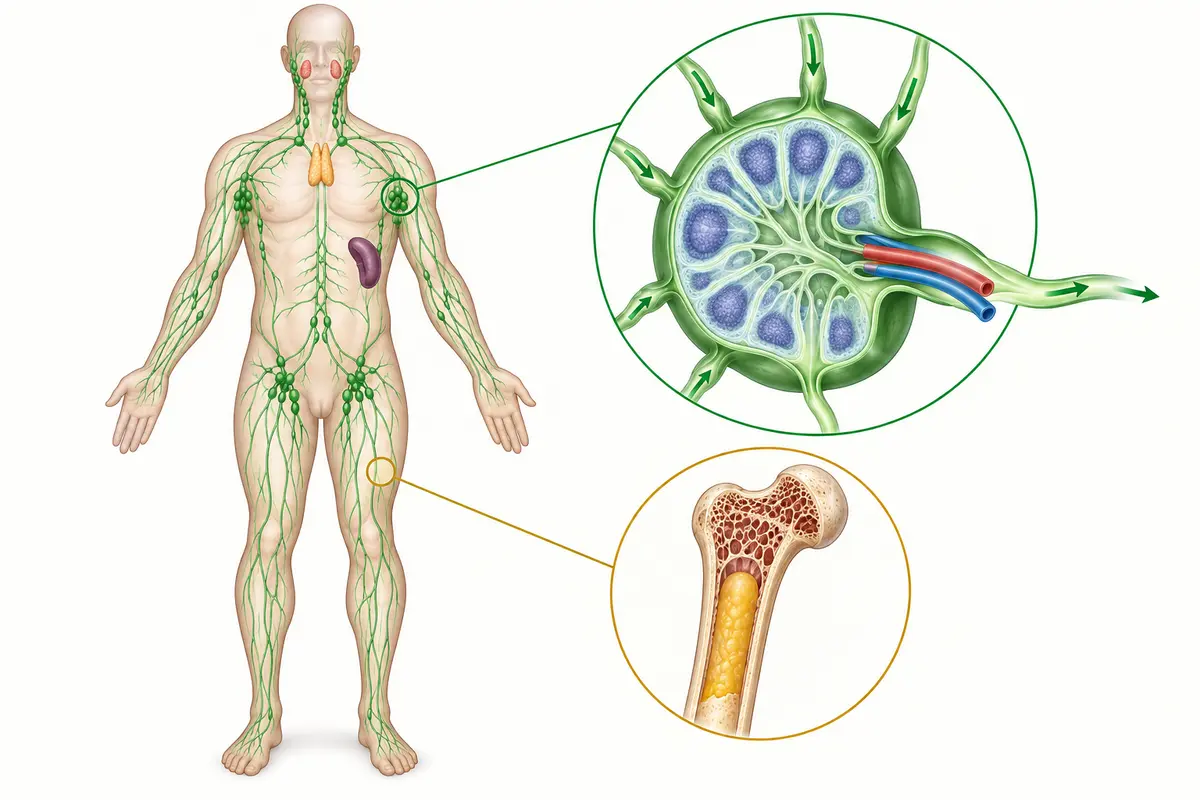
What the lymphatic system does
Three jobs, and only one of them is obviously about immunity.
- Fluid balance — fluid leaks constantly from capillaries into tissue. Lymphatic vessels collect it and return it to the bloodstream. Blocked drainage causes swelling.
- Immune surveillance — lymph passes through lymph nodes, where immune cells encounter anything the fluid has picked up. Nodes swell during infection because cells are multiplying inside them.
- Fat absorption — lymphatic vessels in the villi of the small intestine take up digested fats, which is why fats bypass the direct route into the blood.
Innate and adaptive immunity
| Innate | Adaptive | |
|---|---|---|
| Specific? | No — the same response to anything | Yes — targeted to one pathogen |
| Speed | Immediate | Days on first exposure |
| Memory | None | Yes — faster and stronger next time |
| Includes | Skin, mucus, stomach acid, inflammation, fever, phagocytes | B cells and antibodies, T cells |
How the adaptive response works
An antigen is anything the immune system recognises as foreign — usually a protein on the surface of a pathogen. B cells produce antibodies that bind to one specific antigen, marking the pathogen for destruction or neutralising it directly. T cells destroy infected cells and coordinate the wider response.
Memory is what makes the system worth having. After an infection clears, memory cells remain, so a second exposure produces a response fast enough that illness never develops. That is the mechanism vaccination exploits — an antigen without the disease, producing memory without the illness.
Active and passive immunity
Two axes: whether your own body made the antibodies, and whether exposure was natural.
| Type | How acquired | Lasting? |
|---|---|---|
| Active, natural | Catching the disease and recovering | Long — memory cells form |
| Active, artificial | Vaccination | Long — memory cells form |
| Passive, natural | Antibodies across the placenta or in breast milk | Weeks to months |
| Passive, artificial | An injection of ready-made antibodies | Short |
Passive immunity gives protection without memory. Ready-made antibodies work immediately and then degrade, leaving nothing behind — which is why it is used when there is no time to wait for an immune response, and why it has to be repeated.
Reasoning about a swollen lymph node
Worked example
A patient with a throat infection has swollen, tender nodes in the neck. What does this indicate?
- Lymph from the throat drains through the nodes in the neck.
- Nodes are where immune cells meet antigens carried in the lymph.
- Encountering an antigen makes those cells multiply rapidly.
- More cells in a confined structure means the node enlarges.
It indicates an active immune response to the throat infection: immune cells are proliferating in the nodes that drain the infected area. The swelling is the response working, not the infection spreading.
Terms to know
- Lymph
- Fluid collected from tissues and returned to the bloodstream.
- Lymph node
- A small filtering structure where immune cells encounter antigens.
- Antigen
- A molecule the immune system recognises as foreign.
- Antibody
- A protein made by B cells that binds one specific antigen.
- B cell
- A lymphocyte that produces antibodies.
- T cell
- A lymphocyte that destroys infected cells and coordinates the response.
- Phagocyte
- A cell that engulfs and digests pathogens. Part of innate immunity.
- Memory cell
- A long-lived cell that enables a fast response on re-exposure.
- Active immunity
- Protection from antibodies your own body produced.
- Passive immunity
- Protection from antibodies made elsewhere. Immediate but temporary.
What the TEAS asks most
The same core ideas appear in different wording. If you can answer these without stopping to think, you have what this section requires.
Which is an example of innate immunity?
Anything non-specific and immediate: skin, mucus, stomach acid, inflammation, fever, phagocytes.
Why does a second exposure cause no illness?
Memory cells from the first exposure produce a faster, stronger response.
How does a vaccine work?
It presents an antigen without the disease, producing memory cells and so active artificial immunity.
What is the difference between active and passive immunity?
Active means your own body made the antibodies and left memory behind. Passive means they were made elsewhere and will fade.
Key points
- The lymphatic system returns tissue fluid, filters it through nodes, and absorbs dietary fat.
- Innate immunity is immediate and non-specific; adaptive immunity is targeted and remembered.
- Antibodies come from B cells and bind one specific antigen.
- Vaccination produces active artificial immunity by creating memory without illness.
- Passive immunity is immediate, borrowed and temporary.
Review quiz
4 questions on this topic, each with the reasoning worked through. Pick an answer to see how it went, or open the explanation straight away.
-
Question 1 of 4
Which of the following is part of innate rather than adaptive immunity?
Show the answer and explanation
Correct answer: B. Stomach acid destroying swallowed bacteria
Stomach acid is a barrier that acts on anything swallowed, without recognising what it is — non-specific and immediate, which is the definition of innate. The other three are all targeted to a particular pathogen, which places them in the adaptive arm.
-
Question 2 of 4
Why does a person usually not become ill on a second exposure to the same virus?
Show the answer and explanation
Correct answer: B. Memory cells produce a faster and stronger response than the first time.
Memory cells left from the first infection allow the adaptive response to act before the infection can establish itself. The virus is unchanged, innate immunity does not learn, and receptors are not lost after an infection.
-
Question 3 of 4
An infant receives antibodies through breast milk. What kind of immunity is this?
Show the answer and explanation
Correct answer: C. Passive natural
The antibodies were made by the mother rather than the infant, which makes it passive, and the route is a natural one. It gives immediate protection and then fades, because no memory cells form in the infant.
-
Question 4 of 4
Why do lymph nodes swell during an infection?
Show the answer and explanation
Correct answer: B. Immune cells multiply rapidly inside them in response to antigens.
Nodes are where immune cells meet antigens carried in the lymph, and encountering one triggers rapid proliferation, which enlarges the node. The swelling is the response working rather than a blockage, a drainage failure or bleeding.
Put this TEAS topic into practice
Build a set on lymphatic and immune system and use the rationale on every question to reinforce what you just reviewed.
Keep reading
More TEAS Resources
Guides and tools across the TEAS course.
TEAS 7 Exam Prep
Format, sections, timing
TEAS 7 FAQ
Scoring, retakes, test day
Is the TEAS Hard?
An honest answer
How Long Is the TEAS 7?
209 minutes, section by section
What Is a Passing TEAS Score?
Your programme sets the bar
TEAS Reading
18 topics · 39 scored questions
TEAS Math
18 topics · 34 scored questions
TEAS Science
22 topics · 44 scored questions
TEAS English
21 topics · 33 scored questions
Free TEAS Practice Test
Sit a set before you buy
TEAS Plans & Pricing
Choose your access
Start TEAS Prep
Create your account
TEAS Study Guide
All four sections, free
8-Week Study Plan
Week-by-week schedule
TEAS Cheat Sheet
Formulas and high-yield facts
TEAS vs HESI A2
Which exam to take