
Free ATI TEAS 7 Science guide
October 2026 - Endocrine System Study Guide for nursing students in
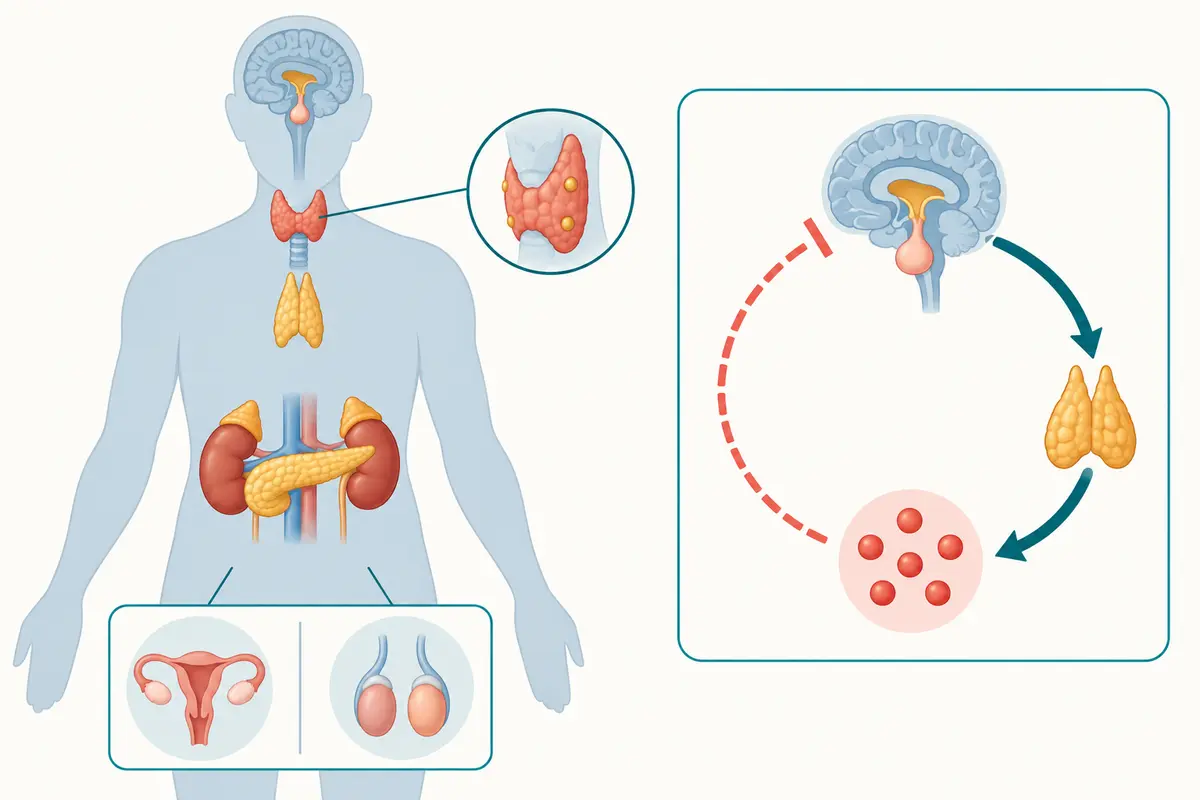
Glands release hormones into the bloodstream to act on distant targets, which makes endocrine signalling slower and longer-lasting than nervous signalling. The pituitary directs several other glands, and insulin and glucagon appear more often than any other pair.
Endocrine against nervous signalling
Both are control systems. The exam asks how they differ.
| Nervous | Endocrine | |
|---|---|---|
| Message carried by | Electrical impulse and neurotransmitter | Hormone in the blood |
| Speed | Milliseconds | Seconds to hours |
| Duration | Brief | Prolonged |
| Target | A specific muscle or gland | Any cell with the matching receptor |
The glands worth knowing
| Gland | Hormone | Effect |
|---|---|---|
| Pituitary | Growth hormone, and hormones directing other glands | Growth; control of thyroid, adrenals and gonads |
| Thyroid | Thyroxine | Sets metabolic rate |
| Parathyroid | Parathyroid hormone | Raises blood calcium |
| Adrenal | Adrenaline; cortisol | Fight or flight; stress response |
| Pancreas | Insulin; glucagon | Lowers and raises blood glucose |
| Ovaries | Oestrogen, progesterone | Female reproductive cycle |
| Testes | Testosterone | Male reproductive function |
Insulin lowers blood glucose and glucagon raises it. That pair appears more than any other item in this topic. Insulin moves glucose out of the blood and into cells; glucagon prompts the liver to release stored glucose back into it.
Negative feedback
Most hormone systems are self-correcting: the result of a hormone's action switches off the signal that produced it. Blood glucose rises after a meal, insulin is released, glucose enters cells, blood glucose falls, and insulin release slows. Nothing has to monitor the system from outside.
Thyroxine works the same way through the pituitary: low thyroxine prompts the pituitary to stimulate the thyroid, and rising thyroxine suppresses that stimulation. Recognising the loop is usually enough to answer a question about what happens when one part of it fails.
Predicting from a feedback loop
Worked example
A patient's pancreas produces very little insulin. What happens to blood glucose after a meal, and why?
- A meal raises blood glucose, as it would in anyone.
- Insulin is the signal that moves glucose from the blood into cells.
- Without insulin, that transfer largely fails.
- So glucose accumulates in the blood rather than entering cells.
Blood glucose stays high, and cells go short of fuel despite the glucose being present. The problem is not the amount of glucose but the missing signal that lets cells take it up.
Two more distinctions worth holding
- Endocrine glands release into the bloodstream. Exocrine glands release through ducts to a surface — sweat, saliva, digestive enzymes.
- The pancreas is both: endocrine for insulin and glucagon, exocrine for digestive enzymes.
- The hypothalamus is the bridge between the two control systems, directing the pituitary and so linking nervous input to hormonal output.
- A hormone only affects cells carrying the right receptor, which is why a substance travelling everywhere in the blood has specific effects.
Terms to know
- Hormone
- A chemical messenger released into the blood to act on distant cells.
- Endocrine gland
- A ductless gland releasing hormones into the bloodstream.
- Exocrine gland
- A gland releasing its product through a duct onto a surface.
- Target cell
- A cell with receptors for a particular hormone.
- Negative feedback
- A loop in which a hormone's effect reduces the signal that produced it.
- Insulin
- The pancreatic hormone that lowers blood glucose.
- Glucagon
- The pancreatic hormone that raises blood glucose.
- Thyroxine
- The thyroid hormone that sets metabolic rate.
- Homeostasis
- The maintenance of stable internal conditions.
What the TEAS asks most
The same core ideas appear in different wording. If you can answer these without stopping to think, you have what this section requires.
Which gland produces this hormone?
Learn the table. Pancreas for insulin and glucagon, thyroid for thyroxine, adrenal for adrenaline.
What does insulin do?
Lowers blood glucose by moving it from the blood into cells. Glucagon does the reverse.
How does the endocrine system differ from the nervous system?
Slower to act, longer to last, carried in blood rather than along nerves.
What is negative feedback?
A loop where the outcome of a hormone's action switches off the signal that released it.
Key points
- Hormones travel in the blood and act only on cells with matching receptors.
- Endocrine signalling is slower and longer-lasting than nervous signalling.
- Insulin lowers blood glucose; glucagon raises it. Both come from the pancreas.
- The pituitary directs several other glands; the hypothalamus links nervous and endocrine control.
- Negative feedback keeps hormone levels stable without outside monitoring.
Review quiz
4 questions on this topic, each with the reasoning worked through. Pick an answer to see how it went, or open the explanation straight away.
-
Question 1 of 4
Which hormone lowers blood glucose, and which gland produces it?
Show the answer and explanation
Correct answer: B. Insulin, from the pancreas
Insulin comes from the pancreas and moves glucose out of the blood and into cells. Glucagon is its opposite number from the same gland, the liver stores and releases glucose rather than producing insulin, and adrenaline raises blood glucose during stress.
-
Question 2 of 4
Which statement best describes how endocrine signalling differs from nervous signalling?
Show the answer and explanation
Correct answer: B. It is slower to take effect but its effects last longer.
Hormones travel in the bloodstream, which takes time, and they persist until cleared — so endocrine effects are slower in onset and longer in duration. Nerve signals are the fast, brief system, and a hormone reaches every cell carrying the right receptor rather than a single target.
-
Question 3 of 4
Blood glucose rises after a meal, insulin is released, glucose enters cells, and insulin release then slows. What is this an example of?
Show the answer and explanation
Correct answer: B. Negative feedback
The outcome of the hormone's action — falling blood glucose — switches off the signal that released it, which is the definition of negative feedback. Positive feedback would amplify the change instead, exocrine secretion goes through ducts, and a reflex arc is a nervous pathway.
-
Question 4 of 4
Why is the pancreas described as both an endocrine and an exocrine gland?
Show the answer and explanation
Correct answer: A. It releases hormones into the blood and digestive enzymes through a duct.
Insulin and glucagon go straight into the bloodstream, making it endocrine, while digestive enzymes travel down a duct to the small intestine, making it exocrine. Producing two opposing hormones is true but does not bear on the distinction, which is about the route of release.
Put this TEAS topic into practice
Build a set on endocrine system and use the rationale on every question to reinforce what you just reviewed.
Keep reading
More TEAS Resources
Guides and tools across the TEAS course.
TEAS 7 Exam Prep
Format, sections, timing
TEAS 7 FAQ
Scoring, retakes, test day
Is the TEAS Hard?
An honest answer
How Long Is the TEAS 7?
209 minutes, section by section
What Is a Passing TEAS Score?
Your programme sets the bar
TEAS Reading
18 topics · 39 scored questions
TEAS Math
18 topics · 34 scored questions
TEAS Science
22 topics · 44 scored questions
TEAS English
21 topics · 33 scored questions
Free TEAS Practice Test
Sit a set before you buy
TEAS Plans & Pricing
Choose your access
Start TEAS Prep
Create your account
TEAS Study Guide
All four sections, free
8-Week Study Plan
Week-by-week schedule
TEAS Cheat Sheet
Formulas and high-yield facts
TEAS vs HESI A2
Which exam to take