
Free ATI TEAS 7 Mathematics guide
October 2026 - Dependent & Independent Variables Study Guide for nursing students in
The independent variable is the one that is changed or controlled. The dependent variable is the one measured in response. Say it as "the dependent variable depends on the independent one" and the pair becomes hard to mix up — and on a graph, the independent variable goes on the x-axis.
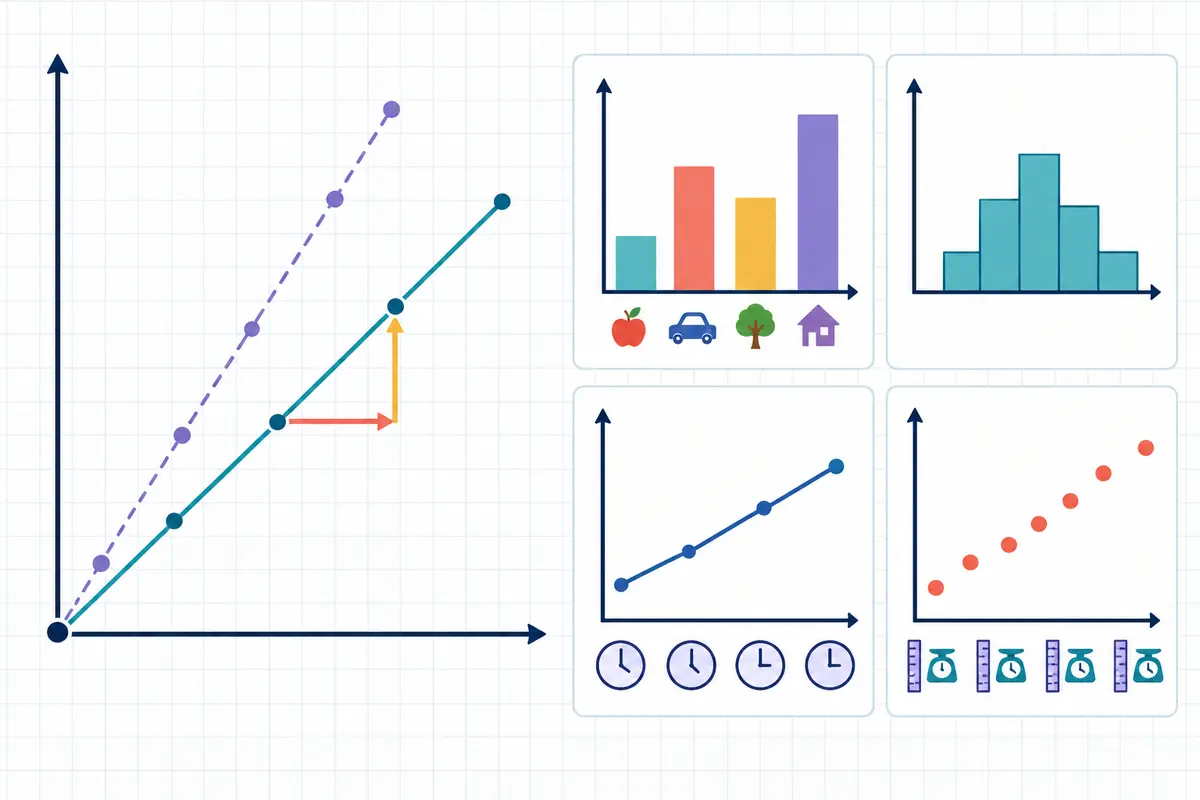
Which is which
| Role | Also called | Where it goes | |
|---|---|---|---|
| Independent | Changed, chosen or controlled | Input, cause, x | The x-axis, the left column of a table |
| Dependent | Measured in response | Output, effect, y | The y-axis, the right column |
Three ways to identify them
Any of these will settle it, and they agree.
- The sentence test — "X depends on Y" makes X dependent and Y independent.
- The control test — the variable you could set in advance is independent. Time is almost always independent, because you cannot make it respond to anything.
- The function test — in
y = 4x + 10, whatever you substitute for is independent. You choosex;ycomes out.
Naming variables in a word problem
Worked example
A study measures how the number of hours a student spends on practice questions affects their score on a mock exam. Identify each variable and describe the graph.
- Ask what was set and what was measured: hours were varied, the score was measured afterwards.
- So hours are independent and the score is dependent.
- Apply the sentence test as a check: the score depends on the hours, not the reverse.
- Graph: hours on the x-axis, score on the y-axis.
Independent: hours of practice, on the x-axis. Dependent: mock exam score, on the y-axis.
A relationship on a graph does not establish which variable causes which — but it does tell you which the researcher treated as the input. The axes record the design of the study, not the direction of causation.
Reading a function as a rule
In y = 4x + 10, the 4 is the rate — how much y changes for each unit of x — and the 10 is where y starts when x is zero. Given a word problem, the fixed amount is the constant and the per-unit amount is the coefficient.
A call-out charge of £10 plus £4 for every mile is exactly this function. The number of miles is independent, the total cost is dependent, and the question of what happens at zero miles is answered by the constant.
Terms to know
- Independent variable
- The variable that is changed or controlled — the input.
- Dependent variable
- The variable measured in response — the output.
- Controlled variable
- A factor deliberately held constant so it cannot affect the result.
- Function
- A rule assigning exactly one output to each input.
- Input
- A value substituted for the independent variable.
- Output
- The value the function returns.
What the TEAS asks most
The same core ideas appear in different wording. If you can answer these without stopping to think, you have what this section requires.
Which is the independent variable in this study?
The one that was set or varied deliberately. Time is independent by default.
Which axis should each variable be plotted on?
Independent on x, dependent on y.
In y = 6x + 20, what does the 6 represent?
The rate of change: how much y increases for each unit increase in x.
What is the value of y when x is 0?
The constant. In a word problem it is the fixed charge or the starting amount.
Key points
- The dependent variable depends on the independent one.
- Independent goes on the x-axis, dependent on the y-axis.
- The variable you can set in advance is independent; time nearly always is.
- In
y = mx + c, x is independent, y is dependent, m is the rate and c is the starting value. - Which variable sits on which axis reflects the study design, not proof of cause.
Review quiz
4 questions on this topic, each with the reasoning worked through. Pick an answer to see how it went, or open the explanation straight away.
-
Question 1 of 4
A researcher records a patient's heart rate at five different exercise intensities. Which is the dependent variable?
Show the answer and explanation
Correct answer: B. Heart rate
Intensity was set by the researcher and heart rate was measured in response, so heart rate depends on intensity. The patient is the subject rather than a variable, and the number of measurements is a feature of the design.
-
Question 2 of 4
A graph plots a clinic's waiting time against the month of the year. Which variable belongs on the x-axis?
Show the answer and explanation
Correct answer: B. The month
The month is independent, since time cannot respond to waiting times, and the independent variable always goes on the x-axis. Convention here is not decorative: swapping the axes misrepresents which variable is the input.
-
Question 3 of 4
A hire company charges £25 plus £12 per day. Written as
y = 12x + 25, what does x represent?Show the answer and explanation
Correct answer: B. The number of days, which is the independent variable
You choose how many days to hire for, and the total follows, so days are the independent variable represented by x. The total is y, the fixed £25 is the constant, and the £12 daily rate is the coefficient.
-
Question 4 of 4
In the equation
y = 8x + 40, what is the value of y when x is 0?Show the answer and explanation
Correct answer: C. 40
Substituting zero removes the
8xterm entirely and leaves the constant, 40. In a word problem this is the starting amount or fixed charge — the figure that applies before any units are counted. 48 comes from adding the coefficient to the constant.
Put this TEAS topic into practice
Build a set on dependent and independent variables and use the rationale on every question to reinforce what you just reviewed.
Keep reading
More TEAS Resources
Guides and tools across the TEAS course.
TEAS 7 Exam Prep
Format, sections, timing
TEAS 7 FAQ
Scoring, retakes, test day
Is the TEAS Hard?
An honest answer
How Long Is the TEAS 7?
209 minutes, section by section
What Is a Passing TEAS Score?
Your programme sets the bar
TEAS Reading
18 topics · 39 scored questions
TEAS Math
18 topics · 34 scored questions
TEAS Science
22 topics · 44 scored questions
TEAS English
21 topics · 33 scored questions
Free TEAS Practice Test
Sit a set before you buy
TEAS Plans & Pricing
Choose your access
Start TEAS Prep
Create your account
TEAS Study Guide
All four sections, free
8-Week Study Plan
Week-by-week schedule
TEAS Cheat Sheet
Formulas and high-yield facts
TEAS vs HESI A2
Which exam to take