
Free ATI TEAS 7 Mathematics guide
October 2026 - Application of Slope Study Guide for nursing students in
Slope is rise over run: the change in y divided by the change in x. In a word problem it is always a rate — cost per item, distance per hour, dose per kilogram — and reading it as a rate is what turns an abstract formula into an answerable question.
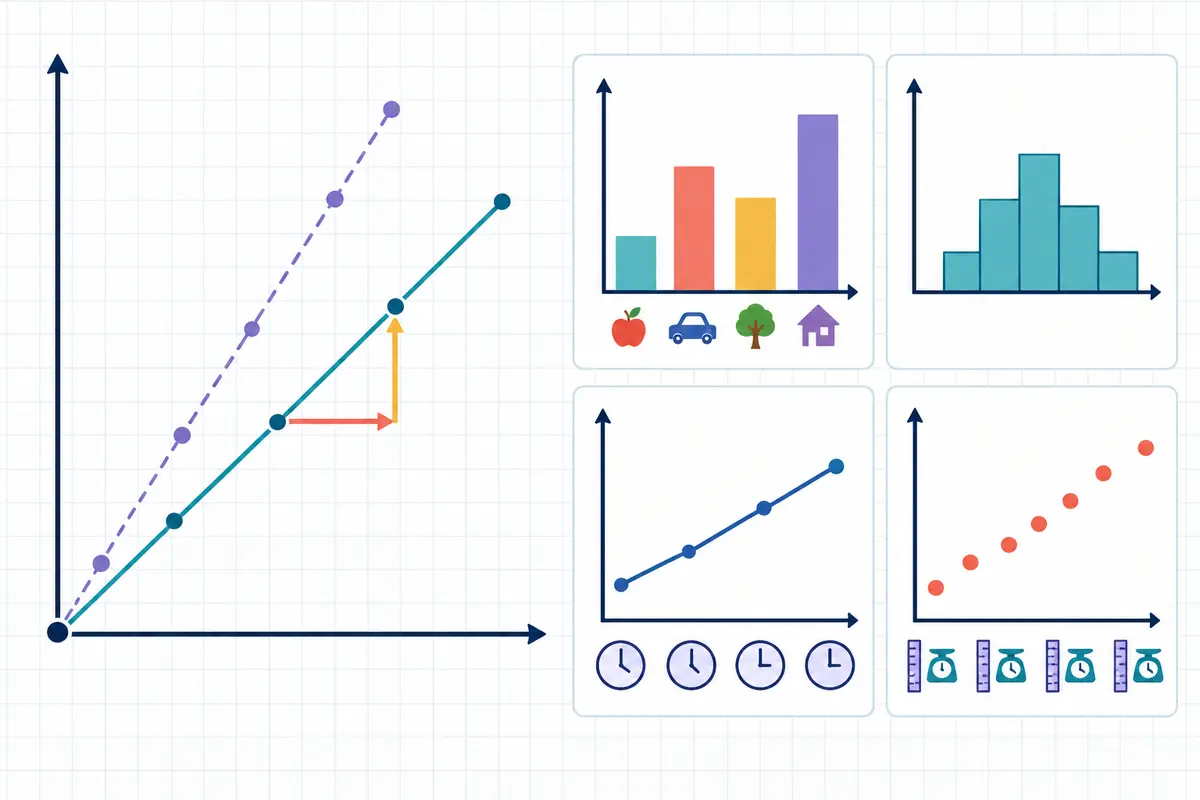
The formula and what it means
Between two points, slope is (y₂ - y₁) / (x₂ - x₁). The order of the points does not matter as long as you keep it consistent: subtract the y-values in the same order as the x-values, or the sign comes out wrong.
Read it aloud as "for every one step across, how far up or down". A slope of 4 means y climbs 4 for each 1 that x advances. A slope of 1/3 means y climbs 1 for every 3 across.
Four kinds of slope
| Slope | Looks like | Means |
|---|---|---|
| Positive | Rises left to right | y increases as x increases |
| Negative | Falls left to right | y decreases as x increases |
| Zero | A horizontal line | y never changes — no relationship |
| Undefined | A vertical line | x never changes; division by zero |
Slope from two points
Worked example
Find the slope of the line through (2, 5) and (6, 17).
- Label them:
x₁ = 2,y₁ = 5,x₂ = 6,y₂ = 17. - Rise:
17 - 5 = 12. - Run:
6 - 2 = 4. - Divide:
12 ÷ 4 = 3.
The slope is 3 — y rises by 3 for every 1 that x increases. Reversing both subtractions gives -12 / -4, which is still 3; reversing only one gives −3, which is the error to watch for.
Slope as a rate, in words
Word problems hide slope inside ordinary phrasing. These are the ones that recur.
- "£4 per additional mile" — slope 4, in pounds per mile.
- "loses 2 kg a month" — slope −2, because the value falls.
- "2 mg for every kilogram of body weight" — slope 2, in mg per kg.
- "a flat fee of £30 plus £5 an hour" — slope 5, y-intercept 30, giving
y = 5x + 30.
A steeper line is not a larger value; it is a faster change. Two lines can cross, with the steeper one starting lower and ending higher — which is exactly the situation graph questions about "when does option B become cheaper" are built on.
Slope-intercept form
In y = mx + c, m is the slope and c is the y-intercept, the value of y when x is zero. Given a graph, read the intercept where the line crosses the vertical axis, then count rise over run between two clear points to get the slope.
Given a word problem, the fixed amount is c and the per-unit amount is m. That single mapping answers most questions in this topic without any algebra at all.
Terms to know
- Slope
- The rate of change of a line: rise over run.
- Rise
- The change in the y-values between two points.
- Run
- The change in the x-values between two points.
- Y-intercept
- Where a line crosses the y-axis — the value of y when x is 0.
- Rate of change
- How much one quantity changes per unit of another. Slope, in words.
- Linear relationship
- A relationship with a constant rate of change, so its graph is a straight line.
What the TEAS asks most
The same core ideas appear in different wording. If you can answer these without stopping to think, you have what this section requires.
What is the slope of the line through these two points?
Rise over run, subtracting the coordinates in the same order both times.
What does the slope represent in this situation?
A rate, with units: pounds per hour, kilograms per month, miles per gallon.
Which graph shows the fastest increase?
The steepest positive slope, regardless of where each line starts.
What is the equation of this line?
y = mx + c: slope from rise over run, c from where it crosses the y-axis.
Key points
- Slope is rise over run — the change in y over the change in x.
- Keep the subtraction order consistent or the sign inverts.
- Positive rises, negative falls, zero is horizontal, vertical is undefined.
- In a word problem, slope is the per-unit rate and the intercept is the fixed amount.
- Steepness is speed of change, not size of value.
Review quiz
4 questions on this topic, each with the reasoning worked through. Pick an answer to see how it went, or open the explanation straight away.
-
Question 1 of 4
What is the slope of the line through
(1, 8)and(5, 2)?Show the answer and explanation
Correct answer: A.
-1.5Rise is
2 - 8 = -6and run is5 - 1 = 4, so the slope is-6/4 = -1.5. The positive version comes from subtracting the y-values in one order and the x-values in the other,-4/6inverts rise and run, and 6 is the rise alone. -
Question 2 of 4
A physiotherapy course costs a £40 assessment fee plus £22 per session. Written as
y = mx + c, what is the slope and what does it represent?Show the answer and explanation
Correct answer: B. 22, the cost per session
The slope is the per-unit rate, which here is £22 for each additional session, while the £40 fee is the constant that applies whatever the session count. £62 is the total after one session, and sessions are the variable rather than the rate.
-
Question 3 of 4
A line is horizontal. What is its slope?
Show the answer and explanation
Correct answer: C. 0
A horizontal line has no rise, so the slope is
0 ÷ run = 0. Undefined describes a vertical line, where the run is zero and the division cannot be performed — the pair is easy to swap, and the exam swaps it often. -
Question 4 of 4
Two hire options are graphed against days. Option A starts at £60 with a slope of 5; Option B starts at £20 with a slope of 15. After how many days do they cost the same?
Show the answer and explanation
Correct answer: B. 4 days
Setting
5x + 60 = 15x + 20gives40 = 10x, sox = 4, and both come to £80 at that point. Option B is cheaper before four days and dearer after, which is why the steeper line starting lower still overtakes.
Put this TEAS topic into practice
Build a set on application of slope and use the rationale on every question to reinforce what you just reviewed.
Keep reading
More TEAS Resources
Guides and tools across the TEAS course.
TEAS 7 Exam Prep
Format, sections, timing
TEAS 7 FAQ
Scoring, retakes, test day
Is the TEAS Hard?
An honest answer
How Long Is the TEAS 7?
209 minutes, section by section
What Is a Passing TEAS Score?
Your programme sets the bar
TEAS Reading
18 topics · 39 scored questions
TEAS Math
18 topics · 34 scored questions
TEAS Science
22 topics · 44 scored questions
TEAS English
21 topics · 33 scored questions
Free TEAS Practice Test
Sit a set before you buy
TEAS Plans & Pricing
Choose your access
Start TEAS Prep
Create your account
TEAS Study Guide
All four sections, free
8-Week Study Plan
Week-by-week schedule
TEAS Cheat Sheet
Formulas and high-yield facts
TEAS vs HESI A2
Which exam to take