
Free ATI TEAS 7 Science guide
October 2026 - States of Matter & Physical Properties Study Guide for nursing students in
Solids, liquids and gases differ in how their particles are arranged and how much energy those particles have. Physical changes such as melting alter form only; chemical changes produce a new substance — and telling the two apart is the most commonly asked question in this topic.
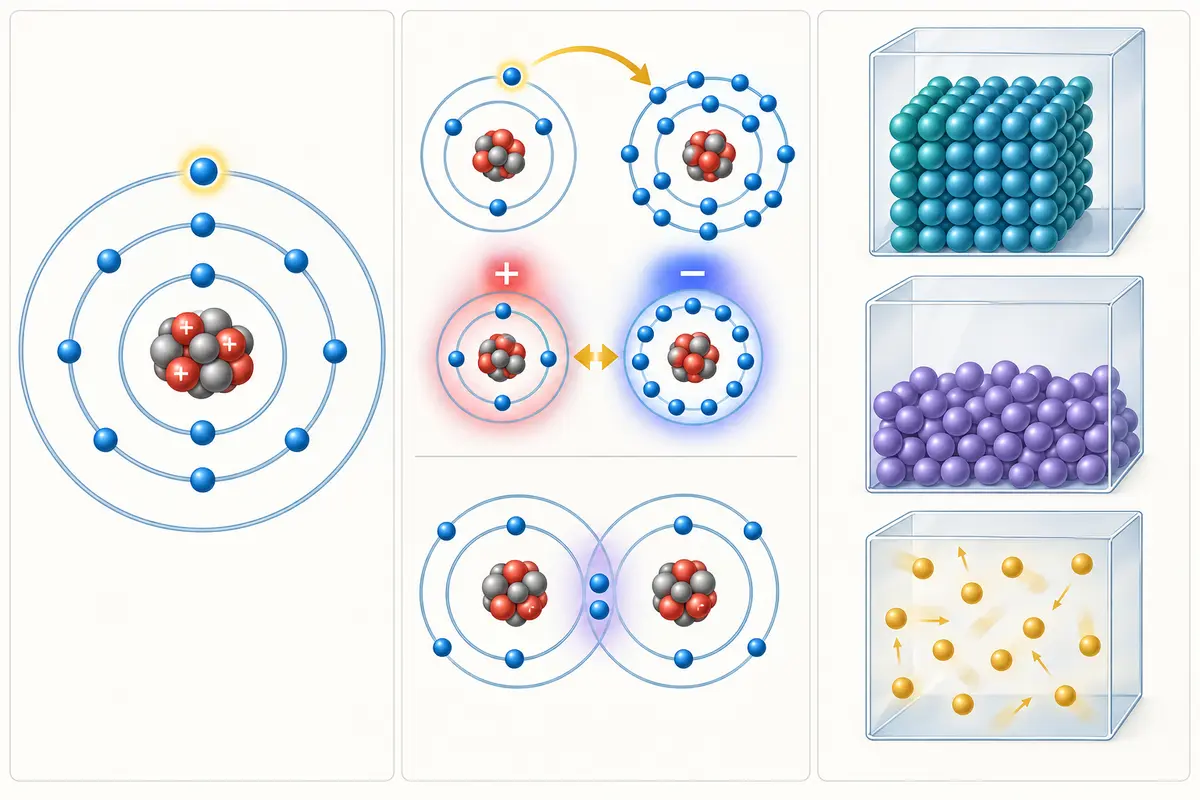
The three states
| State | Particles | Shape | Volume |
|---|---|---|---|
| Solid | Tightly packed, vibrating in place | Fixed | Fixed |
| Liquid | Close but able to slide past each other | Takes its container | Fixed |
| Gas | Far apart, moving freely and fast | Takes its container | Fills its container |
Changes of state
Adding energy loosens the particles; removing it lets them settle. All of these are physical changes.
- Melting solid to liquid; freezing liquid to solid.
- Vaporisation liquid to gas; condensation gas to liquid.
- Sublimation solid straight to gas, as dry ice does; deposition is the reverse.
- During a change of state the temperature holds steady while the energy goes into breaking the arrangement rather than raising the temperature.
Physical or chemical
The test is whether a new substance with new properties has been produced.
| Change | Property | |
|---|---|---|
| Physical | Melting, dissolving, cutting, boiling — often reversible | Colour, density, melting point, solubility, state |
| Chemical | Burning, rusting, digesting, souring — a new substance forms | Flammability, reactivity, ability to rust |
A chemical property can only be observed by attempting the change. You cannot see that paper is flammable without burning some — which is why flammability is a chemical property while colour, which you can observe without altering anything, is physical.
Classifying a change
Worked example
Salt dissolves in water and disappears from view. Is this a physical or a chemical change?
- Ask whether a new substance has been produced.
- The salt is dispersed, not converted — its particles are still salt.
- Test for reversibility: evaporating the water leaves the salt behind, unchanged.
- So no new substance was formed.
Physical. Disappearing from view is not the same as ceasing to exist, and recovering the original substance intact is the strongest evidence that the change was physical.
Mixtures and solutions
- A mixture combines substances without chemically bonding them, so they keep their own properties and can be separated physically.
- A homogeneous mixture is uniform throughout — a solution, such as salt water.
- A heterogeneous mixture is not — sand in water, or a salad.
- In a solution, the solute dissolves into the solvent. Water dissolves so many substances that it is called the universal solvent.
- A compound, by contrast, is chemically bonded and cannot be separated by physical means.
Terms to know
- Solid
- Fixed shape and volume; particles vibrate in place.
- Liquid
- Fixed volume, takes the shape of its container.
- Gas
- Fills its container in both shape and volume.
- Physical change
- A change of form with no new substance produced.
- Chemical change
- A change producing a new substance with new properties.
- Sublimation
- A solid turning directly into a gas.
- Mixture
- Substances combined without chemical bonding.
- Solution
- A homogeneous mixture of solute dissolved in solvent.
- Solute
- The substance being dissolved.
- Solvent
- The substance doing the dissolving.
What the TEAS asks most
The same core ideas appear in different wording. If you can answer these without stopping to think, you have what this section requires.
Is this a physical or a chemical change?
Ask whether a new substance formed. Melting and dissolving are physical; burning and rusting are chemical.
Which of these is a chemical property?
One that can only be observed by changing the substance — flammability, reactivity.
What happens to particles when a solid melts?
They gain energy, break their fixed arrangement, and begin sliding past one another.
Is this a mixture or a compound?
Separable by physical means means a mixture. Chemically bonded means a compound.
Key points
- Solids hold shape and volume, liquids hold volume only, gases hold neither.
- All changes of state are physical changes.
- A chemical change produces a new substance; a physical one does not.
- Chemical properties can only be observed by attempting the change.
- Mixtures separate physically; compounds do not.
Review quiz
4 questions on this topic, each with the reasoning worked through. Pick an answer to see how it went, or open the explanation straight away.
-
Question 1 of 4
Which of the following is a chemical change?
Show the answer and explanation
Correct answer: C. Iron rusting
Rusting converts iron into iron oxide, a new substance with different properties, and it cannot be reversed by physical means. The other three change form only — the water and sugar in them remain exactly what they were.
-
Question 2 of 4
Which of these is a chemical property rather than a physical one?
Show the answer and explanation
Correct answer: C. Flammability
Flammability can only be discovered by burning the substance, which changes it — that is what makes a property chemical. Density, melting point and colour can all be measured while leaving the substance intact.
-
Question 3 of 4
What happens to the particles of a substance as it changes from a liquid to a gas?
Show the answer and explanation
Correct answer: B. They gain energy, move much further apart and travel freely.
Vaporisation adds energy, which separates the particles and lets them move freely enough to fill any container. Moving closer and slowing describes condensation, particles never stop entirely, and no bonding occurs in a change of state.
-
Question 4 of 4
Salt water can be separated by evaporating the water and collecting the salt. What does this tell you about salt water?
Show the answer and explanation
Correct answer: B. It is a mixture, since its parts can be separated physically.
Physical separability is the defining test of a mixture — a compound would need a chemical reaction to break apart. Salt water is specifically a homogeneous mixture, or solution, since it is uniform throughout rather than visibly separate.
Put this TEAS topic into practice
Build a set on physical properties and states of matter and use the rationale on every question to reinforce what you just reviewed.
Keep reading
More TEAS Resources
Guides and tools across the TEAS course.
TEAS 7 Exam Prep
Format, sections, timing
TEAS 7 FAQ
Scoring, retakes, test day
Is the TEAS Hard?
An honest answer
How Long Is the TEAS 7?
209 minutes, section by section
What Is a Passing TEAS Score?
Your programme sets the bar
TEAS Reading
18 topics · 39 scored questions
TEAS Math
18 topics · 34 scored questions
TEAS Science
22 topics · 44 scored questions
TEAS English
21 topics · 33 scored questions
Free TEAS Practice Test
Sit a set before you buy
TEAS Plans & Pricing
Choose your access
Start TEAS Prep
Create your account
TEAS Study Guide
All four sections, free
8-Week Study Plan
Week-by-week schedule
TEAS Cheat Sheet
Formulas and high-yield facts
TEAS vs HESI A2
Which exam to take