
Free ATI TEAS 7 Mathematics guide
October 2026 - Sides of a Right Triangle Study Guide for nursing students in
The Pythagorean theorem, a² + b² = c², relates the two shorter sides of a right triangle to the hypotenuse. The hypotenuse is always the longest side and always sits opposite the right angle — identify it before substituting anything.
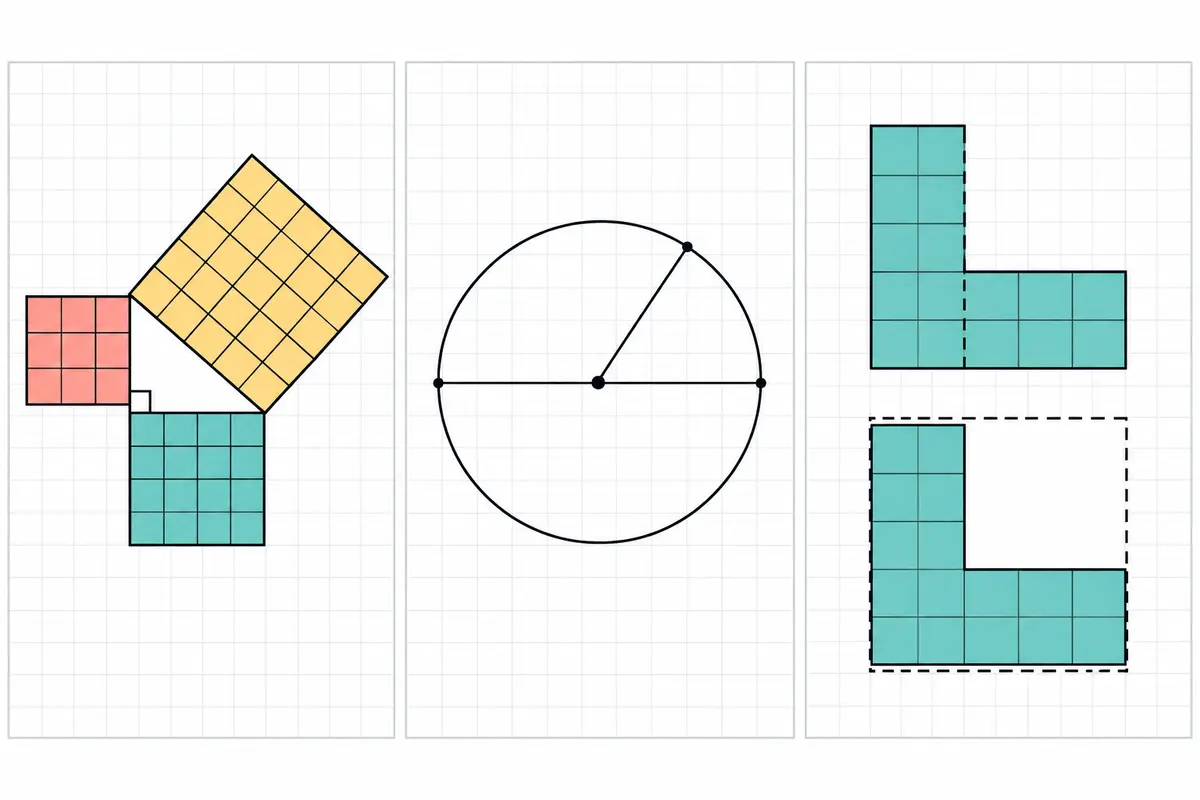
The theorem, and which letter is which
In a² + b² = c², a and b are the two legs — the sides that meet at the right angle — and c is the hypotenuse. The letters are not interchangeable: c must be the side opposite the right angle, whatever the diagram labels it.
That is the whole method for finding a missing side. Square the two you know, then either add (if you want the hypotenuse) or subtract (if you want a leg), and take the square root.
The two directions
Deciding which case you are in before calculating prevents the only real error in this topic.
- Find the right angle
- The side opposite it is c
- Missing c? Add the squares
- Missing a leg? Subtract from c²
- Square root
Finding a leg, not the hypotenuse
Worked example
A ladder 13 m long leans against a wall, with its foot 5 m from the base. How far up the wall does it reach?
- The ladder is the hypotenuse — it is opposite the right angle formed by the wall and the ground. So
c = 13. - One leg is known:
a = 5. The height up the wall is the other leg,b. - Rearrange:
b² = c² - a² = 169 - 25 = 144. - Square root:
b = 12.
12 m. Adding the squares instead would have given √194 ≈ 13.9 m — a ladder reaching further up the wall than its own length, which is the check that catches the error.
The hypotenuse must come out longer than either leg. If your answer for c is smaller than a side you were given, or your answer for a leg is longer than the hypotenuse, you added where you should have subtracted.
Triples worth recognising
These whole-number sets appear constantly, and spotting one saves the arithmetic entirely.
- 3, 4, 5 — and its multiples: 6, 8, 10; 9, 12, 15; 30, 40, 50.
- 5, 12, 13 — and 10, 24, 26.
- 8, 15, 17.
- 7, 24, 25.
Testing whether a triangle is right-angled
The theorem works in reverse. Given three sides, square them all: if the two smaller squares sum to the largest, the triangle has a right angle. For 6, 8 and 11, 36 + 64 = 100, which is not 121, so it does not.
Word problems use this for diagonals — the shortest distance across a rectangular room, the bracing on a rectangular frame, the straight-line distance when someone walks three blocks north and four blocks east.
Terms to know
- Right triangle
- A triangle containing one 90-degree angle.
- Hypotenuse
- The side opposite the right angle. Always the longest.
- Leg
- Either of the two sides that meet at the right angle.
- Pythagorean theorem
a² + b² = c², relating the legs to the hypotenuse.- Pythagorean triple
- Three whole numbers that satisfy the theorem, such as 3, 4, 5.
- Square root
- The number that, multiplied by itself, gives the value under the root.
What the TEAS asks most
The same core ideas appear in different wording. If you can answer these without stopping to think, you have what this section requires.
Find the length of the hypotenuse.
Square both legs, add, take the square root.
Find the missing leg.
Square the hypotenuse, subtract the known leg squared, take the square root.
How far is it diagonally across the rectangle?
The diagonal is a hypotenuse and the two sides are the legs.
Is a triangle with these three sides right-angled?
Square all three. If the two smaller squares sum to the largest, yes.
Key points
a² + b² = c², wherecis the hypotenuse — opposite the right angle, always longest.- Add the squares to find the hypotenuse; subtract to find a leg.
- Check plausibility: the hypotenuse must exceed both legs.
- Recognise 3-4-5, 5-12-13, 8-15-17 and 7-24-25 and their multiples.
- Diagonal-across-a-rectangle problems are Pythagoras in disguise.
Review quiz
4 questions on this topic, each with the reasoning worked through. Pick an answer to see how it went, or open the explanation straight away.
-
Question 1 of 4
A right triangle has legs of 9 cm and 12 cm. How long is the hypotenuse?
Show the answer and explanation
Correct answer: A.
15cm81 + 144 = 225, and√225 = 15— a multiple of the 3-4-5 triple. 21 adds the sides without squaring, while the last two subtract the squares, which is the operation for finding a leg rather than the hypotenuse. -
Question 2 of 4
A right triangle has a hypotenuse of 17 cm and one leg of 8 cm. How long is the other leg?
Show the answer and explanation
Correct answer: B.
15cm289 - 64 = 225, and√225 = 15, which is the 8-15-17 triple.18.8comes from adding the squares — producing a leg longer than the hypotenuse, which is impossible — and 9 is the difference between the two given sides. -
Question 3 of 4
A rectangular room measures 6 m by 8 m. What is the straight-line distance between opposite corners?
Show the answer and explanation
Correct answer: A.
10mThe diagonal is the hypotenuse of a right triangle with legs 6 and 8, so
36 + 64 = 100and the distance is 10 m. 14 m walks around two sides, 28 m is the perimeter, and 48 m is the area. -
Question 4 of 4
Is a triangle with sides 5 cm, 7 cm and 9 cm a right triangle?
Show the answer and explanation
Correct answer: B. No, because
25 + 49 = 74, which is not 81The converse of the theorem settles it: the two smaller squares sum to 74 while the largest is 81, so there is no right angle. Neither having a longest side nor having three unequal sides implies a right angle, and the side lengths alone are enough — no angle measurement is needed.
Put this TEAS topic into practice
Build a set on sides of a right-triangle and use the rationale on every question to reinforce what you just reviewed.
Keep reading
More TEAS Resources
Guides and tools across the TEAS course.
TEAS 7 Exam Prep
Format, sections, timing
TEAS 7 FAQ
Scoring, retakes, test day
Is the TEAS Hard?
An honest answer
How Long Is the TEAS 7?
209 minutes, section by section
What Is a Passing TEAS Score?
Your programme sets the bar
TEAS Reading
18 topics · 39 scored questions
TEAS Math
18 topics · 34 scored questions
TEAS Science
22 topics · 44 scored questions
TEAS English
21 topics · 33 scored questions
Free TEAS Practice Test
Sit a set before you buy
TEAS Plans & Pricing
Choose your access
Start TEAS Prep
Create your account
TEAS Study Guide
All four sections, free
8-Week Study Plan
Week-by-week schedule
TEAS Cheat Sheet
Formulas and high-yield facts
TEAS vs HESI A2
Which exam to take