
Free ATI TEAS 7 Mathematics guide
October 2026 - Area & Perimeter of Figures Study Guide for nursing students in
Rectangle is length × width, triangle is half base × height, parallelogram is base × height. Composite shapes are solved by splitting them into these and adding. Area answers carry squared units — an answer in plain centimetres is wrong before you check the arithmetic.
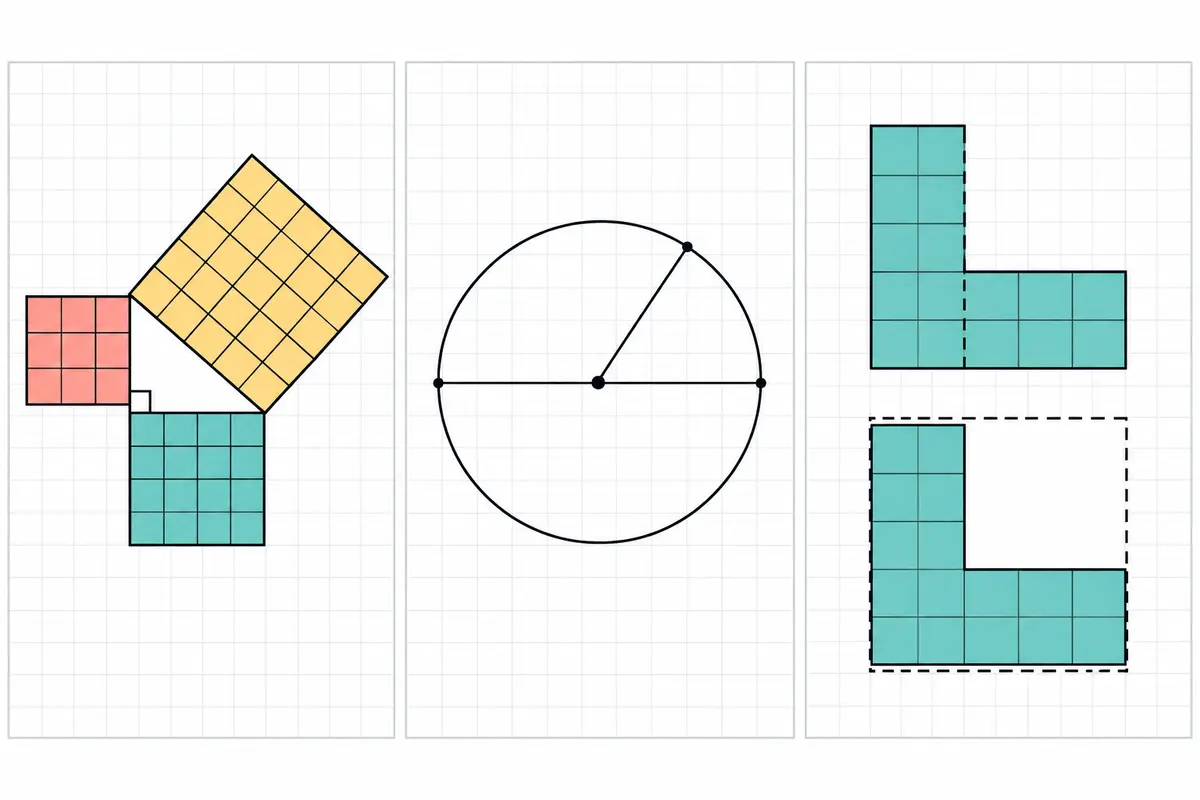
The formulas
| Shape | Area | Perimeter |
|---|---|---|
| Rectangle | l × w | 2l + 2w |
| Square | s² | 4s |
| Triangle | (1/2) × b × h | Add the three sides |
| Parallelogram | b × h | Add all four sides |
| Trapezoid | (1/2) × (a + b) × h | Add all four sides |
Height means perpendicular height, not the slanted side. On a triangle or parallelogram the diagram often gives both, and using the slant instead of the vertical produces a plausible answer that is too large.
Perimeter and area are different questions
Perimeter is the distance around a shape, measured in ordinary units. Area is the space inside, measured in squared units. Skirting board is a perimeter problem; floor tiles are an area problem.
The units are the fastest check you have. If a question asks for the amount of edging needed and your answer is in cm², you solved for the wrong quantity — and vice versa.
A composite shape
Worked example
A room is an L-shape: a rectangle 8 m by 5 m, with a 3 m by 2 m rectangle removed from one corner. What is the floor area?
- Find the area of the full rectangle:
8 × 5 = 40m². - Find the area of the missing piece:
3 × 2 = 6m². - Subtract:
40 - 6 = 34m². - Check the units: two lengths multiplied, so the answer is in square metres.
34 m². Composite shapes are always either a sum of simple shapes or a simple shape with a piece removed — decide which before calculating anything.
Where marks are lost
- Forgetting the half on a triangle.
b × his the rectangle that contains it, twice the answer. - Using the slant height instead of the perpendicular one.
- Mixed units in one diagram — convert everything before multiplying.
- Answering the wrong quantity — perimeter when area was asked for.
- Doubling a scale factor incorrectly — doubling every side of a shape multiplies its area by four, not two.
Scaling
When every length in a shape is multiplied by a factor, the perimeter multiplies by that factor and the area multiplies by its square. Double the sides of a square and the perimeter doubles while the area quadruples.
This appears as a word problem — "if the dimensions of the dressing are doubled, how does the area change?" — and the intuitive answer of "it doubles" is the wrong one.
Terms to know
- Area
- The space inside a two-dimensional shape, in squared units.
- Perimeter
- The distance around a shape, in ordinary units.
- Base
- The side a height is measured perpendicular to.
- Perpendicular height
- The vertical distance from the base to the opposite vertex or side.
- Composite shape
- A shape made by combining or subtracting simple shapes.
- Trapezoid
- A quadrilateral with one pair of parallel sides.
What the TEAS asks most
The same core ideas appear in different wording. If you can answer these without stopping to think, you have what this section requires.
What is the area of this shape?
Match the formula, use the perpendicular height, and give squared units.
How much material is needed to go around the edge?
A perimeter question. Add the sides; the answer is not squared.
What is the area of this composite figure?
Split it into simple shapes, or take a simple shape and subtract the missing piece.
If the dimensions double, what happens to the area?
It multiplies by four. Perimeter doubles; area scales by the square of the factor.
Key points
- Rectangle
l × w, triangle(1/2)bh, parallelogrambh, trapezoid(1/2)(a+b)h. - Height is always the perpendicular height, never the slant.
- Area takes squared units; perimeter does not.
- Composite shapes are a sum of simple ones, or one with a piece removed.
- Doubling every length doubles the perimeter and quadruples the area.
Review quiz
4 questions on this topic, each with the reasoning worked through. Pick an answer to see how it went, or open the explanation straight away.
-
Question 1 of 4
A triangle has a base of 14 cm and a perpendicular height of 9 cm. What is its area?
Show the answer and explanation
Correct answer: B. 63 cm²
(1/2) × 14 × 9 = 63cm². 126 cm² omits the half, giving the area of the enclosing rectangle; 23 cm adds the two lengths instead of multiplying; and the last choice has the right number with unsquared units, which cannot be an area. -
Question 2 of 4
A rectangular dressing measures 12 cm by 8 cm. How much tape is needed to border all four edges?
Show the answer and explanation
Correct answer: B. 40 cm
Bordering the edges is a perimeter question:
2(12) + 2(8) = 40cm. 96 is the area rather than the perimeter, 20 adds one length and one width only, and the last choice attaches squared units to a distance. -
Question 3 of 4
A floor consists of a 6 m by 4 m rectangle plus a 3 m by 4 m rectangle alongside it. What is the total area?
Show the answer and explanation
Correct answer: B. 36 m²
(6 × 4) + (3 × 4) = 24 + 12 = 36m². 24 m² is the larger rectangle alone, 72 m² multiplies the two areas together, and 17 m² comes from adding lengths rather than areas. -
Question 4 of 4
Every side of a square dressing is doubled. What happens to its area?
Show the answer and explanation
Correct answer: B. It quadruples.
Area depends on two dimensions, so doubling both multiplies it by four — a 3 cm square has an area of 9 cm², and a 6 cm square has 36 cm². Only the perimeter doubles, which is the source of the intuitive wrong answer.
Put this TEAS topic into practice
Build a set on area of geometric figures and use the rationale on every question to reinforce what you just reviewed.
Keep reading
More TEAS Resources
Guides and tools across the TEAS course.
TEAS 7 Exam Prep
Format, sections, timing
TEAS 7 FAQ
Scoring, retakes, test day
Is the TEAS Hard?
An honest answer
How Long Is the TEAS 7?
209 minutes, section by section
What Is a Passing TEAS Score?
Your programme sets the bar
TEAS Reading
18 topics · 39 scored questions
TEAS Math
18 topics · 34 scored questions
TEAS Science
22 topics · 44 scored questions
TEAS English
21 topics · 33 scored questions
Free TEAS Practice Test
Sit a set before you buy
TEAS Plans & Pricing
Choose your access
Start TEAS Prep
Create your account
TEAS Study Guide
All four sections, free
8-Week Study Plan
Week-by-week schedule
TEAS Cheat Sheet
Formulas and high-yield facts
TEAS vs HESI A2
Which exam to take