
Free HESI A2 Biology guide
October 2026 - Plant Biology Study Guide for nursing students in
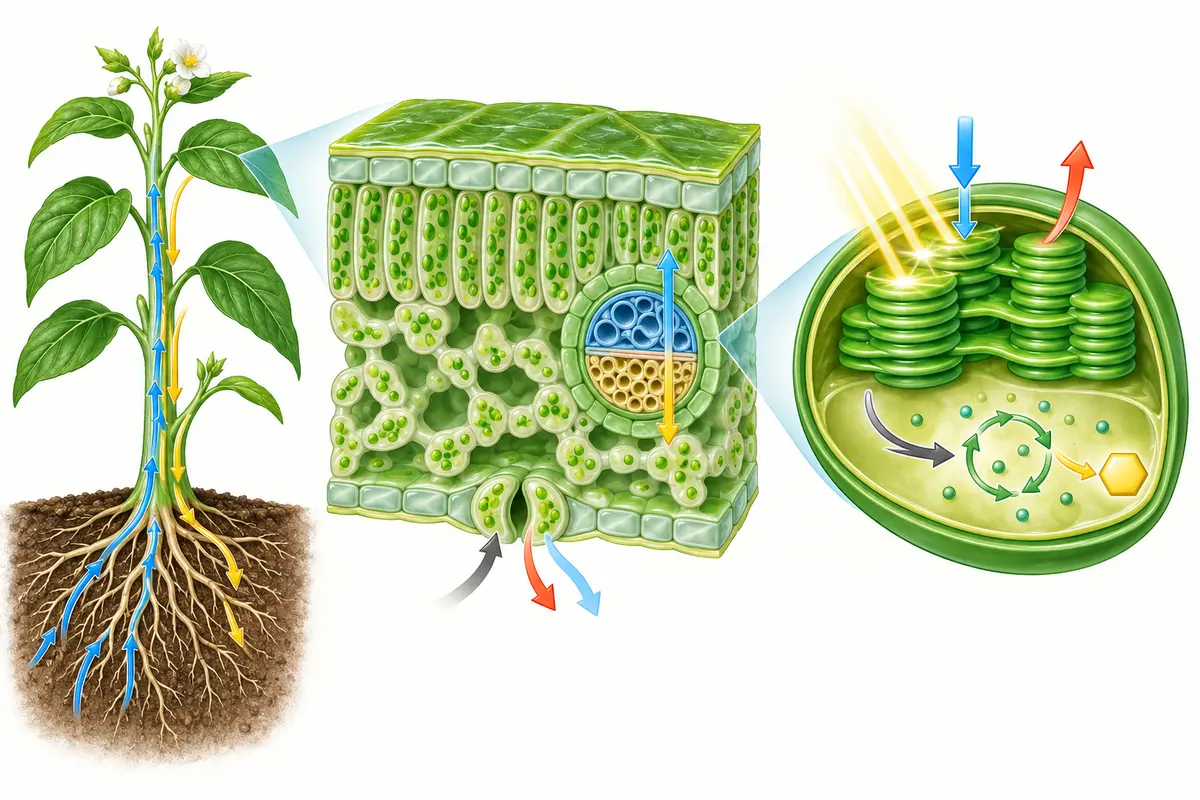
Plant biology connects specialised cell structures with transport, gas exchange, growth and reproduction. Focus on how roots, stems and leaves divide the work, and how xylem, phloem, stomata and plant hormones coordinate the whole organism.
Core ideas to know
Learn the relationships, not a string of isolated definitions. These are the facts that let you reason through unfamiliar wording.
- Plant cells have cellulose cell walls, chloroplasts and a large central vacuole in addition to structures shared with animal cells.
- Xylem moves water and dissolved minerals mainly from roots upward and adds structural support.
- Phloem transports sugars from sources, such as mature leaves, to sinks that use or store them.
- Stomata are adjustable epidermal pores; guard cells regulate carbon dioxide entry and water-vapour loss.
- Roots absorb water and minerals, stems support and transport, and leaves provide a broad surface for photosynthesis and exchange.
A reliable way to answer
Use the same short process every time so the wording of the question does not decide your method for you.
- Identify the material being followed: water, mineral ion, sugar, gas or growth signal.
- Locate its entry or production site and its destination.
- Choose the responsible tissue or structure: xylem, phloem, stomata, root hair or meristem.
- Predict how changing light, water availability or pore opening affects both photosynthesis and water balance.
Distinctions that earn marks
| Idea | What it means | Do not confuse it with |
|---|---|---|
| Xylem | Water and mineral transport | Phloem, sugar transport |
| Source | Produces or releases transported sugar | Sink, uses or stores sugar |
| Stoma | Pore for gas exchange | Guard cell, changes pore opening |
Read every word in the stem before choosing. HESI distractors are often true statements that answer a nearby question rather than the one that was asked.
Terms to know
- Transpiration
- Loss of water vapour from a plant, chiefly through stomata.
- Meristem
- Region of actively dividing plant cells responsible for growth.
- Tropism
- Directional growth response to a stimulus such as light or gravity.
Key points
- Xylem carries water and minerals; phloem carries sugars.
- Opening stomata supports carbon dioxide uptake but also increases water loss.
- Structure and function differ across roots, stems and leaves but depend on continuous transport.
Review quiz
3 questions on this topic, each with the reasoning worked through. Pick an answer to see how it went, or open the explanation straight away.
-
Question 1 of 3
Which tissue primarily transports sugars from leaves to other plant organs?
Show the answer and explanation
Correct answer: B. Phloem
Phloem translocates sugars from sources to sinks. Xylem mainly carries water and minerals from roots and also provides support.
-
Question 2 of 3
What is one direct tradeoff when stomata open?
Show the answer and explanation
Correct answer: A. Carbon dioxide entry increases, but water loss can also increase.
Open stomata permit carbon dioxide diffusion for photosynthesis while allowing water vapour to escape. Guard cells balance those competing needs.
-
Question 3 of 3
A developing fruit that imports sugar is best described as a
Show the answer and explanation
Correct answer: B. sink
A sink consumes or stores transported carbohydrate, so a growing fruit is a sink. A mature photosynthesising leaf commonly acts as a source.
Put this HESI topic into practice
Build a set on plant biology and use the rationale on every question to reinforce what you just reviewed.
Keep reading
More HESI Resources
Guides and tools across the HESI course.
HESI A2 Exam Prep
Subjects and format
HESI A2 FAQ
Scoring, retakes, test day
Which HESI Am I Taking?
A2, specialty or exit exam
Which Subjects Will I Sit?
The full Elsevier menu
HESI Math
4 topics · ratios and conversions
HESI Reading
16 topics · inference and tone
HESI Vocabulary
9 topics · affixes and word choice
HESI Grammar
7 topics · usage and punctuation
HESI Anatomy & Physiology
16 topics · one system at a time
HESI Biology
13 topics · cells and genetics
HESI Plans & Pricing
Choose your access
Start HESI Prep
Create your account
Ask Your Programme
What to confirm before you book
HESI A2 Study Guide
Six covered subjects, free
6-Week Study Plan
Week-by-week schedule
HESI Cheat Sheet
Formulas and high-yield facts
TEAS vs HESI A2
Which exam to take