
Free HESI A2 Biology guide
October 2026 - Microscopy Study Guide for nursing students in
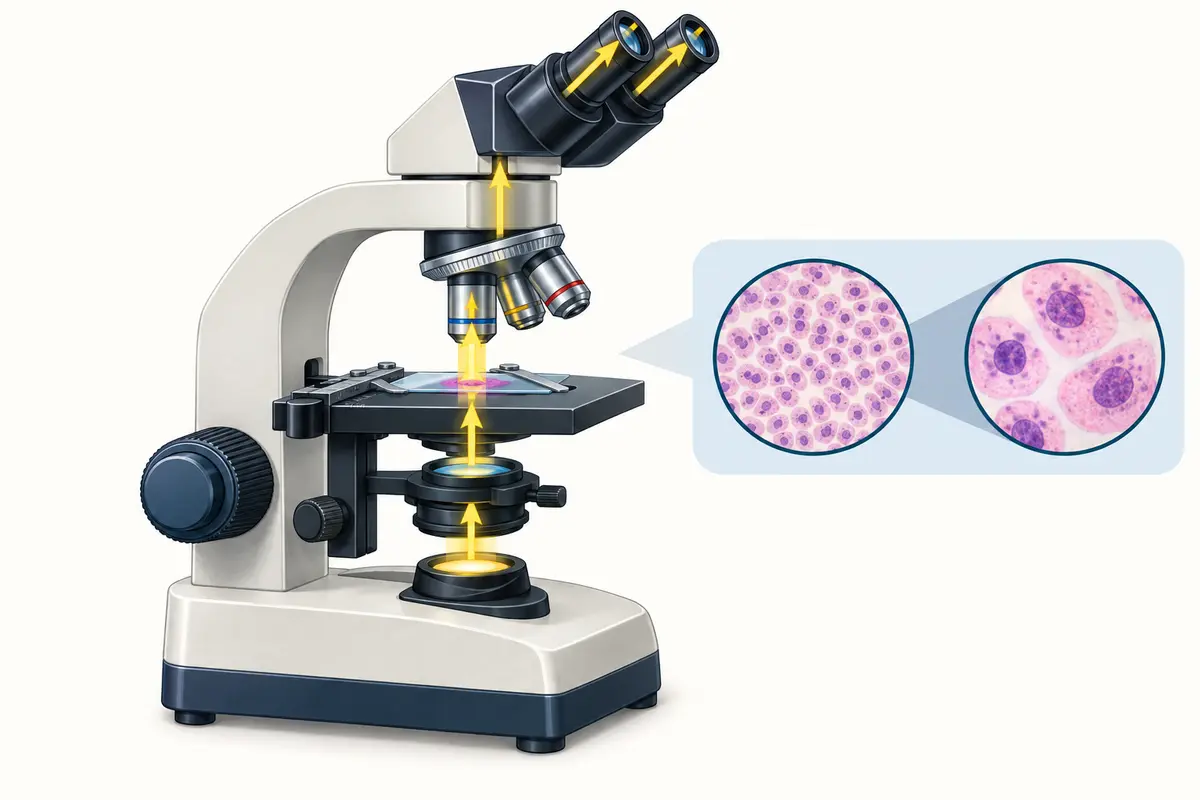
Microscopy enlarges structures too small to inspect unaided, but useful detail depends on resolution as well as magnification. Learn the light-microscope workflow, calculate total magnification and explain why field of view and working distance change at higher power.
Core ideas to know
Learn the relationships, not a string of isolated definitions. These are the facts that let you reason through unfamiliar wording.
- Total magnification equals eyepiece magnification multiplied by objective magnification.
- Resolution is the ability to distinguish two nearby points as separate; enlargement without resolution adds no real detail.
- Begin with the lowest-power objective because it gives the widest field of view and greatest working distance.
- Use coarse focus at low power and fine focus at higher power to reduce the chance of striking the slide.
- As objective magnification increases, field of view and depth of field decrease, while the specimen appears larger.
A reliable way to answer
Use the same short process every time so the wording of the question does not decide your method for you.
- Secure and centre the slide with the lowest-power objective selected.
- Use coarse focus to locate the specimen, then sharpen with fine focus and adjust illumination.
- Re-centre the feature before rotating to a higher-power objective.
- At higher power use fine focus only, and calculate magnification from both lens values.
Distinctions that earn marks
| Idea | What it means | Do not confuse it with |
|---|---|---|
| Magnification | How large the image appears | Resolution, how well close details are separated |
| Coarse focus | Large movement used at low power | Fine focus, small precise adjustment |
| Light microscope | Uses visible light and glass lenses | Electron microscope, uses electron beams |
Read every word in the stem before choosing. HESI distractors are often true statements that answer a nearby question rather than the one that was asked.
Terms to know
- Field of view
- The circular area visible through the microscope at one setting.
- Working distance
- Space between the objective lens and specimen when focused.
- Resolution
- Ability to distinguish close points as separate details.
Key points
- Multiply ocular and objective powers for total magnification.
- Always find and centre the specimen on low power first.
- Higher magnification narrows field of view and working distance.
Review quiz
3 questions on this topic, each with the reasoning worked through. Pick an answer to see how it went, or open the explanation straight away.
-
Question 1 of 3
A 10× eyepiece is used with a 40× objective. What is the total magnification?
Show the answer and explanation
Correct answer: C. 400×
Total magnification is the product of eyepiece and objective powers:
10 × 40 = 400. Adding the lens values would incorrectly produce 50. -
Question 2 of 3
Why should a specimen be located first with the lowest-power objective?
Show the answer and explanation
Correct answer: A. It provides the widest field of view and more working distance.
Low power shows a larger area and leaves more space above the slide, making the specimen easier and safer to locate before increasing magnification.
-
Question 3 of 3
What does resolution describe?
Show the answer and explanation
Correct answer: B. The ability to distinguish close points as separate
Resolution measures separable detail. A blurry image can be highly magnified but still have poor resolution, so the two concepts are not interchangeable.
Put this HESI topic into practice
Build a set on microscopy and use the rationale on every question to reinforce what you just reviewed.
Keep reading
More HESI Resources
Guides and tools across the HESI course.
HESI A2 Exam Prep
Subjects and format
HESI A2 FAQ
Scoring, retakes, test day
Which HESI Am I Taking?
A2, specialty or exit exam
Which Subjects Will I Sit?
The full Elsevier menu
HESI Math
4 topics · ratios and conversions
HESI Reading
16 topics · inference and tone
HESI Vocabulary
9 topics · affixes and word choice
HESI Grammar
7 topics · usage and punctuation
HESI Anatomy & Physiology
16 topics · one system at a time
HESI Biology
13 topics · cells and genetics
HESI Plans & Pricing
Choose your access
Start HESI Prep
Create your account
Ask Your Programme
What to confirm before you book
HESI A2 Study Guide
Six covered subjects, free
6-Week Study Plan
Week-by-week schedule
HESI Cheat Sheet
Formulas and high-yield facts
TEAS vs HESI A2
Which exam to take