Free HESI A2 Biology guide
October 2026 - Embryology Study Guide for nursing students in
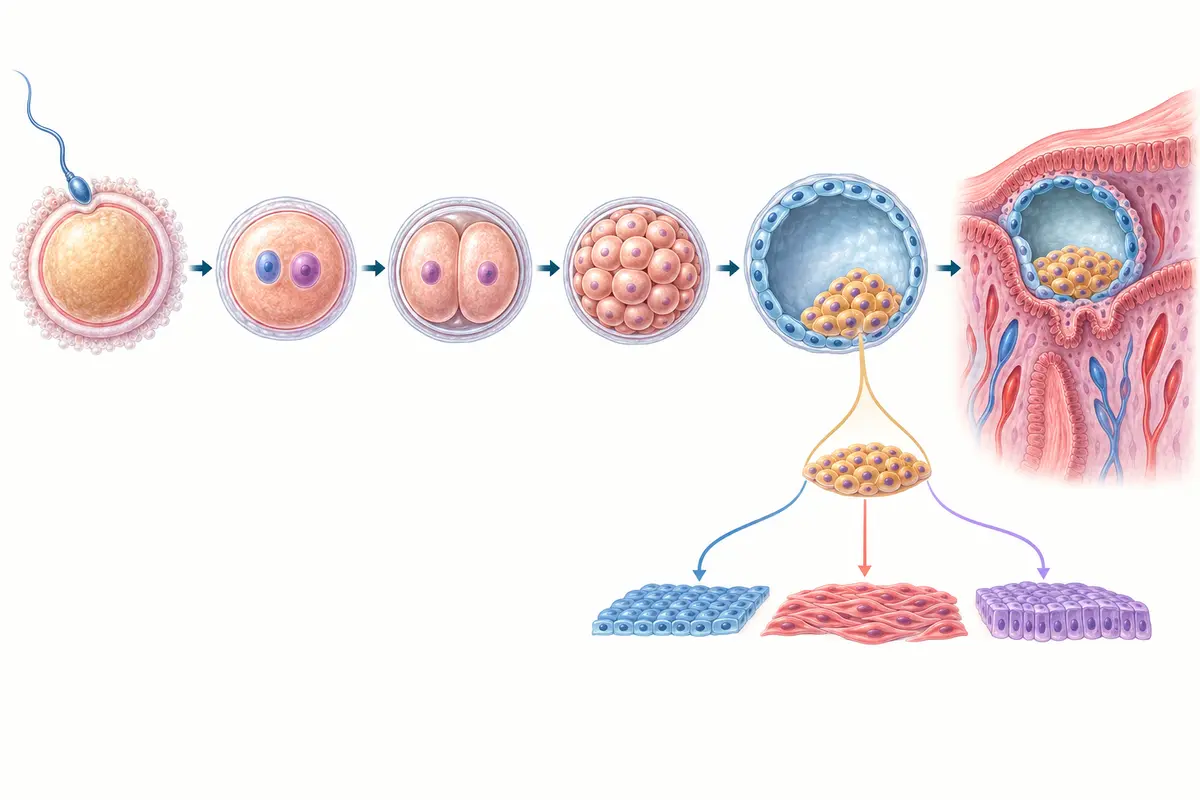
Embryology follows development from fertilisation through cleavage, implantation, germ-layer formation and early organ development. The high-yield task is to keep events in order and connect ectoderm, mesoderm and endoderm with the tissues they principally form.
Core ideas to know
Learn the relationships, not a string of isolated definitions. These are the facts that let you reason through unfamiliar wording.
- Fertilisation usually produces a diploid zygote when haploid gamete nuclei unite.
- Rapid mitotic cleavage increases cell number without greatly increasing the conceptus’s overall size.
- The morula develops into a blastocyst, whose trophoblast contributes to placental structures and inner cell mass forms the embryo.
- Implantation embeds the blastocyst in the uterine lining; gastrulation later establishes three primary germ layers.
- Ectoderm chiefly forms epidermis and nervous tissue, mesoderm muscle/bone/blood, and endoderm digestive and respiratory epithelial linings.
A reliable way to answer
Use the same short process every time so the wording of the question does not decide your method for you.
- Place the named event in sequence: fertilisation, cleavage, morula, blastocyst, implantation, gastrulation and organogenesis.
- Distinguish a structure that supports development from one that becomes the embryo proper.
- For a tissue-origin question, identify the mature tissue type before selecting its germ layer.
- Use broad germ-layer patterns first and reserve exceptions for questions that explicitly require them.
Distinctions that earn marks
| Idea | What it means | Do not confuse it with |
|---|---|---|
| Zygote | Single cell formed at fertilisation | Blastocyst, later hollow multicellular stage |
| Trophoblast | Contributes to supporting/placental structures | Inner cell mass, forms embryo proper |
| Gastrulation | Establishes germ layers | Organogenesis, develops organ rudiments |
Read every word in the stem before choosing. HESI distractors are often true statements that answer a nearby question rather than the one that was asked.
Terms to know
- Cleavage
- Early mitotic divisions that partition the zygote into smaller cells.
- Implantation
- Attachment and embedding of the blastocyst in the uterine lining.
- Germ layer
- One of three early cell layers from which tissues develop.
Key points
- Cleavage raises cell number without comparable growth in total size.
- The inner cell mass forms the embryo proper.
- Nervous tissue is mainly ectodermal, muscle mainly mesodermal and gut epithelium mainly endodermal.
Review quiz
3 questions on this topic, each with the reasoning worked through. Pick an answer to see how it went, or open the explanation straight away.
-
Question 1 of 3
Which stage normally follows the morula?
Show the answer and explanation
Correct answer: A. Blastocyst
Continued cleavage and fluid accumulation transform the solid morula into a hollow blastocyst. Gametes and the zygote occur earlier in the sequence.
-
Question 2 of 3
Which germ layer principally gives rise to nervous tissue?
Show the answer and explanation
Correct answer: A. Ectoderm
The nervous system and epidermis are major ectoderm derivatives. Mesoderm chiefly forms muscle, bone and blood, while endoderm forms internal epithelial linings.
-
Question 3 of 3
What is distinctive about early cleavage?
Show the answer and explanation
Correct answer: A. Cell number increases with little increase in total size.
Cleavage partitions the zygote into progressively smaller blastomeres, raising cell number while overall conceptus size changes little during these early divisions.
Put this HESI topic into practice
Build a set on embryology and use the rationale on every question to reinforce what you just reviewed.
Keep reading
More HESI Resources
Guides and tools across the HESI course.
HESI A2 Exam Prep
Subjects and format
HESI A2 FAQ
Scoring, retakes, test day
Which HESI Am I Taking?
A2, specialty or exit exam
Which Subjects Will I Sit?
The full Elsevier menu
HESI Math
4 topics · ratios and conversions
HESI Reading
16 topics · inference and tone
HESI Vocabulary
9 topics · affixes and word choice
HESI Grammar
7 topics · usage and punctuation
HESI Anatomy & Physiology
16 topics · one system at a time
HESI Biology
13 topics · cells and genetics
HESI Plans & Pricing
Choose your access
Start HESI Prep
Create your account
Ask Your Programme
What to confirm before you book
HESI A2 Study Guide
Six covered subjects, free
6-Week Study Plan
Week-by-week schedule
HESI Cheat Sheet
Formulas and high-yield facts
TEAS vs HESI A2
Which exam to take