
Free HESI A2 Anatomy and Physiology guide
October 2026 - The Human Body Plan Study Guide for nursing students in
The human body plan explains how cells build tissues, tissues build organs and organs cooperate in systems while internal cavities and membranes organise and protect them. It is the map that makes every later anatomy topic easier to place.
Core ideas to know
Learn the relationships, not a string of isolated definitions. These are the facts that let you reason through unfamiliar wording.
- Organisation increases from chemical to cellular, tissue, organ, organ-system and organism levels.
- The four primary tissues are epithelial, connective, muscle and nervous tissue, each defined by structure and function.
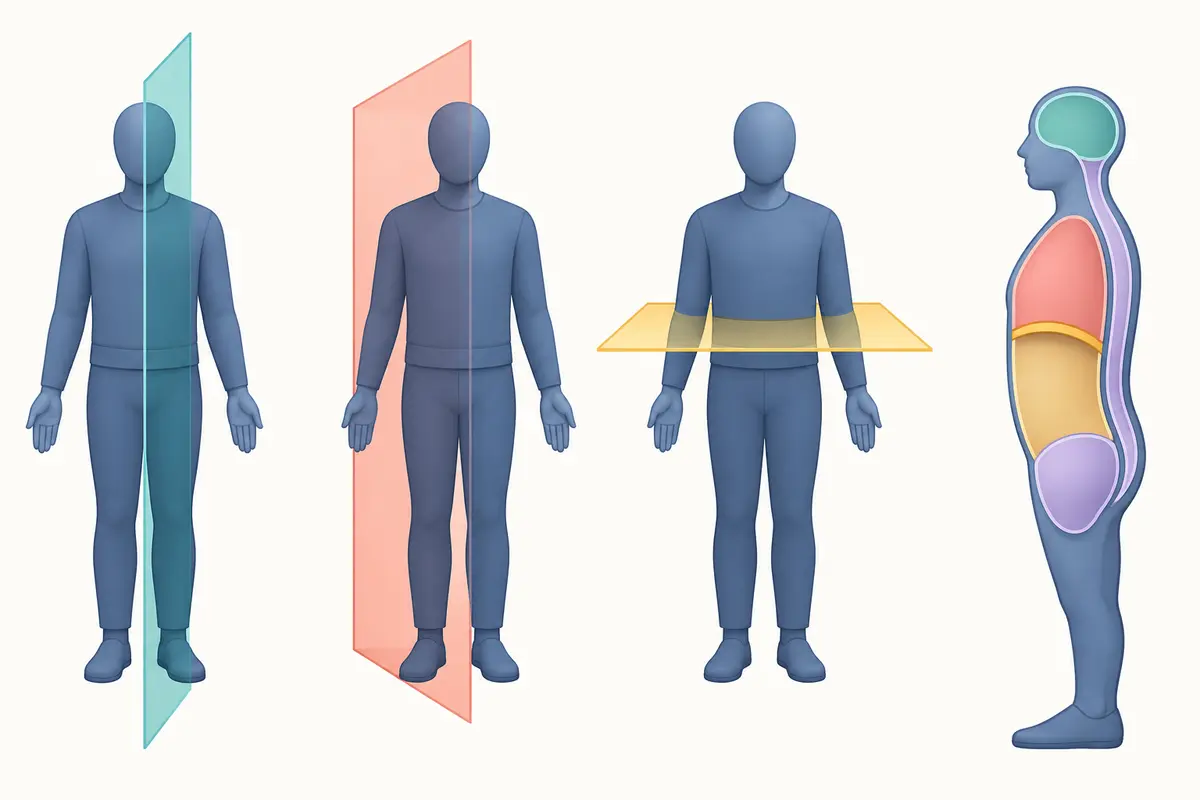
- The dorsal cavity contains cranial and vertebral spaces; the ventral cavity contains thoracic and abdominopelvic spaces.
- The diaphragm separates the thoracic cavity from the abdominopelvic cavity.
- Serous membranes have parietal layers lining cavity walls and visceral layers covering organs, with lubricating fluid between.
A reliable way to answer
Use the same short process every time so the wording of the question does not decide your method for you.
- Place the named structure at its level of organisation: cell, tissue, organ or system.
- Locate it in the dorsal or ventral body cavity and then in the correct subdivision.
- Relate its structure to function and identify the other systems needed for that function.
- Use homeostasis to explain why a disruption in one system can affect several others.
Distinctions that earn marks
| Idea | What it means | Do not confuse it with |
|---|---|---|
| Organ | Two or more tissue types performing a function | Tissue, similar cells and matrix working together |
| Dorsal cavity | Cranial and vertebral cavities | Ventral cavity, thoracic and abdominopelvic cavities |
| Visceral membrane | Directly covers an organ | Parietal membrane, lines a cavity wall |
Read every word in the stem before choosing. HESI distractors are often true statements that answer a nearby question rather than the one that was asked.
Terms to know
- Homeostasis
- Maintenance of a relatively stable internal environment.
- Organ system
- Multiple organs cooperating in major body functions.
- Serous membrane
- Double-layered membrane that reduces friction around a ventral-cavity organ.
Key points
- An organ contains multiple tissue types; an organ system contains multiple organs.
- Dorsal means cranial and vertebral, while ventral means thoracic and abdominopelvic.
- Visceral touches the organ and parietal lines the wall.
Review quiz
3 questions on this topic, each with the reasoning worked through. Pick an answer to see how it went, or open the explanation straight away.
-
Question 1 of 3
Which sequence moves from simpler to more complex organisation?
Show the answer and explanation
Correct answer: B. Cell, tissue, organ, organ system
Cells cooperate to form tissues, multiple tissues form organs and multiple organs cooperate in organ systems. The other sequences reverse or scramble those levels.
-
Question 2 of 3
The lungs are located primarily in the
Show the answer and explanation
Correct answer: C. thoracic cavity
The lungs occupy pleural cavities within the thoracic cavity above the diaphragm. Cranial and vertebral cavities are dorsal, while the pelvic cavity is inferior.
-
Question 3 of 3
Which serous membrane layer directly covers an organ?
Show the answer and explanation
Correct answer: B. Visceral
The visceral layer adheres to the organ surface, whereas the parietal layer lines the surrounding cavity wall. Fluid between them reduces friction.
Put this HESI topic into practice
Build a set on human body plan and use the rationale on every question to reinforce what you just reviewed.
Keep reading
More HESI Resources
Guides and tools across the HESI course.
HESI A2 Exam Prep
Subjects and format
HESI A2 FAQ
Scoring, retakes, test day
Which HESI Am I Taking?
A2, specialty or exit exam
Which Subjects Will I Sit?
The full Elsevier menu
HESI Math
4 topics · ratios and conversions
HESI Reading
16 topics · inference and tone
HESI Vocabulary
9 topics · affixes and word choice
HESI Grammar
7 topics · usage and punctuation
HESI Anatomy & Physiology
16 topics · one system at a time
HESI Biology
13 topics · cells and genetics
HESI Plans & Pricing
Choose your access
Start HESI Prep
Create your account
Ask Your Programme
What to confirm before you book
HESI A2 Study Guide
Six covered subjects, free
6-Week Study Plan
Week-by-week schedule
HESI Cheat Sheet
Formulas and high-yield facts
TEAS vs HESI A2
Which exam to take