Free HESI A2 Anatomy and Physiology guide
October 2026 - Special Senses Study Guide for nursing students in
The special senses are vision, hearing, equilibrium, taste and smell. Each system detects a particular form of energy, converts it into an electrical signal and carries that signal through a cranial nerve for the brain to interpret.
Core ideas to know
Learn the relationships, not a string of isolated definitions. These are the facts that let you reason through unfamiliar wording.
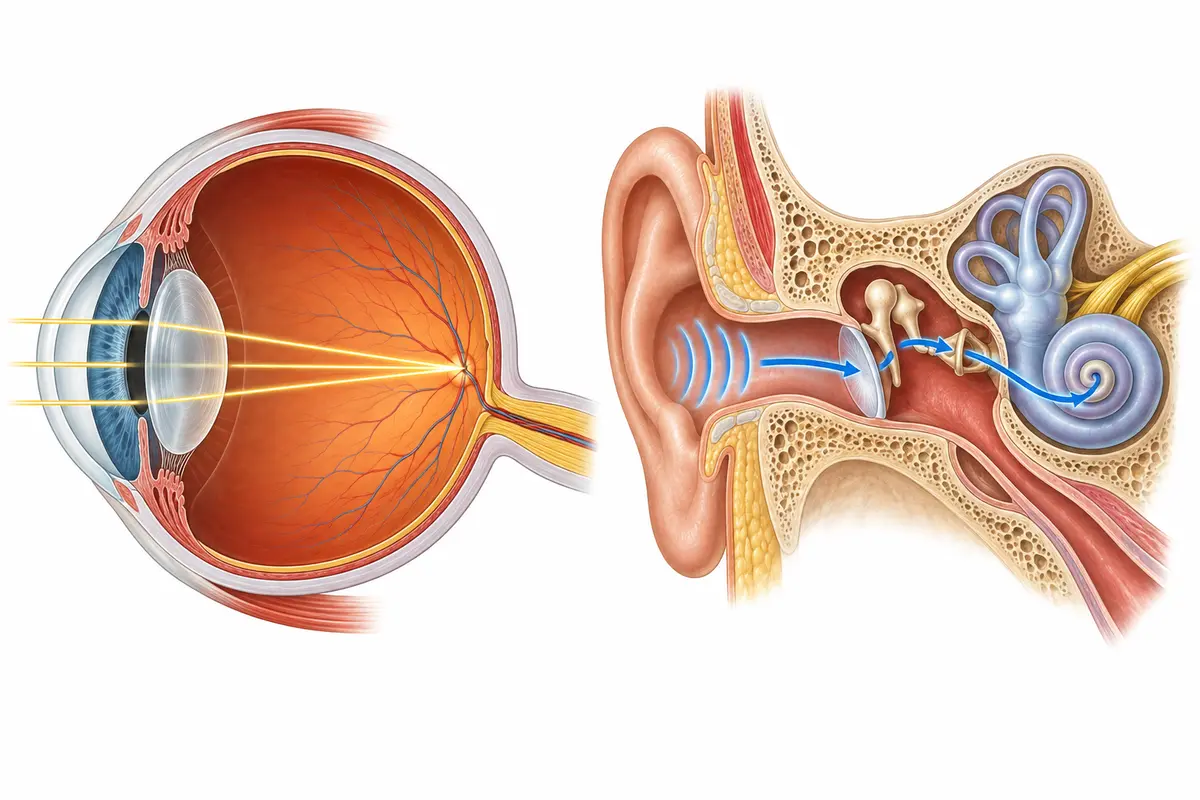
- Vision: light passes through cornea, pupil, lens and vitreous humor before reaching rods and cones in the retina.
- Hearing: sound vibrates the tympanic membrane, then the malleus, incus and stapes transmit it to the fluid-filled cochlea.
- Equilibrium: semicircular canals detect rotational movement; the utricle and saccule detect linear acceleration and head position.
- Taste: receptor cells in taste buds respond to dissolved chemicals and contribute to flavour alongside smell.
- Smell: olfactory receptors in the upper nasal cavity send signals through cranial nerve I to the olfactory bulb.
A reliable way to answer
Use the same short process every time so the wording of the question does not decide your method for you.
- Identify the stimulus—light, vibration, head movement or dissolved chemical.
- Trace the stimulus through the structures in physical order to its receptor.
- Locate transduction, where receptor cells turn the stimulus into a nerve signal.
- Name the nerve or brain pathway only after the receptor and stimulus are clear.
Distinctions that earn marks
| Idea | What it means | Do not confuse it with |
|---|---|---|
| Rods | Dim light and peripheral vision | Cones, colour and sharp central vision |
| Cochlea | Hearing | Semicircular canals, rotational equilibrium |
| Pupil | Opening that admits light | Iris, muscle that changes pupil size |
Read every word in the stem before choosing. HESI distractors are often true statements that answer a nearby question rather than the one that was asked.
Terms to know
- Transduction
- Conversion of a physical or chemical stimulus into an electrical signal.
- Retina
- Light-sensitive neural layer at the back of the eye.
- Cochlea
- Spiral inner-ear structure containing receptors for hearing.
Key points
- The retina converts light, while the cochlea converts sound vibration.
- The ossicles amplify and transmit vibration; they do not contain hearing receptors.
- Taste and smell both use chemoreceptors and work together to produce flavour.
Review quiz
3 questions on this topic, each with the reasoning worked through. Pick an answer to see how it went, or open the explanation straight away.
-
Question 1 of 3
Which structure contains the receptors that transduce sound vibration into nerve signals?
Show the answer and explanation
Correct answer: B. Cochlea
Hair cells in the cochlea perform auditory transduction. The tympanic membrane and ossicles transmit vibration, while semicircular canals are primarily involved in equilibrium.
-
Question 2 of 3
Which photoreceptors are most important in dim light?
Show the answer and explanation
Correct answer: B. Rods
Rods are highly sensitive and support dim-light and peripheral vision. Cones require brighter light and specialise in colour and sharp central detail.
-
Question 3 of 3
The semicircular canals primarily detect
Show the answer and explanation
Correct answer: B. rotational head movement
Fluid movement in the semicircular canals bends receptor hair cells during rotation. Hearing uses the cochlea, while colour and smell use different sensory systems.
Put this HESI topic into practice
Build a set on special senses and use the rationale on every question to reinforce what you just reviewed.
Keep reading
More HESI Resources
Guides and tools across the HESI course.
HESI A2 Exam Prep
Subjects and format
HESI A2 FAQ
Scoring, retakes, test day
Which HESI Am I Taking?
A2, specialty or exit exam
Which Subjects Will I Sit?
The full Elsevier menu
HESI Math
4 topics · ratios and conversions
HESI Reading
16 topics · inference and tone
HESI Vocabulary
9 topics · affixes and word choice
HESI Grammar
7 topics · usage and punctuation
HESI Anatomy & Physiology
16 topics · one system at a time
HESI Biology
13 topics · cells and genetics
HESI Plans & Pricing
Choose your access
Start HESI Prep
Create your account
Ask Your Programme
What to confirm before you book
HESI A2 Study Guide
Six covered subjects, free
6-Week Study Plan
Week-by-week schedule
HESI Cheat Sheet
Formulas and high-yield facts
TEAS vs HESI A2
Which exam to take