
Free HESI A2 Anatomy and Physiology guide
October 2026 - Anatomical Terminology Study Guide for nursing students in
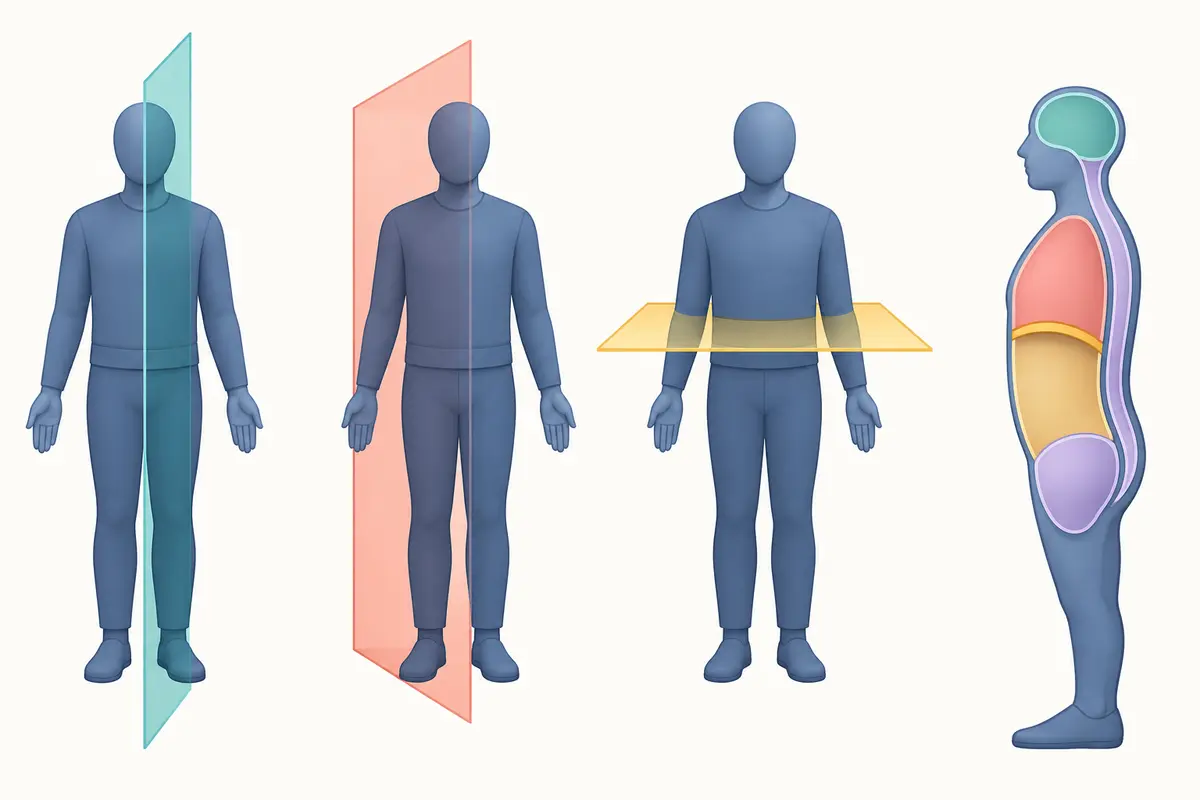
Anatomical terminology gives every body relationship a fixed reference point. Directional terms, planes and regions are interpreted from anatomical position, so they remain precise regardless of how a patient or diagram is turned.
Core ideas to know
Learn the relationships, not a string of isolated definitions. These are the facts that let you reason through unfamiliar wording.
- Anatomical position is standing upright, facing forward, arms at the sides and palms facing forward.
- Superior/inferior compare vertical position; anterior/posterior compare front and back.
- Medial/lateral compare distance from the midline; proximal/distal compare distance from a limb’s attachment.
- A sagittal plane divides left and right, a frontal plane anterior and posterior, and a transverse plane superior and inferior.
- Superficial/deep compare distance from the body surface; the terms do not describe severity.
A reliable way to answer
Use the same short process every time so the wording of the question does not decide your method for you.
- Mentally place the body in anatomical position before reading the relationship.
- Identify whether the structures are compared along a vertical, front–back, midline, limb or depth axis.
- Choose the matching pair of opposites and state the relationship in both directions.
- For planes, name the portions produced rather than relying on the drawing’s orientation.
Distinctions that earn marks
| Idea | What it means | Do not confuse it with |
|---|---|---|
| Medial | Closer to the midline | Lateral, farther from the midline |
| Proximal | Closer to a limb’s attachment | Distal, farther from its attachment |
| Sagittal plane | Divides left and right | Frontal plane, divides front and back |
Read every word in the stem before choosing. HESI distractors are often true statements that answer a nearby question rather than the one that was asked.
Terms to know
- Ipsilateral
- On the same side of the body.
- Contralateral
- On opposite sides of the body.
- Midsagittal
- A plane dividing the body into equal left and right halves.
Key points
- All directional terms assume anatomical position.
- Proximal and distal are most useful along limbs or branching structures.
- Name a plane from the body portions it creates, not the angle of the page.
Review quiz
3 questions on this topic, each with the reasoning worked through. Pick an answer to see how it went, or open the explanation straight away.
-
Question 1 of 3
In anatomical position, the thumb is _____ to the little finger.
Show the answer and explanation
Correct answer: B. lateral
With palms facing forward, the thumb lies farther from the body’s midline than the little finger and is therefore lateral to it.
-
Question 2 of 3
The elbow is _____ to the wrist.
Show the answer and explanation
Correct answer: C. proximal
The elbow lies closer than the wrist to the upper limb’s attachment at the shoulder, making the elbow proximal to the wrist.
-
Question 3 of 3
Which plane divides the body into anterior and posterior portions?
Show the answer and explanation
Correct answer: C. Frontal
A frontal, or coronal, plane separates front from back. Sagittal separates left and right, while transverse separates superior and inferior portions.
Put this HESI topic into practice
Build a set on anatomical terminology and use the rationale on every question to reinforce what you just reviewed.
Keep reading
More HESI Resources
Guides and tools across the HESI course.
HESI A2 Exam Prep
Subjects and format
HESI A2 FAQ
Scoring, retakes, test day
Which HESI Am I Taking?
A2, specialty or exit exam
Which Subjects Will I Sit?
The full Elsevier menu
HESI Math
4 topics · ratios and conversions
HESI Reading
16 topics · inference and tone
HESI Vocabulary
9 topics · affixes and word choice
HESI Grammar
7 topics · usage and punctuation
HESI Anatomy & Physiology
16 topics · one system at a time
HESI Biology
13 topics · cells and genetics
HESI Plans & Pricing
Choose your access
Start HESI Prep
Create your account
Ask Your Programme
What to confirm before you book
HESI A2 Study Guide
Six covered subjects, free
6-Week Study Plan
Week-by-week schedule
HESI Cheat Sheet
Formulas and high-yield facts
TEAS vs HESI A2
Which exam to take