
Free HESI A2 Anatomy and Physiology guide
October 2026 - The Skeletal System Study Guide for nursing students in
Bone supports the body, protects organs, stores calcium and produces blood cells in red marrow. The axial skeleton is the skull, spine and ribs; the appendicular skeleton is the limbs and the girdles that attach them. Both the five functions and that division are directly tested.
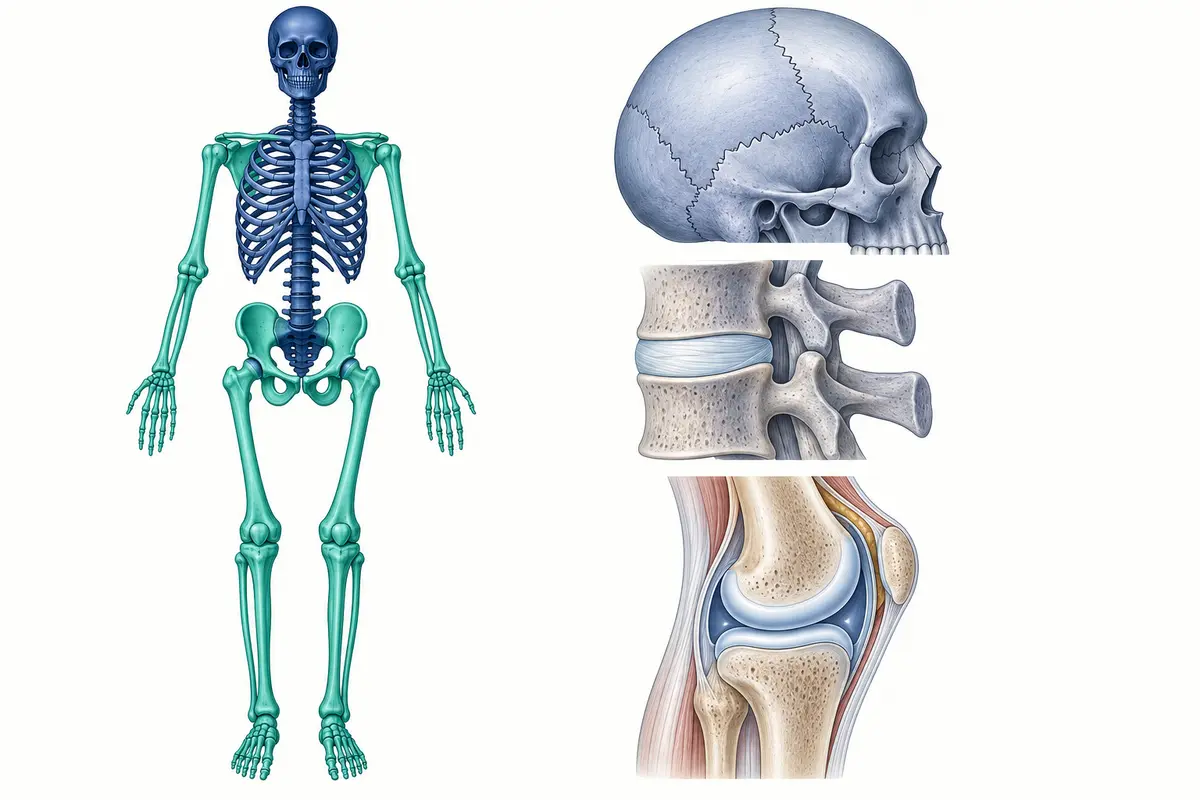
The five functions
Two are obvious and three are easily forgotten, which is why the forgotten ones get asked about.
- Support — the framework that holds the body upright.
- Protection — the skull for the brain, ribs for the heart and lungs, vertebrae for the spinal cord.
- Movement — bones act as levers for muscles to pull against.
- Mineral storage — most of the body's calcium and phosphorus is held in bone and released when blood levels fall.
- Blood cell production — haematopoiesis, in red marrow.
Axial and appendicular
| Division | Contains | Chiefly for |
|---|---|---|
| Axial | Skull, vertebral column, ribs, sternum | Protection and central support |
| Appendicular | Arms, legs, shoulder girdle, pelvic girdle | Movement |
The girdles are appendicular, not axial. The pelvis and the shoulder blades attach limbs to the axial skeleton, so they belong to the appendicular division despite sitting close to the body's core — a favourite question.
Joints
Joints are classified by how much they move, and the exam asks for examples.
| Type | Movement | Example |
|---|---|---|
| Ball and socket | In every direction | Shoulder, hip |
| Hinge | One plane, like a door | Elbow, knee |
| Pivot | Rotation | Neck, at the top of the spine |
| Gliding | Sliding across a flat surface | Wrist, ankle |
| Fixed (suture) | None | Skull plates |
Bone, marrow and the connective tissues
- Compact bone is the dense outer layer; spongy bone is the lighter inner structure that houses marrow.
- Red marrow makes blood cells. Yellow marrow stores fat, and much red marrow converts to yellow with age.
- Cartilage cushions joints and forms flexible structures such as the nose and ear.
- Ligaments connect bone to bone. Tendons connect muscle to bone. Mixing the two up is the commonest error in this topic.
Reasoning from function to consequence
Worked example
Why might long-term dietary calcium deficiency weaken bone, even though bone stores calcium?
- Note the storage function: bone holds calcium and releases it to maintain blood levels.
- Blood calcium is tightly regulated because nerves and muscle depend on it.
- When dietary intake is low, the body draws on the store to protect blood levels.
- Sustained withdrawal reduces bone density over time.
Because the store is the reserve that blood calcium is defended with. Bone gives up calcium to keep circulating levels stable, so a long shortfall in intake is paid for out of bone density.
Terms to know
- Axial skeleton
- Skull, vertebral column, ribs and sternum.
- Appendicular skeleton
- Limbs and the shoulder and pelvic girdles.
- Compact bone
- The dense outer layer of a bone.
- Spongy bone
- The lighter internal structure that contains marrow.
- Red marrow
- Marrow that produces blood cells.
- Yellow marrow
- Marrow that stores fat.
- Cartilage
- Flexible connective tissue that cushions joints.
- Ligament
- Connective tissue joining bone to bone.
- Tendon
- Connective tissue joining muscle to bone.
- Haematopoiesis
- The production of blood cells, which occurs in red marrow.
What the HESI asks most
The same core ideas appear in different wording. If you can answer these without stopping to think, you have what this section requires.
Which of these is a function of the skeletal system?
Support, protection, movement, mineral storage, blood cell production. The last two are the ones usually forgotten.
Is this bone axial or appendicular?
Skull, spine and ribs are axial. Limbs and both girdles are appendicular.
What type of joint is this?
Match by movement: ball and socket for the hip and shoulder, hinge for the elbow and knee.
What is the difference between a ligament and a tendon?
Ligaments join bone to bone; tendons join muscle to bone.
Key points
- Five functions: support, protection, movement, mineral storage, blood cell production.
- Axial is skull, spine, ribs and sternum; appendicular is limbs and girdles.
- Red marrow makes blood cells; yellow marrow stores fat.
- Ligaments join bone to bone; tendons join muscle to bone.
- Ball and socket moves in all directions; a hinge moves in one plane.
Review quiz
4 questions on this topic, each with the reasoning worked through. Pick an answer to see how it went, or open the explanation straight away.
-
Question 1 of 4
Which of the following is a function of the skeletal system that does not involve movement or protection?
Show the answer and explanation
Correct answer: A. Producing blood cells in red marrow
Haematopoiesis in red marrow is one of the five skeletal functions, and it is the one most often forgotten. Contraction belongs to muscle, oxygen transport to blood, and filtration to the kidneys.
-
Question 2 of 4
Which of these bones belongs to the appendicular skeleton?
Show the answer and explanation
Correct answer: C. The pelvis
The pelvic girdle attaches the legs to the axial skeleton, which places it in the appendicular division despite its central position. The sternum, ribs and vertebrae are all axial.
-
Question 3 of 4
The elbow allows movement in one plane only. What type of joint is it?
Show the answer and explanation
Correct answer: B. Hinge
Single-plane movement is the definition of a hinge joint, which the elbow and knee both are. Ball and socket joints such as the shoulder move in every direction, pivot joints rotate, and fixed joints such as skull sutures do not move at all.
-
Question 4 of 4
A tendon connects
Show the answer and explanation
Correct answer: B. muscle to bone.
Tendons transmit a muscle's pull to the bone it moves. Bone-to-bone connections are ligaments, and the two words are swapped so often that a question on the distinction appears on most forms of the exam.
Put this HESI topic into practice
Build a set on the skeletal system and use the rationale on every question to reinforce what you just reviewed.
Keep reading
More HESI Resources
Guides and tools across the HESI course.
HESI A2 Exam Prep
Subjects and format
HESI A2 FAQ
Scoring, retakes, test day
Which HESI Am I Taking?
A2, specialty or exit exam
Which Subjects Will I Sit?
The full Elsevier menu
HESI Math
4 topics · ratios and conversions
HESI Reading
16 topics · inference and tone
HESI Vocabulary
9 topics · affixes and word choice
HESI Grammar
7 topics · usage and punctuation
HESI Anatomy & Physiology
16 topics · one system at a time
HESI Biology
13 topics · cells and genetics
HESI Plans & Pricing
Choose your access
Start HESI Prep
Create your account
Ask Your Programme
What to confirm before you book
HESI A2 Study Guide
Six covered subjects, free
6-Week Study Plan
Week-by-week schedule
HESI Cheat Sheet
Formulas and high-yield facts
TEAS vs HESI A2
Which exam to take