Free HESI A2 Anatomy and Physiology guide
October 2026 - The Muscular System Study Guide for nursing students in
Skeletal muscle is voluntary and striated, cardiac muscle is involuntary and striated, and smooth muscle is involuntary and non-striated. Muscles can only pull, never push, which is why they are arranged in opposing pairs.
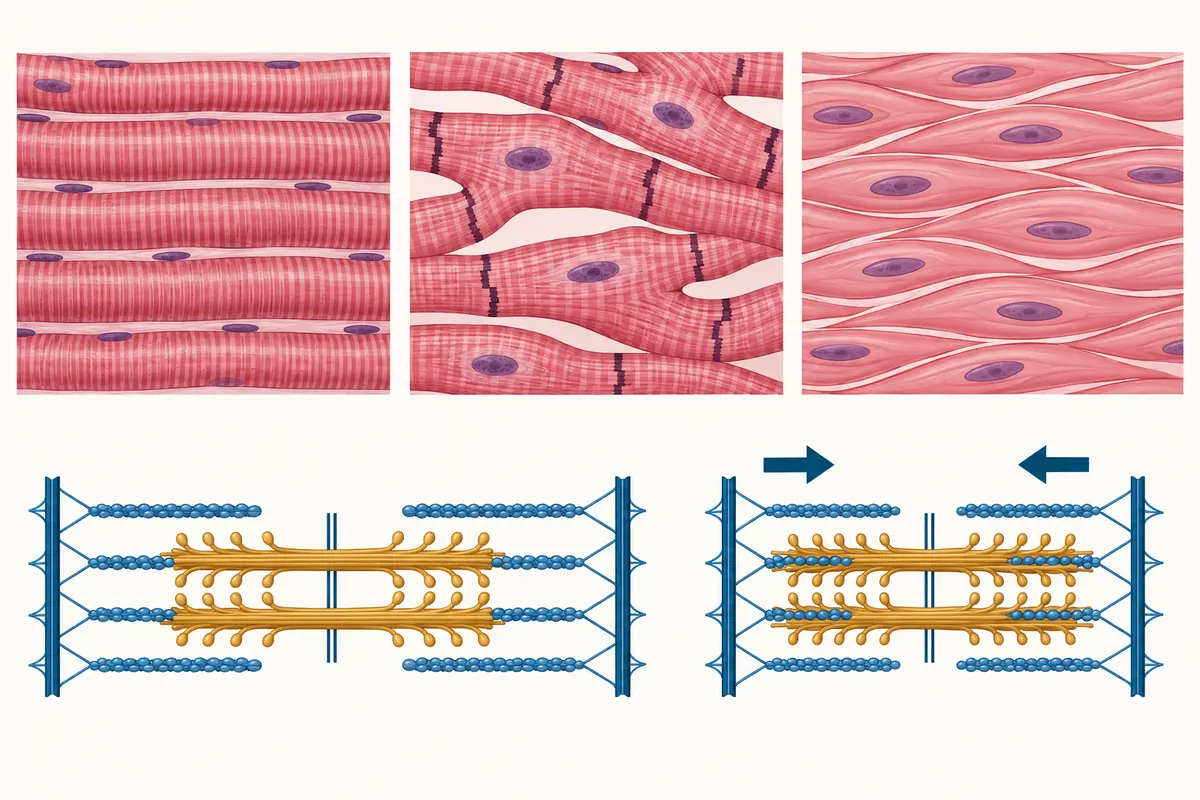
The three muscle types
Two properties tell them apart: whether you control them, and whether they appear striped under a microscope.
| Type | Control | Striated? | Found in |
|---|---|---|---|
| Skeletal | Voluntary | Yes | Attached to bone — biceps, quadriceps |
| Cardiac | Involuntary | Yes | The heart only |
| Smooth | Involuntary | No | Blood vessels, gut, bladder, airways |
Cardiac muscle is the one that breaks the pattern: striated like skeletal muscle, but involuntary like smooth muscle. Questions are built on that combination, because a student who has learned "striated means voluntary" gets it wrong.
Muscles pull, so they work in pairs
A contracting muscle shortens and pulls the bone it is attached to. Nothing in muscle can push, so returning a limb to its original position requires a second muscle pulling the other way. These opposing pairs are called antagonistic.
At the elbow, the biceps contracts to bend the arm while the triceps relaxes; to straighten it, the triceps contracts and the biceps relaxes. The muscle doing the work is the agonist, and its opposite number is the antagonist — the roles swap depending on the direction of movement.
How a contraction happens
Enough of the mechanism to answer what the exam asks, without the full biochemistry.
- A motor neuron delivers a signal at the neuromuscular junction.
- Calcium is released inside the muscle fibre.
- Protein filaments — actin and myosin — slide past one another, shortening the fibre.
- ATP supplies the energy. Without it, the filaments cannot release, which is why muscle stiffens after death.
Attachment and the wider role
- Skeletal muscle attaches to bone by tendons, which transmit the pull.
- The origin is the attachment that stays relatively fixed; the insertion is the one that moves.
- Muscle also generates heat — shivering is muscular contraction used for warmth.
- Smooth muscle does slow, sustained work: moving food along the gut by peristalsis, and narrowing or widening blood vessels.
Identifying muscle type from a description
Worked example
Which type of muscle lines the walls of the small intestine, and how would you know from a description of its behaviour?
- Ask whether it is under conscious control. Nobody decides to move food along the gut, so it is involuntary.
- That narrows it to cardiac or smooth.
- Ask where it is. Cardiac muscle exists only in the heart.
- So it is smooth muscle — and it will be non-striated.
Smooth muscle: involuntary, non-striated, producing the slow rhythmic peristalsis that moves food through the intestine.
Terms to know
- Skeletal muscle
- Voluntary, striated muscle attached to bone.
- Cardiac muscle
- Involuntary, striated muscle found only in the heart.
- Smooth muscle
- Involuntary, non-striated muscle in organs and vessels.
- Striated
- Showing a striped appearance under a microscope.
- Antagonistic pair
- Two muscles that pull a joint in opposite directions.
- Agonist
- The muscle producing a given movement.
- Antagonist
- The muscle that opposes it and relaxes during that movement.
- Origin and insertion
- The fixed attachment and the moving attachment of a muscle.
- Neuromuscular junction
- Where a motor neuron meets a muscle fibre.
What the HESI asks most
The same core ideas appear in different wording. If you can answer these without stopping to think, you have what this section requires.
Which type of muscle is this?
Voluntary and striated is skeletal; involuntary and striated is cardiac; involuntary and non-striated is smooth.
Why do muscles work in pairs?
Because a muscle can only pull. A second muscle is needed to reverse the movement.
What happens to the antagonist during a movement?
It relaxes and lengthens while the agonist contracts.
What supplies the energy for contraction?
ATP, produced largely by the mitochondria in the muscle fibres.
Key points
- Skeletal: voluntary, striated. Cardiac: involuntary, striated, heart only. Smooth: involuntary, non-striated.
- Muscles pull and never push, so they are arranged in antagonistic pairs.
- The agonist contracts while the antagonist relaxes, and the roles reverse.
- Tendons attach skeletal muscle to bone.
- Contraction is driven by calcium and powered by ATP.
Review quiz
4 questions on this topic, each with the reasoning worked through. Pick an answer to see how it went, or open the explanation straight away.
-
Question 1 of 4
Which type of muscle is both striated and involuntary?
Show the answer and explanation
Correct answer: C. Cardiac
Cardiac muscle combines the striped appearance of skeletal muscle with involuntary control, which is exactly what makes it the exam's favourite question here. Skeletal muscle is striated but voluntary, and smooth muscle is involuntary but not striated.
-
Question 2 of 4
When the biceps contracts to bend the elbow, what is happening in the triceps?
Show the answer and explanation
Correct answer: B. It relaxes and lengthens.
In an antagonistic pair, one muscle relaxing is what allows the other to shorten the joint. Muscles cannot push, and the triceps is far from uninvolved — it becomes the agonist when the arm straightens.
-
Question 3 of 4
Peristalsis, the wave of contraction that moves food through the intestine, is produced by
Show the answer and explanation
Correct answer: C. smooth muscle under involuntary control.
Gut movement is automatic and its muscle is non-striated, which makes it smooth muscle. Cardiac muscle is confined to the heart, nobody controls digestion consciously, and tendons are connective tissue that cannot contract at all.
-
Question 4 of 4
What directly supplies the energy for muscle contraction?
Show the answer and explanation
Correct answer: B. ATP
ATP is the energy currency the filaments actually use, both to slide and to release afterwards. Calcium triggers the contraction rather than fuelling it, while glucose and oxygen are the raw materials from which ATP is made.
Put this HESI topic into practice
Build a set on the muscular system and use the rationale on every question to reinforce what you just reviewed.
Keep reading
More HESI Resources
Guides and tools across the HESI course.
HESI A2 Exam Prep
Subjects and format
HESI A2 FAQ
Scoring, retakes, test day
Which HESI Am I Taking?
A2, specialty or exit exam
Which Subjects Will I Sit?
The full Elsevier menu
HESI Math
4 topics · ratios and conversions
HESI Reading
16 topics · inference and tone
HESI Vocabulary
9 topics · affixes and word choice
HESI Grammar
7 topics · usage and punctuation
HESI Anatomy & Physiology
16 topics · one system at a time
HESI Biology
13 topics · cells and genetics
HESI Plans & Pricing
Choose your access
Start HESI Prep
Create your account
Ask Your Programme
What to confirm before you book
HESI A2 Study Guide
Six covered subjects, free
6-Week Study Plan
Week-by-week schedule
HESI Cheat Sheet
Formulas and high-yield facts
TEAS vs HESI A2
Which exam to take