
Free HESI A2 Biology guide
October 2026 - Genetics & DNA Study Guide for nursing students in
DNA is a double helix in which adenine pairs with thymine and cytosine with guanine. Genotype is the genetic makeup, phenotype the observable trait, and alleles can be dominant or recessive. Base pairing is the fact most directly tested.
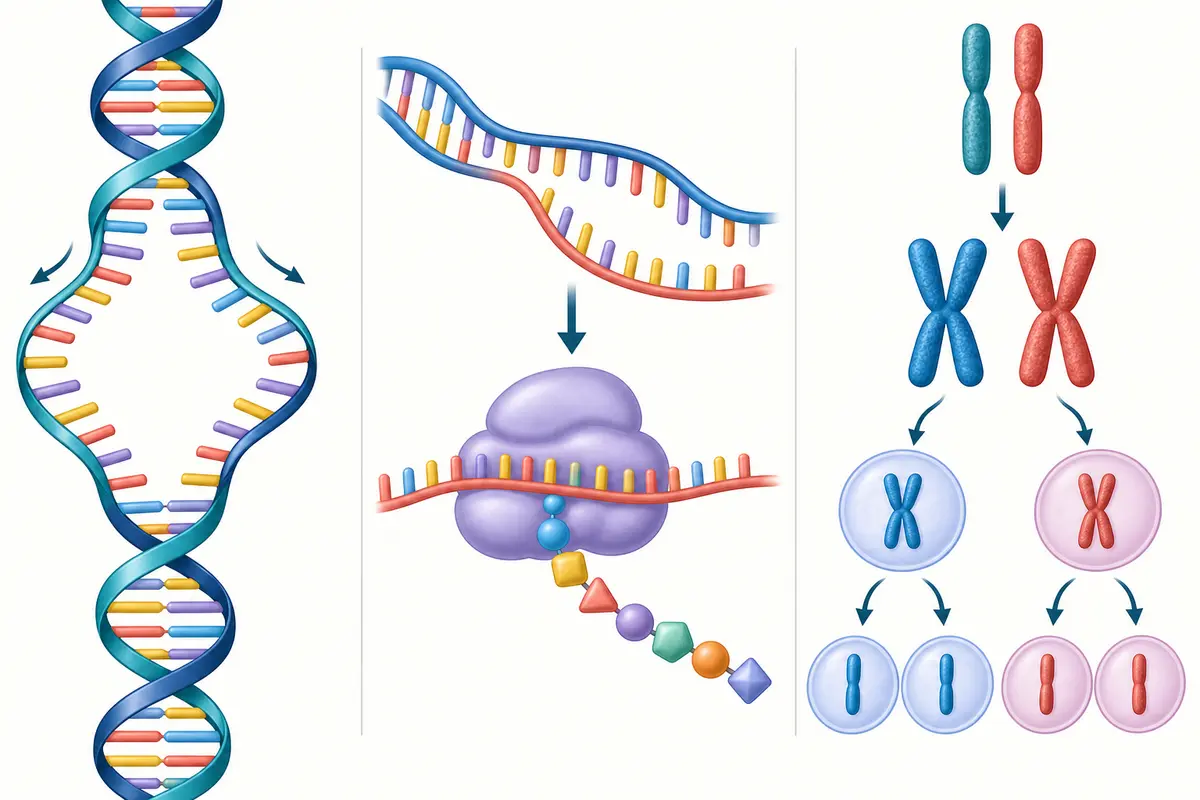
The structure of DNA
- A double helix: two strands twisted around each other.
- Each strand is a chain of nucleotides, and each nucleotide is a sugar, a phosphate and a base.
- The two strands are held together by pairs of bases: A with T, and C with G.
- The pairing rule means one strand determines the other exactly, which is what makes copying possible.
DNA and RNA
| DNA | RNA | |
|---|---|---|
| Strands | Double | Single |
| Sugar | Deoxyribose | Ribose |
| Bases | A, T, C, G | A, U, C, G — uracil replaces thymine |
| Where | The nucleus | Made in the nucleus, works in the cytoplasm |
| Job | Long-term storage of the code | Carrying it to the ribosome and building protein |
In RNA, adenine pairs with uracil rather than thymine. A transcription question that offers a T in the RNA answer is testing exactly this, and the choice with a T is always there.
From gene to protein
Three processes, and the exam asks which is which.
- DNA
- Replication — DNA copied
- Transcription — DNA to mRNA
- Translation — mRNA to protein
Genotype and phenotype
Genotype is the pair of alleles an individual carries — BB, Bb or bb. Phenotype is what you can observe: the trait that pair produces. Two different genotypes can give the same phenotype, which is the whole reason recessive traits can skip a generation.
An individual with two identical alleles is homozygous; with two different ones, heterozygous. A dominant allele shows in the phenotype whenever it is present, so a recessive trait appears only when both alleles are recessive.
Building a complementary strand
Worked example
A DNA strand reads A-T-G-C-C-A. Give the complementary DNA strand, and the mRNA transcribed from the original.
- For DNA, apply A–T and C–G to each base in turn.
A→T,T→A,G→C,C→G,C→G,A→T, givingT-A-C-G-G-T.- For mRNA, apply the same rule but replace thymine with uracil.
A→U,T→A,G→C,C→G,C→G,A→U, givingU-A-C-G-G-U.
Complementary DNA: T-A-C-G-G-T. mRNA: U-A-C-G-G-U. The only difference is U in place of T.
Chromosomes and mutations
- Human body cells carry 46 chromosomes in 23 pairs; gametes carry 23.
- A gene is a section of DNA coding for a protein; an allele is one version of a gene.
- A mutation is a change in the DNA sequence. It may be harmful, beneficial or have no effect at all.
- Sex is determined by the 23rd pair: XX or XY.
Terms to know
- DNA
- The double-helix molecule that stores genetic information.
- Nucleotide
- The unit of DNA: a sugar, a phosphate and a base.
- Base pair
- A joined pair of bases: A with T, C with G. In RNA, A with U.
- Gene
- A section of DNA coding for a protein.
- Allele
- One version of a gene.
- Genotype
- The alleles an individual carries.
- Phenotype
- The observable trait those alleles produce.
- Homozygous
- Carrying two identical alleles.
- Heterozygous
- Carrying two different alleles.
- Mutation
- A change in the DNA sequence.
What the HESI asks most
The same core ideas appear in different wording. If you can answer these without stopping to think, you have what this section requires.
Which base pairs with this one?
A with T, C with G. In RNA, A with U.
What is the difference between genotype and phenotype?
Genotype is the alleles carried; phenotype is the trait you can observe.
What distinguishes RNA from DNA?
Single-stranded, ribose sugar, and uracil in place of thymine.
Which process converts DNA into mRNA?
Transcription. Translation converts mRNA into protein.
Key points
- DNA is a double helix; A pairs with T and C with G.
- RNA is single-stranded and uses uracil instead of thymine.
- Replication copies DNA, transcription makes mRNA, translation makes protein.
- Genotype is the alleles; phenotype is the observable result.
- A recessive trait appears only when both alleles are recessive.
Review quiz
4 questions on this topic, each with the reasoning worked through. Pick an answer to see how it went, or open the explanation straight away.
-
Question 1 of 4
In DNA, which base pairs with cytosine?
Show the answer and explanation
Correct answer: C. Guanine
Cytosine always pairs with guanine, just as adenine pairs with thymine. Uracil appears only in RNA, where it substitutes for thymine — so it never pairs with cytosine in either molecule.
-
Question 2 of 4
A DNA strand reads
T-A-C-G. What is the corresponding mRNA sequence?Show the answer and explanation
Correct answer: B.
A-U-G-CApplying complementary pairing gives A, U, G, C — with uracil replacing the thymine that DNA would use.
A-T-G-Cis the complementary DNA strand rather than the RNA, and the last two choices copy the original instead of complementing it. -
Question 3 of 4
A person carries one dominant and one recessive allele for a trait. Which term describes this?
Show the answer and explanation
Correct answer: C. Heterozygous
Two different alleles is heterozygous, and because the dominant allele is present it is the one expressed in the phenotype. Homozygous means both alleles are the same, and "phenotypic" describes the observable trait rather than the genotype.
-
Question 4 of 4
Which process produces a protein from an mRNA sequence?
Show the answer and explanation
Correct answer: C. Translation
Translation is the ribosome reading mRNA and assembling amino acids into a protein. Replication copies DNA, transcription produces the mRNA that translation then reads, and a mutation is a change to the sequence rather than a step in making a protein.
Put this HESI topic into practice
Build a set on genetics and use the rationale on every question to reinforce what you just reviewed.
Keep reading
More HESI Resources
Guides and tools across the HESI course.
HESI A2 Exam Prep
Subjects and format
HESI A2 FAQ
Scoring, retakes, test day
Which HESI Am I Taking?
A2, specialty or exit exam
Which Subjects Will I Sit?
The full Elsevier menu
HESI Math
4 topics · ratios and conversions
HESI Reading
16 topics · inference and tone
HESI Vocabulary
9 topics · affixes and word choice
HESI Grammar
7 topics · usage and punctuation
HESI Anatomy & Physiology
16 topics · one system at a time
HESI Biology
13 topics · cells and genetics
HESI Plans & Pricing
Choose your access
Start HESI Prep
Create your account
Ask Your Programme
What to confirm before you book
HESI A2 Study Guide
Six covered subjects, free
6-Week Study Plan
Week-by-week schedule
HESI Cheat Sheet
Formulas and high-yield facts
TEAS vs HESI A2
Which exam to take