
Free HESI A2 Biology guide
October 2026 - Cell Physiology Study Guide for nursing students in
Passive transport needs no energy and moves substances down a concentration gradient by diffusion or osmosis. Active transport uses ATP to move them against it. Osmosis specifically means the movement of water — cells swell in a hypotonic solution and shrink in a hypertonic one.
Passive and active transport
| Type | Direction | Energy | Example |
|---|---|---|---|
| Diffusion | Down the gradient | None | Oxygen entering a cell |
| Osmosis | Down the gradient (water only) | None | Water entering a cell in dilute surroundings |
| Facilitated diffusion | Down the gradient, through a protein | None | Glucose entering a cell |
| Active transport | Against the gradient | ATP | The sodium-potassium pump |
| Endocytosis | Into the cell in bulk | ATP | A white blood cell engulfing a bacterium |
| Exocytosis | Out of the cell in bulk | ATP | A neuron releasing neurotransmitter |
The one distinction that matters
Everything in this topic follows from a single question: is the substance moving with the concentration gradient or against it? With the gradient is downhill and free. Against it is uphill and costs ATP.
Facilitated diffusion is the one that catches people out. It uses a membrane protein, which sounds like machinery, but the substance is still moving down its gradient — so no energy is required. A protein channel is a doorway, not a pump.
Tonicity: what happens to the cell
The prefix describes the solution outside the cell, not the cell itself.
| Solution | Solute outside | Water moves | Cell |
|---|---|---|---|
| Hypotonic | Less than inside | Into the cell | Swells, and may burst |
| Hypertonic | More than inside | Out of the cell | Shrinks |
| Isotonic | Equal | No net movement | Stays the same |
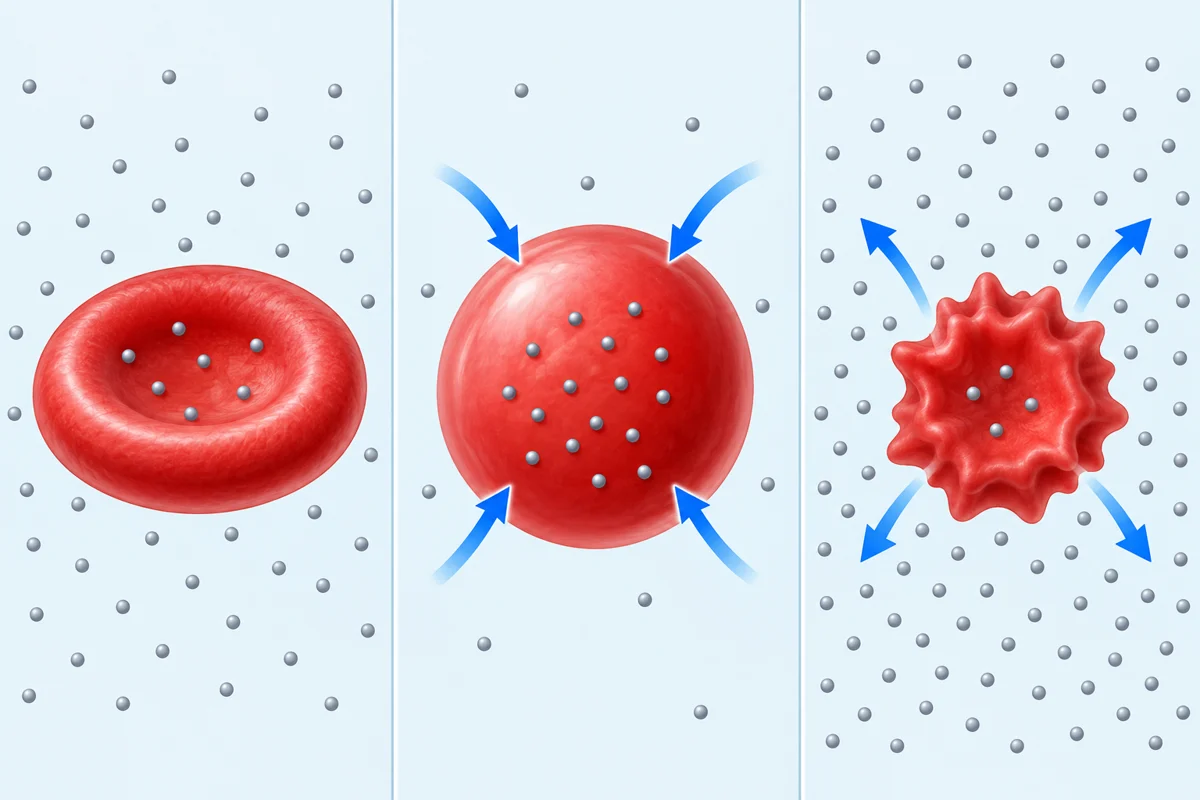
Water moves towards the higher solute concentration — it follows the salt. Students frequently reason with the solute instead: the salt does not move in osmosis, only the water does.
Predicting what happens to a cell
Worked example
A red blood cell is placed in pure water. What happens, and why?
- Compare solute concentrations: pure water has none; the cell contains dissolved substances.
- So the solution outside is hypotonic relative to the cell.
- Water moves towards the higher solute concentration, which is inside the cell.
- Water enters, and an animal cell has no rigid wall to resist the pressure.
The cell swells and may burst. A plant cell in the same solution would swell and become firm, because its cell wall resists the pressure — which is why the same conditions produce different outcomes in the two cell types.
Why active transport exists at all
- Cells frequently need a concentration that diffusion would destroy — high potassium inside, high sodium outside.
- The sodium-potassium pump maintains exactly that difference, using ATP continuously.
- That gradient is what nerve impulses run on, which is why so much of the body's energy budget goes on it.
- Any question mentioning movement against a gradient is asking about active transport, whatever the substance.
Terms to know
- Diffusion
- Movement of a substance from high to low concentration, without energy.
- Osmosis
- Diffusion of water across a semi-permeable membrane.
- Facilitated diffusion
- Diffusion through a membrane protein. Still passive.
- Active transport
- Movement against the concentration gradient, requiring ATP.
- Concentration gradient
- The difference in concentration between two areas.
- Semi-permeable membrane
- A membrane that lets some substances through and not others.
- Hypotonic
- A solution with less solute than the cell. Water enters.
- Hypertonic
- A solution with more solute than the cell. Water leaves.
- Isotonic
- Equal solute concentration. No net movement of water.
- Endocytosis
- Taking material into the cell by engulfing it.
What the HESI asks most
The same core ideas appear in different wording. If you can answer these without stopping to think, you have what this section requires.
Which process requires energy?
Active transport, endocytosis and exocytosis. Anything moving against a gradient.
What happens to a cell in a hypertonic solution?
Water leaves and the cell shrinks.
What is the difference between diffusion and osmosis?
Osmosis is diffusion applied specifically to water across a membrane.
Why is facilitated diffusion passive?
The protein provides a route, but the substance still moves down its gradient.
Key points
- Down the gradient is passive and free; against it is active and costs ATP.
- Osmosis is the movement of water only, towards the higher solute concentration.
- Hypotonic makes cells swell, hypertonic makes them shrink, isotonic leaves them unchanged.
- Facilitated diffusion uses a protein but no energy.
- The sodium-potassium pump is the standard example of active transport.
Review quiz
4 questions on this topic, each with the reasoning worked through. Pick an answer to see how it went, or open the explanation straight away.
-
Question 1 of 4
Which of the following processes requires ATP?
Show the answer and explanation
Correct answer: D. The sodium-potassium pump moving ions against their gradients
Only movement against a concentration gradient costs energy, which is what the pump does. The first three all move substances down their gradients — and the third is facilitated diffusion, which uses a protein but no ATP.
-
Question 2 of 4
A cell is placed in a hypertonic solution. What happens?
Show the answer and explanation
Correct answer: B. Water leaves the cell and it shrinks.
Hypertonic means more solute outside, and water moves towards the higher solute concentration, so it leaves and the cell shrinks. The solute itself does not move in osmosis, and the membrane is permeable to water rather than sealed.
-
Question 3 of 4
What distinguishes osmosis from diffusion?
Show the answer and explanation
Correct answer: B. Osmosis refers specifically to the movement of water across a membrane.
Osmosis is diffusion applied to water across a semi-permeable membrane — a special case rather than a different mechanism. It is passive, moves down the gradient like any diffusion, and happens in every cell type.
-
Question 4 of 4
A white blood cell engulfs a bacterium, surrounding it with membrane and drawing it inside. What is this process called?
Show the answer and explanation
Correct answer: C. Endocytosis
Taking material in by wrapping membrane around it is endocytosis, and it costs ATP because the membrane has to be reshaped. Exocytosis is the reverse, while osmosis and facilitated diffusion move individual molecules rather than whole cells.
Put this HESI topic into practice
Build a set on cell physiology and use the rationale on every question to reinforce what you just reviewed.
Keep reading
More HESI Resources
Guides and tools across the HESI course.
HESI A2 Exam Prep
Subjects and format
HESI A2 FAQ
Scoring, retakes, test day
Which HESI Am I Taking?
A2, specialty or exit exam
Which Subjects Will I Sit?
The full Elsevier menu
HESI Math
4 topics · ratios and conversions
HESI Reading
16 topics · inference and tone
HESI Vocabulary
9 topics · affixes and word choice
HESI Grammar
7 topics · usage and punctuation
HESI Anatomy & Physiology
16 topics · one system at a time
HESI Biology
13 topics · cells and genetics
HESI Plans & Pricing
Choose your access
Start HESI Prep
Create your account
Ask Your Programme
What to confirm before you book
HESI A2 Study Guide
Six covered subjects, free
6-Week Study Plan
Week-by-week schedule
HESI Cheat Sheet
Formulas and high-yield facts
TEAS vs HESI A2
Which exam to take