
Free HESI A2 Anatomy and Physiology guide
October 2026 - The Integumentary System Study Guide for nursing students in
Skin, hair and nails form the body's first barrier. Skin also regulates temperature through sweating and blood vessel dilation, senses the outside world, and synthesises vitamin D. Its three layers are the epidermis, the dermis and the hypodermis.
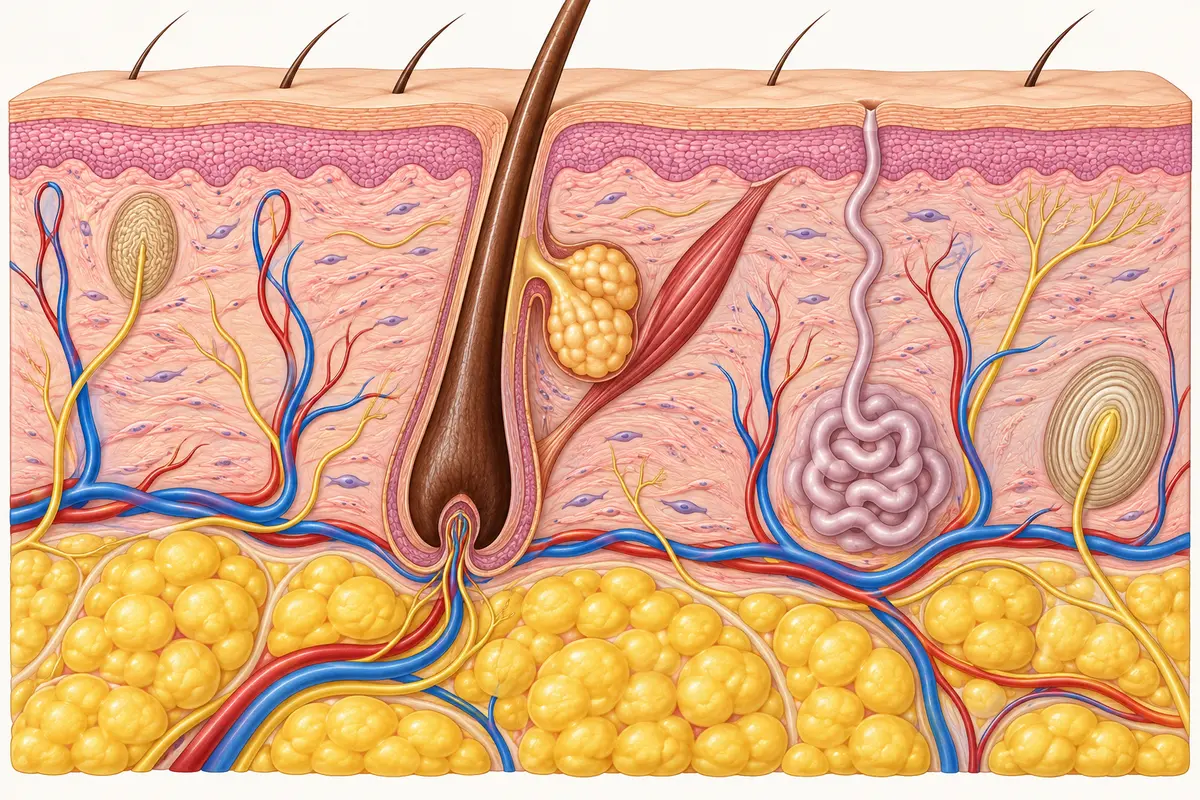
The three layers
Outermost to deepest. Knowing what each contains answers most questions in this topic.
| Layer | Position | Contains |
|---|---|---|
| Epidermis | Outermost | Dead keratinised cells at the surface, dividing cells and melanocytes at the base. No blood vessels |
| Dermis | Middle | Blood vessels, nerve endings, sweat glands, hair follicles, collagen |
| Hypodermis (subcutaneous) | Deepest | Fat for insulation and cushioning; anchors skin to underlying tissue |
The epidermis has no blood supply of its own — it is nourished by diffusion from the dermis below. That is why a shallow scrape does not bleed, and why a wound that bleeds has reached the dermis.
What skin does
- Protection — a physical barrier against pathogens, chemicals and abrasion, kept slightly acidic to discourage bacterial growth.
- Thermoregulation — sweating cools by evaporation; blood vessels dilate to release heat and constrict to conserve it.
- Sensation — nerve endings in the dermis detect touch, pressure, temperature and pain.
- Vitamin D synthesis — triggered by ultraviolet light, which is why sunlight exposure affects vitamin D status.
- Fluid retention — the barrier keeps water in. Extensive burns are dangerous partly because that barrier is lost.
Temperature control in practice
When the body is too warm, dermal blood vessels widen, bringing more blood close to the surface so heat is lost, and sweat glands release fluid that carries heat away as it evaporates. Flushed skin during exertion is vasodilation you can see.
When it is too cold, those vessels narrow, keeping warm blood deeper in the body, and skeletal muscle shivers to generate heat. Pale, cold skin in someone chilled is vasoconstriction working as intended.
Burns and healing
Burn depth is classified by how far into the layers the damage reaches, which makes it a direct test of knowing them.
- Superficial — epidermis only. Red and painful, heals without scarring.
- Partial thickness — into the dermis. Blistering, severe pain because nerve endings are exposed.
- Full thickness — through the dermis into the hypodermis. Often painless in the deepest areas, because the nerve endings themselves are destroyed.
Reasoning from structure to symptom
Worked example
Why can a very deep burn be less painful than a shallower one?
- Locate the nerve endings: they sit in the dermis, not the epidermis.
- A partial-thickness burn damages the dermis but leaves nerve endings alive and exposed — intensely painful.
- A full-thickness burn destroys the dermis, and the nerve endings with it.
- No functioning nerve endings means no pain signal from that area.
Because the sensory nerve endings themselves have been destroyed. Reduced pain in a deep burn is a sign of more damage, not less — which is exactly why the observation is clinically important.
Terms to know
- Epidermis
- The outer skin layer, without its own blood supply.
- Dermis
- The middle layer, containing vessels, nerves, glands and follicles.
- Hypodermis
- The deepest layer, largely fat. Also called subcutaneous tissue.
- Keratin
- The tough protein that makes the skin surface, hair and nails resilient.
- Melanin
- The pigment that determines skin colour and absorbs ultraviolet light.
- Sebaceous gland
- An oil gland that lubricates skin and hair.
- Vasodilation
- Widening of blood vessels, releasing heat.
- Vasoconstriction
- Narrowing of blood vessels, conserving heat.
- Thermoregulation
- Maintaining a stable body temperature.
What the HESI asks most
The same core ideas appear in different wording. If you can answer these without stopping to think, you have what this section requires.
Which layer contains blood vessels and nerve endings?
The dermis. The epidermis has neither.
How does skin cool the body?
Sweat evaporating, and vasodilation bringing blood closer to the surface.
Which function of skin is not about protection?
Thermoregulation, sensation and vitamin D synthesis are the three usually forgotten.
Why is a full-thickness burn often painless?
The nerve endings in the dermis have been destroyed.
Key points
- Three layers: epidermis, dermis, hypodermis.
- The epidermis has no blood vessels; the dermis holds vessels, nerves and glands.
- Skin protects, regulates temperature, senses, synthesises vitamin D and retains fluid.
- Vasodilation and sweating release heat; vasoconstriction conserves it.
- Burn depth is classified by which layers are affected.
Review quiz
4 questions on this topic, each with the reasoning worked through. Pick an answer to see how it went, or open the explanation straight away.
-
Question 1 of 4
Which layer of the skin contains blood vessels, sweat glands and nerve endings?
Show the answer and explanation
Correct answer: B. The dermis
The dermis is the working middle layer, holding the vessels, glands, follicles and sensory nerve endings. The epidermis has no blood supply at all, and the hypodermis is chiefly fat for insulation and cushioning.
-
Question 2 of 4
A person becomes flushed and sweaty during exercise. What is happening?
Show the answer and explanation
Correct answer: B. Vasodilation and sweating are releasing heat.
Widened dermal vessels bring warm blood near the surface, producing the flush, while evaporating sweat carries heat away — both cooling mechanisms. Vasoconstriction does the opposite, and neither epidermal thickening nor melanin has any role in short-term temperature control.
-
Question 3 of 4
Which of these is a function of the skin?
Show the answer and explanation
Correct answer: B. Synthesising vitamin D when exposed to ultraviolet light
Vitamin D synthesis is one of skin's five functions and the one most often overlooked. Blood cell production belongs to red bone marrow, filtration to the kidneys, and glucose regulation to the pancreas.
-
Question 4 of 4
A burn extends through the dermis into the subcutaneous tissue and the patient reports little pain in the centre of the wound. What explains this?
Show the answer and explanation
Correct answer: B. The sensory nerve endings in the dermis have been destroyed.
Full-thickness damage destroys the dermal nerve endings, so no pain signal can be generated from that area — reduced sensation marks more damage rather than less. Regrowth takes far longer than this, and sweat glands have no analgesic role.
Put this HESI topic into practice
Build a set on the integumentary system and use the rationale on every question to reinforce what you just reviewed.
Keep reading
More HESI Resources
Guides and tools across the HESI course.
HESI A2 Exam Prep
Subjects and format
HESI A2 FAQ
Scoring, retakes, test day
Which HESI Am I Taking?
A2, specialty or exit exam
Which Subjects Will I Sit?
The full Elsevier menu
HESI Math
4 topics · ratios and conversions
HESI Reading
16 topics · inference and tone
HESI Vocabulary
9 topics · affixes and word choice
HESI Grammar
7 topics · usage and punctuation
HESI Anatomy & Physiology
16 topics · one system at a time
HESI Biology
13 topics · cells and genetics
HESI Plans & Pricing
Choose your access
Start HESI Prep
Create your account
Ask Your Programme
What to confirm before you book
HESI A2 Study Guide
Six covered subjects, free
6-Week Study Plan
Week-by-week schedule
HESI Cheat Sheet
Formulas and high-yield facts
TEAS vs HESI A2
Which exam to take